
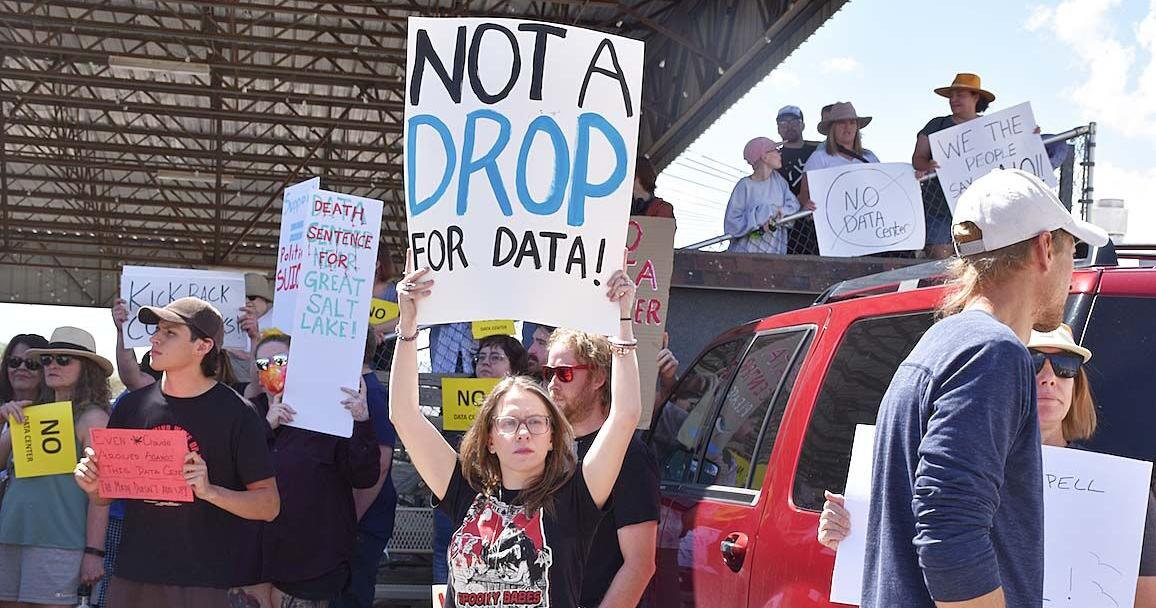
TREMONTON – The question on the minds of many of the protestors here on May 4 voicing their opposition to a proposed data center in western Box Elder County was: “Who the heck is MIDA?”
The seemingly faceless Military Installation Development Authority (MIDA) is the Utah entity — combined Canadian millionaire businessman Kevin O’Leary of “Shark Tank” fame — driving the initiative to create the so-called Stratos Data Center Project in Box Elder County.
“The combination of site location (in the remote Hansel Valley) and design will make Stratos one of the most sustainable and effective data centers in the country,” according to Paul Morris, executive director of MIDA.
“This project reflects what’s possible when state and local leaders work together to advance strategic infrastructure that supports our military mission, strengthens energy resilience and delivers long-term economic investment.”
But an estimated 600 opponents of the project who didn’t share that rosy view gathered at the Box Elder Fairgrounds on May 4 to voice their displeasure at the prospect of veritable 40,000-acre industrial city being sited in the rural county.
On paper, Utah’s Military Installation Development Authority (MIDA) is a state entity that promotes economic development and military initiatives. In the case of the Stratos Project, MIDA had already urged Box Elder officials to approve the interlocal agreement for the proposed data center and offered state tax incentives to O’Leary Digital.
But critics of the MIDA board claim the set-up is rigged to guarantee development, with the entity’s board members having a record of generously granting property rebates and energy tax cuts for private developers without any prior due diligence.
That board’s members include state Senate President Stuart Adams (R-Woods Cross), Clearfield Mayor Mark Shepherd, state Sen. Jerry Stevenson from Davis County, Gage Froerer from the Weber County Commission, lobbyist Mike Ostermiller, former state Senator Jeff Moss and Gary Harter, executive director of the Utah Department of Veterans & Military Affairs.
The same critics observe that three of the board’s seven voting members are active real estate brokers or developers. The board’s composition also makes it naturally inclined to protect the interests of Hill Air Force Base at the expense of the rest of Utah, they contend.
Utah is currently home to 48 operational data centers with over 920 megawatts of energy capacity, with another seven under construction that will add an additional 2,600 megawatts of capacity.
Those facilities are the wave of the future, according to the Ken C. Gardner Policy Institute at the University of Utah, driving stock market valuations, supporting artificial intelligence research and promoting tech industry growth.
While data centers are fairly commonplace in Salt Lake City, West Jordan, Bluffdale, Eagle Mountain and Delta, the Stratos Project has become a lightning rod for opposition due to its proximity to the shrinking Great Salt Lake.
The Democratic leadership in the Utah Senate has already send a letter of protest to the Box Elder County commissioners and requested meetings with MIDA, along the Department of Natural Resources and the Department of Environment Quality, to discuss their concerns about the project.
“This data center is not right for Utah,” they wrote. “We are heading towards an environmental catastrophe that will alter our ability to live in this state.”
The signatories of that letter include Senators Luz Escamilla, Karen Kwan, Jen Plumb, Kathleen Riebe, Nate Blouin and Stephanie Pitcher.
A similar letter of concern has been sent to Gov. Spencer Cox, signed by “the People of Box Elder,” who claim to represent families, neighbors, farmers, business owners, taxpayers and others who support public input on such projects.
The Military Installation Development Authority is a state entity created in 2007 to further economic development across multiple jurisdictions, bringing together private and public enterprise to promote military initiatives, according to the group’s website.