
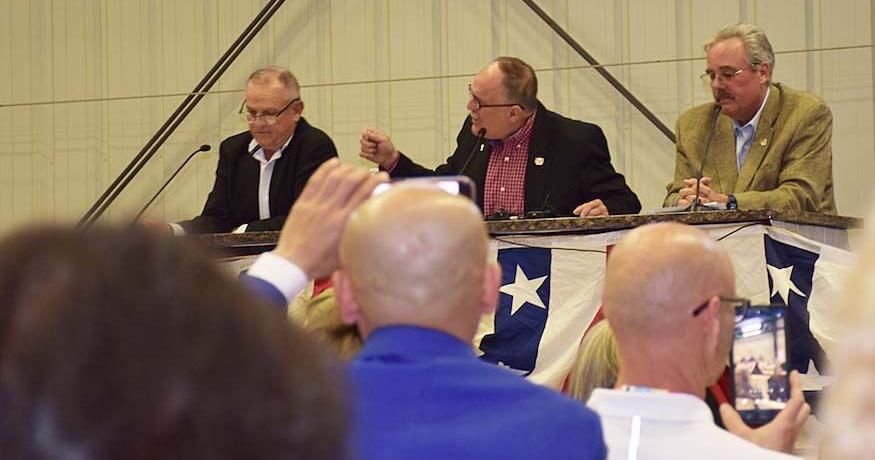
TREMONTON – Ignoring the vocal displeasure of a hostile crowd, the members of the Box Elder County Commission cleared the way toward the construction of the controversial Stratos Project in the remote Hansel Valley on May 4.
The approved project area, currently occupied by the privately owned Bar H Ranch, encompasses approximately 40,000 acres of vacant land split into three different sites.
One of those sites is intended to support large-scale natural gas-fired power generation plant and a data center, with two additional sites planned for later development uses such as manufacturing, retail, restaurants, hotels and public works infrastructure.
Anticipating a huge audience far exceeding that of a previous meeting on April 27, the gathering was moved to the Fine Arts Building of the Box Elder County Fairgrounds here. Preparations for the May 4 meeting also included a significant police presence, with Box Elder County deputies and Utah Highway Patrol troopers on hand.
During the hour-long gathering here prior to giving consent to the project proposed by the state’s Military Installation Development Authority (MIDA), the commissioners endured catcalls, chanting and other disruptive antics from the nearly out-of-control audience estimated at more than 600 people, most of whom were clearly opposed to the project.
Commission chair Tyler Vincent pleaded for calm to allow the minority of Box Elder County residents in the audience to hear what officials considered their due diligence on the proposal. After about 30 minutes of sustained disruption, however, the commissioners moved behind closed doors to conclude their deliberations via a closed-circuit television broadcast.
When the Box Elder officials left the dais, their departure provoked sustained shouts of “recall the commissioners!”
Utah is, however, one of several states that does not have recall legislation on its books.
Prior to the unanimous vote approving the interlocal agreement, Commissioner Lee Perry emphasized that no member of the Box Elder County government will benefit financially from the proposed data center. He also added that the commissioners had little choice but to authorize the proposal given that the project area is privately owned and currently unzoned.
The commissioners and local officials made much of having used their brief awareness of the proposed project to include several improvements and guardrail provisions in the interlocal agreement between Box Elder County and MIDA.
Those included restrictions on noise levels and building heights; compliance with local “dark sky” regulations; inclusion of a local landowner on the project’s development review committee; and leasebacks to landowners for grazing, ranching and farming.
None of those concessions satisfied the crowd of protestors, however, who had been demonstrating for an hour outside the Fine Arts Building prior to the 4 p.m. meeting.
Their concerns, based largely on emotions rather than information, focused on unanswered questions about the proposed data center’s water usage, its impact on the Great Salt Lake, the current statewide drought conditions and potential impact on air quality and other environmental factors.
When information was presented that contradicted their preconceived notions during the meeting, that data was often greeted with repeated shouts of “We don’t believe that.”
Vincent said that the county had established a website for public comment on the project which had received more than 2,500 comments from various individuals and advocacy groups in the past week. But fewer than 300 of those comments came from Box Elder County residents.
At a press conference after the May 4 meeting, Box Elder County officials emphasized their commitment to continued oversight, transparency and public engagement as the project moves forward.
Backed by Canadian businessman Kevin O’Leary of “Shark Tank” fame, the Stratos Project is expected to consume up to 9 giga-watts of power at full capacity, which is more than double the entire state of Utah’s current average usage of roughly 4 giga-watts.
As currently planned, however, the Stratos Project is intended to generate its own power through agreements with the Ruby natural gas pipeline without placing additional demands on the regional power grid.
Despite the project’s proximity to the Great Salt Lake, Box Elder County officials said that the project will draw mineral water for cooling purposes from wells.
Under the interlocal agreement with MIDA, the developer is also required to pay for construction and the maintenance of public services infrastructure needed for the project.
Benefits to Box Elder County are projected to be $30 million per year in tax revenue during construction and $108 million at full build-out, according to Adam Long, a contract attorney with Smith Harrtvigsen PLLC.
The Military Installation Development Authority (MIDA) is a state entity that promotes economic development and military initiatives.
MIDA officials anticipate the creation of an estimated more than 2,000 jobs associated with the Stratos Project.