
Note to readers •This story is made possible through a partnership between The Salt Lake Tribune and Grist, a nonprofit environmental media organization.
Farmington • Major names in Utah’s business community announced they are donating big bucks to solve a seemingly insurmountable problem — refilling the Great Salt Lake.
The Larry H. and Gail Miller Family Foundation, Maverik, which owns gas stations and convenience stores across the West, and the J. Willard and Alice S. Marriott Foundation said Monday they’re committing $10 million each to Great Salt Lake Rising. That initiative, launched last year and led by developer Josh Romney, wants to bring the lake back to a sustainable elevation in time for Utah to host the 2034 Olympic Winter Games.
“The impact of a low lake in terms of [public] health, the economy, the environment, it really resonates,” Romney said in an interview near the lake’s shore at the Eccles Wildlife Education Center. “People want to get involved.”
The $30 million will go toward a $100 million goal that Great Salt Lake Rising announced alongside Gov. Spencer Cox last September. Ducks Unlimited has set a similar $100 million fundraising goal.
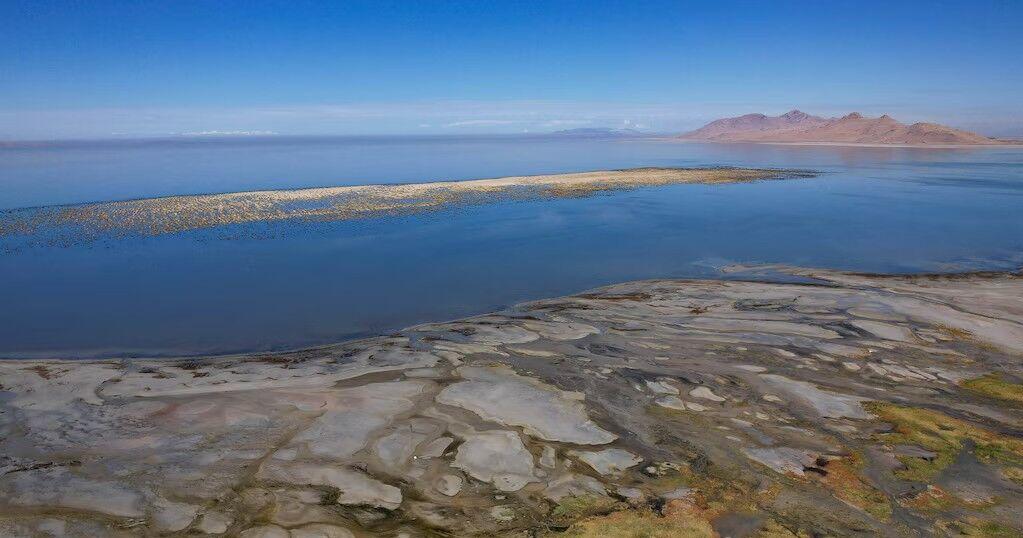
Utah’s salty inland sea has lost about half its volume over the past 30 years, a long-term state of decline that shows no sign of reversing. The issue is almost entirely human-caused, with farms, cities and industries using more water from the lake’s tributary streams and rivers than the lake’s ecosystem can sustain. But business leaders say Utahns are waking up to the importance of the Great Salt Lake and its role in sustaining healthy communities on the Wasatch Front.
The lakebed, laden with toxic metals, is quickly drying to dust and posing a threat to lives and livelihoods downwind.
“If we don’t get 130% rainfall every year, the lake is going to continue to decline,” said Romney, the son of former U.S. senator and presidential candidate Mitt Romney. “So we can’t expect God to just come in and rescue this. We have to do it ourselves.”
Utah experienced its worst snowfall on record this winter along with record warmth. In some areas, snowpack melted nearly three months earlier than normal, putting pressure on the state’s already strained water resources. The lake currently sits about four feet above the record-low elevation it set in late 2022, and loses about three feet every summer and fall to evaporation.
Money alone won’t refill the lake, but Romney said the donations will help leverage creative solutions for securing real water. The funds could help tap runoff that accumulates in the neighboring Newfoundland Basin — where Utah pumped surplus water from the Great Salt Lake when it flooded in the 1980s. It could be used to eradicate invasive, water-guzzling phragmites on the lake’s peripheral wetlands. Or it could be used to encourage conservation and purchase water leases from farmers.
“This doesn’t get solved by agriculture alone, and it doesn’t get solved by residential alone,” Romney said. “Everyone has to play a role.”
Great Salt Lake Rising and Romney were instrumental in the state’s effort to buy the defunct US Magnesium plant from bankruptcy proceedings at the start of the year, said Joel Ferry, director of the Utah Department of Natural Resources. One of the key assets from that sale was the right to tens of thousands of acre-feet of water that the mineral extractor previously pumped out of the Great Salt Lake.
Ferry and his team weren’t sure Utah lawmakers would provide the $30 million needed for the sale in time, particularly during the final, busy days of the state’s annual legislative session.
“I needed to have a backstop just in case,” Ferry said. “We [got] Josh to step up and do it.”
The Legislature did authorize the funds, but Romney said Great Salt Lake Rising is exploring other ways to contribute.
“Having these types of commitments,” Ferry said, “gives some level of comfort to the Legislature to say, ‘Hey … we’re in this together.’”
Maverik CEO Crystal Maggelet said investing in the Great Salt Lake was an easy decision, partly spurred by her son and company board member Drew Maggelet.
“I don’t want to be moving the headquarters for Maverik, our base camp, to any other place,” she said. “This is where we belong.”
Speaking on behalf of his family’s charitable foundation, Greg Miller said the Great Salt Lake’s future remains intrinsically linked with the future of the state.
“This is an issue where timing matters,” Miller said. “We have an opportunity to be proactive, to build momentum and to support practical solutions that can make a real difference, starting right now.”
While the Marriotts’ foundation is now based in Washington, D.C., Karen Marriott said her family still has deep roots in the Beehive State and is concerned about the ecological consequences of a drying Great Salt Lake.
“We have decided it’s imperative that we act now,” she said. “We feel a deep responsibility to this place.”
As the world descends on Utah for the 2034 Games, the state will tell one of two stories, Marriott said. Spectators and athletes will either see a Wasatch Front turned to a dust bowl, or they will see the result of businesses, communities and policymakers coming together to accomplish something that’s never been done before — reversing the disappearance of a terminal, desert lake.
“It is possible,” Marriott said, “and this is why we are happy to support the efforts of Great Salt Lake Rising and all those that are doing great work to save this lake.”
Disclosure: Drew Maggelet, an executive at FJ Management, the parent company of Maverik, is a member of The Salt Lake Tribune’s Board of Directors.