
While the conflict in Iran is set to loom over President Donald Trump’s China summit, what might be the most consequential security issue discussed behind closed doors is much closer to Beijing.
“I’m sure Taiwan will be a topic of conversation as it always is,” Secretary of State Marco Rubio told White House reporters last week.
“I think both countries understand that it is in neither one of our interests to see anything destabilizing happen in that part of the world,” he said. “We don’t need any destabilizing events to occur with regards to Taiwan or anywhere in the Indo-Pacific.”

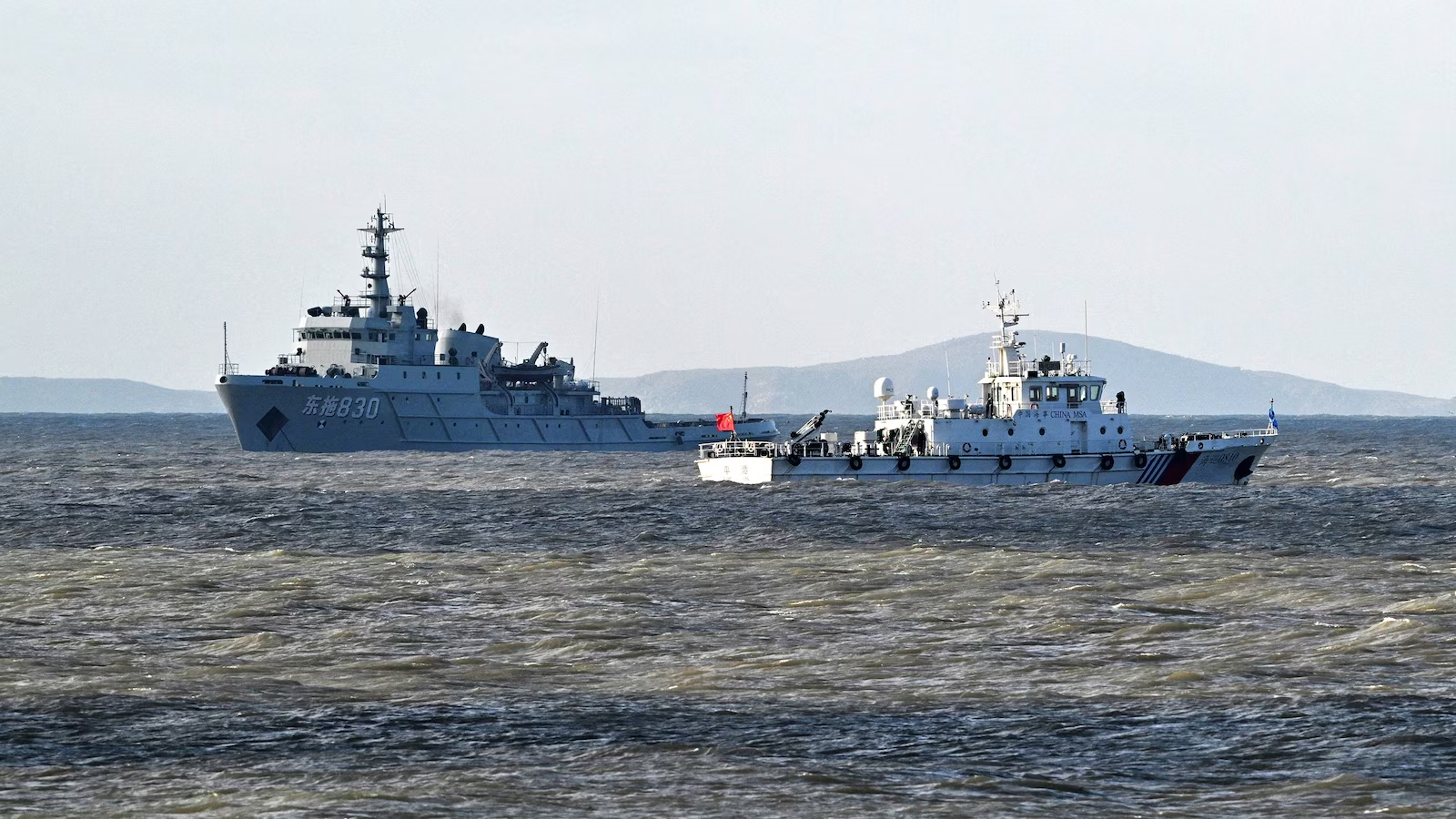
In this Dec. 30, 2025, file photo, Chinese ships patrol as the People’s Liberation Army (PLA) conduct military drills on Pingtan island, in eastern China’s Fujian province, the closest point to Taiwan.
Adek Berry/AFP via Getty Images, FILE
Beijing considers its island neighbor to be run by a separatist government that must be “re-unified” with the Chinese state. The U.S. has long advocated for a status quo policy in which China does not make advances on Taiwan’s independence and the U.S. does not recognize its statehood.
Trump said Monday when asked about weapons sales to Taiwan said, “I’m going to have that discussion with President Xi. President Xi would like us not to.”
On the eve of the summit, a bipartisan group of eight senators asked about the status of a $14 billion package of arms sales to Taiwan that it had approved in January has not been sent along by the White House.
“You can make clear to Beijing that as you seek to level the economic playing field, American support for Taiwan is not up for negotiation,” the senators, led by New Hampshire Democrat Jeanne Shaheen and joined by Republicans Thom Tillis and John Curtis, wrote Friday.
The U.S. Congress has codified into law a principle that it won’t take part in such discussions with China.
Asked in a House Appropriations hearing on Tuesday about the pending weapons sales to Taiwan, Defense Secretary Pete Hegseth said, “The president’s on the cusp of a trip and I’ll be with him, and he will make all decisions related to that.”
Retired Navy Rear Adm. Mark Montgomery, a senior director at Foundation for the Defense of Democracies that promotes U.S. support for Taiwan, said he feared Taiwan would be “on the menu” at the summit.

In this Jan. 29, 2026, file photo, soldiers fire an unmanned aerial vehicle (UAV) during the spring military drills at the Tsoying Naval Base in Kaohsiung.
I-hwa Cheng/AFP via Getty Images, FILE
“I’d be worried if I was a Taiwanese,” he said, citing indications the two parties could discuss U.S. arms sales to Taiwan.
“I do worry that we have a transactional president and a transactional opportunity could arise, and then we would have a challenge,” Montgomery said.
China analysts said the discussion of Taiwan in itself raises risks, as Chinese President Xi Jinping will likely look to advance his goals in his meetings with Trump. The Chinese will likely aim chiefly for so-called “declaratory language” from Washington, or public statements from U.S. officials that move toward accommodating China’s position, three former senior government officials said.
Talks between Trump and Xi come after the Chinese president gave a warm welcome in Beijing to the leader of Taiwan’s opposition party, which advocates for closer ties with Xi’s government there.
“I think as it relates to Taiwan policy,” one of the former officials said, “the anxiety [within the Trump administration] is more about the potential next two or three moves on Taiwan” than any public statements the U.S. might make about the situation.

In this Jan. 29, 2026, file photo, a Taiwanese Navy ship conducts a military exercise outside a naval base in Kaohsiung, Taiwan.
An Rong Xu/Bloomberg via Getty Images, FILE
“I think administration officials will argue that shifts in declaratory policy are words, [and that] capabilities matter more. And [that] the commitment of the U.S. Congress to Taiwan is still there,” the former official said.
Other China analysts said that any rhetoric that emerges from the summit could be reversed by a future administration or even the current one.
But the former officials agreed that it would be hard to know what Xi privately conveys to Trump about his ambitions toward the island, which he is largely believed to seek control over as soon as 2027.
Recent U.S. intelligence assessments have found that timeline to be improbable.
One former official, who said both heads of state wield unprecedented influence over their respective governments, predicted Taiwan would be Xi’s dominant focus.
That reflects “confidence in himself, and, frankly, his ability to take some careful risk,” the official said.