
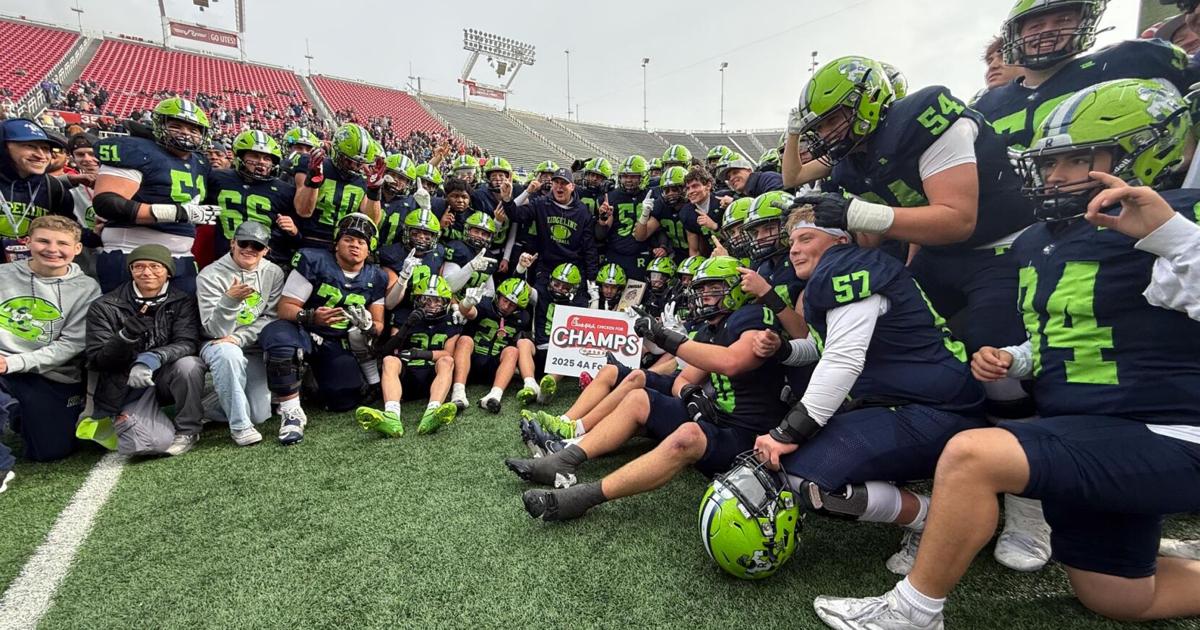
LOGAN — High school athletics across Northern Utah could undergo significant changes beginning in 2027, with Ridgeline potentially moving into 6A football, Rich transitioning from eight-player to 11-player football and several longtime Cache Valley rivals facing different regional opponents.
The Utah High School Activities Association Board of Trustees gave preliminary approval Thursday, Nov. 19, to new classifications for the 2027-28 and 2028-29 school years.
The proposal could reshape competition for eight Northern Utah high schools — Ridgeline, Green Canyon, Sky View, Mountain Crest, Logan, Bear River, Box Elder and Rich — affecting regional rivalries, travel schedules and postseason opportunities.
While some schools would move into higher classifications, others would remain in their current classifications but could find themselves competing in substantially different regions.
The classifications are preliminary, and the UHSAA has not yet proposed regional assignments. Those are scheduled for consideration Dec. 1, with final decisions expected Dec. 17.
Ridgeline’s proposed jump to 6A highlights Cache Valley changes
Perhaps the most significant change among Cache Valley’s larger high schools would be Ridgeline’s proposed move from 4A to 6A in football. The RiverHawks would also move from 4A to 5A for all other athletic activities.
That would place Ridgeline football in Utah’s highest classification, competing against some of the state’s largest and most successful programs.
The change could also separate Ridgeline from its traditional Cache Valley football opponents, including Green Canyon, Sky View, Mountain Crest and Bear River.
Green Canyon would move from 4A to 5A in both football and other sports, while Sky View would move to 5A in football but remain in 4A for other activities.
Mountain Crest and Bear River would remain in 4A for football and other activities, while Logan would continue competing in 3A.
Currently, the five Cache Valley high schools other than Logan compete together in 4A Region 11. Under the proposal, those five schools would be divided among three football classifications and two classifications for other activities.
Traditional rivalry games could still be arranged as nonregion contests, but they would no longer count toward the same region championships when schools are assigned to different classifications.
For student-athletes, the changes could mean different levels of competition, new opportunities to establish rivalries and potentially longer trips for regional contests. Schools could also face scheduling challenges as they attempt to preserve longstanding matchups.
Box Elder could gain Cache Valley regional opponents
Box Elder High School in Brigham City would remain in 5A for football and other activities, but the proposed changes could substantially alter the Bees’ regional competition.
Box Elder currently competes in 5A Region 5 with Bonneville, Clearfield, Fremont, Northridge, Roy and West Field.
Under the proposed classifications, Bonneville would move to 4A in football and other activities, while Roy would move to 4A for activities other than football.
Meanwhile, Ridgeline and Green Canyon would join Box Elder in 5A for sports other than football, creating the possibility of a new northern region that includes the Bees and two Cache Valley schools.
For football, Green Canyon and Sky View could potentially join Box Elder in a region with Fremont, West Field, Weber and Roy.
Such an alignment could provide Box Elder students with closer regional opponents while creating new competitive relationships between Brigham City and Cache Valley schools.
However, the actual travel impact would depend on the UHSAA’s final regional assignments. The Bees could still be grouped with schools farther south in Weber or Davis counties.
Rich could face transition to 11-player football
For Rich High School in Randolph, the most consequential proposed change involves football.
Just five days before the UHSAA announced its preliminary classifications, Rich defeated Milford 69-35 to capture its fourth consecutive eight-player football state championship.
Now, the Rebels could find themselves competing in an entirely different football format.
The preliminary alignment does not have a 8-player classification, which places Rich in the 1A 11-player football classification while its other athletic programs would remain in 1A.
Moving from eight-player to 11-player football would require three additional players on the field for each team and could have significant implications for roster depth, player development and offensive and defensive strategies.
For a small, rural school such as Rich, maintaining sufficient roster numbers throughout a season could become an important consideration, particularly when accounting for injuries, substitutions and students participating in multiple activities.
The change could also create additional opportunities for students to participate in different positions, although a larger lineup would require more available players.
Rich would face a different group of football opponents. The proposed 1A 11-player classification includes North Summit, Duchesne, Millard, Gunnison Valley, North Sevier, South Sevier, Enterprise, Grand County, Parowan and American Leadership Academy.
North Summit in Coalville and Duchesne would be among Rich’s geographically closer potential opponents, but filling a region with the customary five to eight schools could require significant travel to other parts of Utah.
Those trips could affect students beyond the football field, particularly if lengthy road games require time away from school or additional coordination with other extracurricular activities.
For sports other than football, Rich could experience greater continuity. Its proposed 1A classification would allow the Rebels to remain with all six schools currently competing alongside them in Region 22: Altamont, Manila, St. Joseph, Tabiona, Tintic and Wendover.
What could Northern Utah’s new regions look like?
Although the UHSAA has not released proposed regional assignments, its preliminary classifications offer some indication of how Northern Utah schools might be grouped geographically.
Regions typically include five to eight schools, meaning the association must balance competitive classifications with geographic proximity, travel requirements and existing rivalries.
For football, Ridgeline’s proposed move to 6A creates one of the most significant geographic challenges. With no other Cache Valley school in that classification, the RiverHawks could potentially compete in a five-school region with Syracuse, Davis, Farmington and Bountiful.
That would require Ridgeline to travel into Davis County for most of its region contests.
In 5A football, Green Canyon, Sky View and Box Elder could form the northern foundation of a seven-school region that also includes Fremont, West Field, Weber and Roy.
Such a grouping would preserve the Green Canyon-Sky View rivalry while adding a mix of traditional Box Elder and Weber County opponents.
Mountain Crest and Bear River could remain together in a six-school 4A football region with Bonneville, Morgan, Stansbury and Grantsville.
Logan could continue competing against Ogden and Ben Lomond in 3A football, potentially joining Tooele and Deseret Peak in a five-school region.
Rich could face a more difficult geographic challenge in 1A 11-player football. One possible six-school grouping would include Rich, North Summit, Duchesne, American Leadership Academy, North Sevier and Millard.
However, with only 11 schools statewide proposed for 1A 11-player football, the UHSAA could choose a different regional structure. Any division into regions of five or six teams would involve considerable geographic distances for some schools.
For sports other than football, Ridgeline, Green Canyon and Box Elder could compete together in a five-school 5A region with Fremont and West Field.
That would create a relatively compact northern region, with student-athletes frequently traveling between Cache Valley, Brigham City and western Weber County.
In 4A, Sky View, Mountain Crest and Bear River could remain together in a six-school region with Bonneville, Morgan and Roy.
Such an arrangement would preserve several traditional Cache Valley matchups while introducing regional competition against schools in neighboring counties.
Logan could remain in a five-school 3A region with Ogden, Ben Lomond, Grantsville and Deseret Peak.
Rich could potentially retain its existing seven-school Region 22 alignment for activities other than football, providing continuity for its students and athletic programs.
None of these geographic groupings has been proposed or approved by the UHSAA. They are possible scenarios based on the preliminary classifications, the typical number of schools assigned to a region and geographic considerations.
New realignment formula places greater emphasis on competitive success
The UHSAA said the realignment process uses a Competitive Realignment Index based on three factors: school enrollment, socioeconomic status and competitive performance over the previous three years.
For activities other than football, enrollment accounts for 77% of the calculation, socioeconomic factors account for 13%, and competitive performance accounts for 10%.
Football uses a different formula, with enrollment weighted at 65%, socioeconomic factors at 13% and competitive performance at 22%.
The greater emphasis on competitive results in football helps explain why schools such as Ridgeline and Sky View could be placed in higher football classifications than those assigned for other sports.
Enrollment figures are based on sophomore and junior student counts as of Oct. 1, as provided by the Utah State Board of Education.
The UHSAA Board of Trustees reviewed the data and determined the number of schools to place in each classification for its initial consideration.
The proposal includes 146 schools across six classifications for activities other than football. The separate football alignment includes 107 schools in 11-player football classifications and 11 schools assigned to the eight-player division.
Final decisions expected in December
The UHSAA Board of Trustees will meet Tuesday, Dec. 1, for its second consideration of classifications and first consideration of proposed regional assignments.
A virtual public hearing is scheduled for Tuesday, Dec. 8, allowing school districts, administrators and community members to provide feedback.
The board will consider regional assignments again Dec. 9 before making its final decisions Thursday, Dec. 17.
The new classifications and regions would take effect in August 2027 and remain in place for the 2027-28 and 2028-29 school years.
For Northern Utah students, coaches and communities, the decisions could determine not only which schools compete for regional and state championships but also how far teams must travel and which longstanding rivalries continue as conference matchups.
Additional information is available on the UHSAA website at uhsaa.org.