
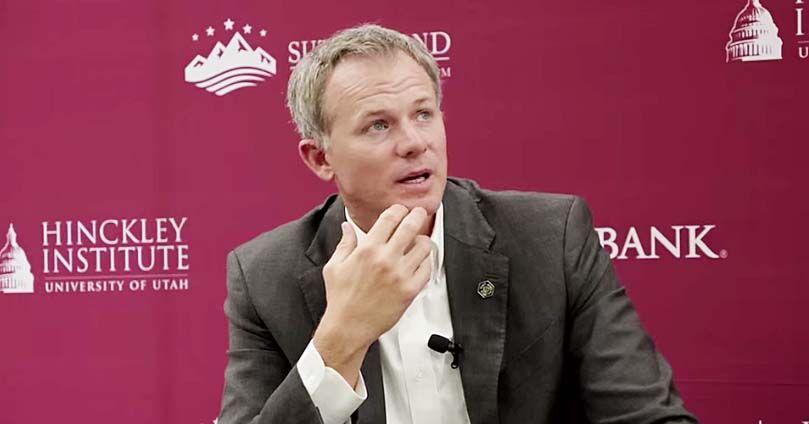
SALT LAKE CITY – In a long and admittedly wonky discussion about U.S. fiscal policy, Rep. Blake Moore (R-1st Dist.) defended two recent legislative proposals as long-term solutions to the nation’s debt crisis.
The pending legislation cited during a thoughtful Sept. 24 forum hosted by the Sutherland Institute on the University of Utah campus were Moore’s own Comprehensive Congressional Budget Act and the Fiscal Commission Act, both of which were previously introduced into the 119th Congress.
In response to an aspirational question from moderator Nic Dunn of the Sutherland staff, Moore said without hesitation that the first step toward addressing the $40 trillion national debt should be the enactment of the Fiscal Commission Act.
“If we could get that passed during the upcoming lame duck session (after the Nov. 3 general election),” he replied, “ … that would be a really good use of our time.”
That bipartisan proposal — jointly sponsored by Senators John Curtis (R-UT) and Angus King (I-ME) in the Senate and Representatives Bill Huizenga (R-MI) and Scott Peters (D-CA) in the House – promises to be a road map to start the process of getting the U.S. fiscal house in order.
The legislation would create a bipartisan, bicameral panel of members of Congress and outside experts to work across party lines to produce concrete fiscal policy recommendations to improve America’s fiscal status, achieve a sustainable debt-to-GDP (gross domestic product) ratio and improve the solvency of federal trust funds, including those for Social Security and Medicare.
Moore explains that there wouldn’t be any leadership maneuvers or politics involved to spike the recommendations from the fiscal commission.
“Those recommendations would go right to the floor,” he said, “for an up or down vote.”
The next step toward correcting the U.S., financial woes would be adopting the Comprehensive Congressional Budget Act, according to Moore.
The three-term incumbent told the audience of UofU students that his colleagues on Capitol Hill only manage about 22 percent of the federal budget, an amount that represents total discretionary spending.
The other 77 percent of the federal budget, which Congress hasn’t voted on for years, covers mandatory spending for interest on the national debt, Social Security, Medicare/Medicaid and other so-called entitlement programs.
As proposed by Moore, the Comprehensive Congressional Budget Act will make Capitol Hill budgeting all-inclusive by requiring lawmakers to vote every year to reauthorize all federal spending.
In the process of reauthorizing those formerly mandatory spending programs like Social Security and Medicare, Moore said that Congress would be able to fine-tune them to create budgetary savings.
As of July, the proposed reforms cited by Moore were supported by ten members of the Senate and 43 members of the House, along with a host of non-profit groups advocating for fiscal sanity in federal spending.