
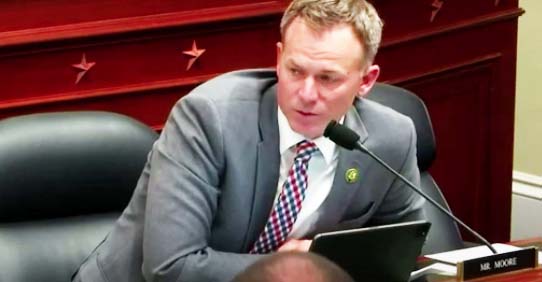
U.S. Rep. Blake Moore (R-UT) argues in favor of the House Budget Committee’s 10-year plan to reduce the federal deficit during deliberations on Sept. 20.
WASHINGTON, D.C. – In the midst of all the headline-grabbing sound and fury here about stop-gap funding and a potential government shut-down, the House Budget Committee has quietly created a framework that aims to reverse the federal government’s debt culture.
With the national debt reaching an unprecedented $33 trillion, this budget framework counters the Biden Administration’s tax-and-spend agenda and creates a path to balancing the federal budget in 10 years, according to U.S. Rep. Blake Moore (R-UT).
“We’re giving hope to every single American that there’s a plan,” Moore said before the Budget Committee on Sept. 20.
“Every single American, regardless of ideology or party affiliation, knows that this debt has occurred and that interest (on that debt) overtakes too much of our budget so that we can’t invest in needed things.
“And we are now well down that path,” he added
The House Budget Committee, of which Moore is a member, has proposed a budget resolution for Fiscal Year 2024 that will be a first step toward “reversing the curse” of runaway spending and the unsustainable federal balance sheet.
If enacted, Moore says, the committee’s budget framework would lower interest payments on the debt by $3 trillion over the next decade; reduce the federal deficit by $16.3 trillion over the same period; grow the economy by 3 percent per year (as opposed to the Congressional Budget Office’s projection of 2 percent per year); and create a $130 billion budget surplus in Fiscal 2033.
The Budget Committee’s plan proposes a $1.22 trillion deficit in Fiscal 2024, but that amount gradually begins to shrink in 2025 until it hits $7 billion in 2032 and a surplus of $130 billion in 2033.
Moore explains that plan restores federal fiscal responsibility by reversing President Joe Biden’s spending spree.
That includes dismantling Biden’s so-called Inflation Reducing Act; eliminating Biden’s army of 87,000 new agents working for the Internal Revenue Service; repealing $129 billion in “Green New Deal” programs; and rolling back $57 billion in Obamacare subsidies for the wealthy.
Other elements of the Budget Committee’s plan include reining-in runaway spending (saving $8.7 trillion over 10 years); rooting out waste and fraud (saving another $1 trillion); and reigniting growth and prosperity (saving $3 trillion by growing the economy and locking in tax cuts for the middle class and small businesses).
Before Congress can even consider that long-term plan, however, it must find its way out of a short-term fiscal crisis that threatens to shut down the federal government after Sept. 30.
When the U.S. House reconvenes on Tuesday, its members are set to consider four fiscal 2024 appropriations bills after making cuts of nearly $3.8 billion from their agriculture and foreign aid programs.
That’s seen as an effort to return to regular business for the House members after talks stalled over the weekend on a continuing resolution to fund the federal government’s continued operations after Sept. 30.
Amid an ongoing revolt by a handful of ultra-conservative members, House leaders admit that a continuing resolution to simply keep federal agencies’ lights on beyond the end-of-month deadline was still nowhere in sight.
To break that impasse, Republican leaders are hopefully looking at extending the length of a 30-stopgap bill they introduced last week to six weeks while adding a fiscal commission to look at long-term deficit reduction measures, presumably to duplicate the aforementioned efforts of the House Budget Committee.
But no continuing resolution debate is scheduled for House action as of Sept. 25.