
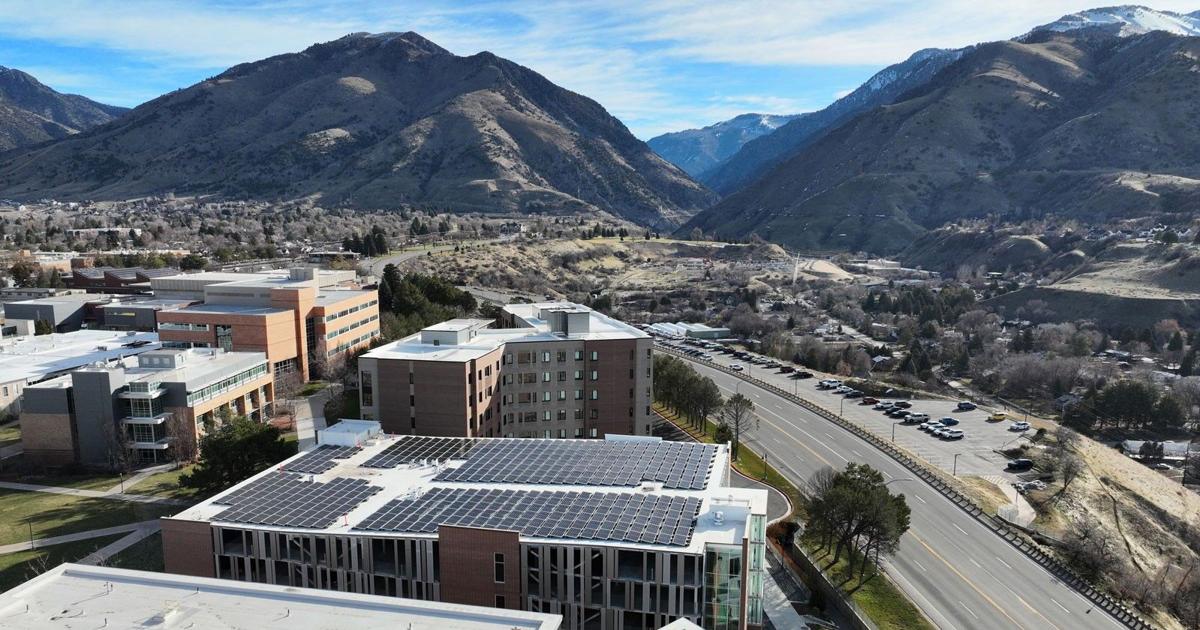
LOGAN — Utah State University has completed the second phase of its campus solar expansion, adding more than 1 megawatt of solar generation capacity and its first large-scale battery storage system as part of an effort to reduce energy costs and the university’s environmental impact.
The latest installations bring USU’s total new solar capacity to more than 2 megawatts across seven locations, with the combined systems expected to generate more than 3 million kilowatt-hours of electricity annually.
The second phase includes two projects in Logan and one at the university’s Uintah Basin Campus in Vernal.
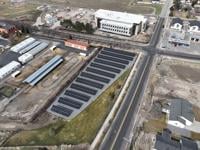
Solar panels at USU’s Poisonous Plant Research Lab in Logan.
In Logan, a 317-kilowatt ground-mounted solar array has been installed at the Poisonous Plant Research Lab at 1150 East 1400 North, while a 239-kilowatt system has been added to the roof of the new Canyon Terrace parking structure along 400 North.
The largest installation in the second phase is at the Uintah Basin Campus, where a 449-kilowatt ground-mounted solar array has been paired with a 500-kilowatt-hour battery storage system.
The battery represents a significant addition to USU’s renewable energy infrastructure, allowing the university to store electricity generated during daylight hours for use when needed.

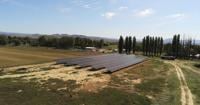
Solar panels at the Bingham Entrepreneurship and Energy Research Center on USU’s Uintah Basin campus.
The Vernal project received financial support through Rocky Mountain Power’s Blue Sky Program and Wattsmart Battery Program.
Under the arrangement, a portion of the battery’s capacity is reserved for Rocky Mountain Power to dispatch when needed, helping improve the reliability of the regional electrical grid.
“Every kilowatt-hour we generate on our own campuses is one we don’t have to buy, and over the 25- to 30-year life of these systems, those savings add up,” said Zac Cook, associate director of utilities and energy management at USU. “Projects like this save the university money while reducing the environmental impact of our operations. Adding battery storage in Vernal helps us get even more value from that clean energy and gives us experience we can carry to future projects across the state.”
The newly completed installations are expected to produce approximately 1.5 million kilowatt-hours of electricity annually, enough to power roughly 140 average Utah homes for a year.
University officials estimate the second phase will also avoid more than 1,100 metric tons of carbon dioxide emissions annually, comparable to removing approximately 245 passenger vehicles from the road or avoiding the burning of about 1.1 million pounds of coal.
The expansion follows the completion of the first phase earlier this year, which added 1,058 kilowatts of solar capacity.
Together, the two phases represent a significant investment in USU’s long-term energy infrastructure, with the systems expected to operate for 25 to 30 years.
Beyond reducing electricity purchases, the projects will provide the university with practical experience in solar generation and battery storage technology that could help guide future energy investments at USU campuses throughout Utah.