
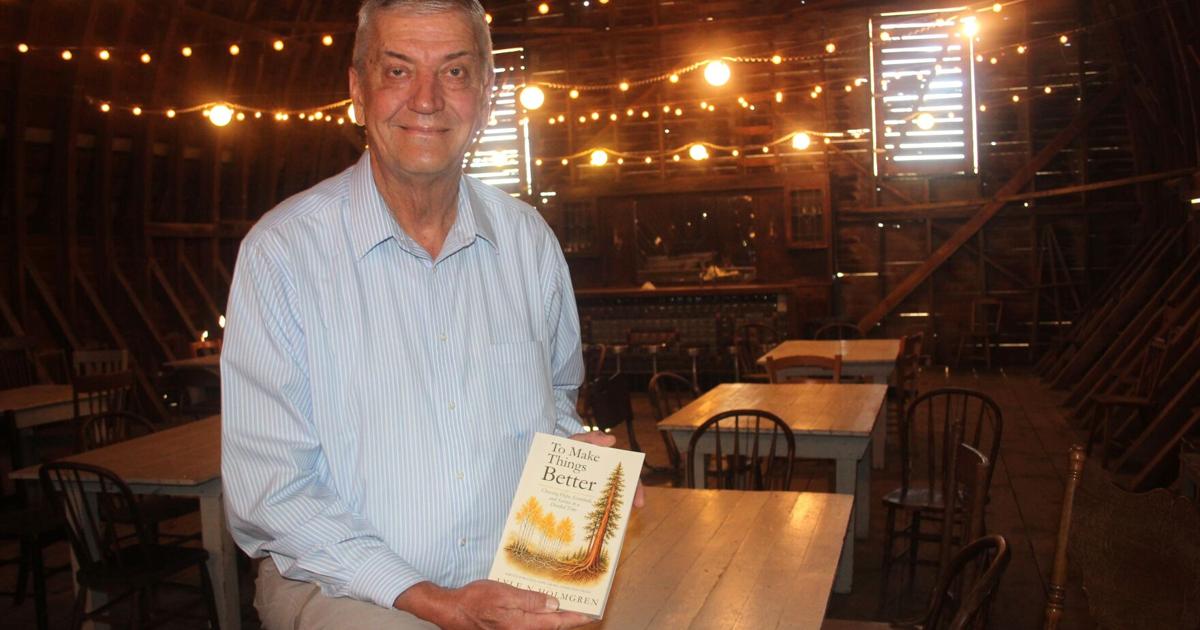
TREMONTON – After 35 years of public service, including 27 as a Utah State University agricultural agent and time serving on the Tremonton City Council and as Tremonton mayor, Lyle Holmgren has seen a troubling change in the way people communicate with one another.
Hoping to encourage more respectful public discourse, Holmgren has written a book drawing on personal experiences and local history to explore how communities can overcome division through hope, service and gratitude.
Lyle Holmgren holds a copy of his new book to Make Things Better inside on Wednesday Oct. 22, 2026.
His book, “To Make Things Better: Choosing Hope, Service, Gratitude in a Divided Time,” examines how anger and distrust can divide communities and how ordinary people can help restore trust and strengthen relationships.
He said people are making online attacks instead of in-person conversations. People with good intentions are staying away from public service, because of the bitterness they are witnessing in todays political scene.
Holmgren holds a master’s degree in agricultural economics from Utah State University. His years in public service gave him a firsthand look at the challenges elected officials and other public servants face.
“The book is basically about my experience with public service,” Holmgren said. “The behavior is not getting better. I think a lot of it has to do with social media.”
Through his research, Holmgren found that communities throughout northern Utah face many of the same challenges.
“It’s not just a Tremonton problem; it’s a Northern Utah problem,” he said. “The way people behave, the way they treat public servants is appalling.”
Holmgren said people are often willing to help their neighbors in an emergency, offering whatever they can to someone in need. But when someone is elected to public office, that same person can become the target of suspicion and accusations.
He said the contrast prompted him to examine what causes people to turn against one another and how communities can rebuild a sense of shared purpose.
Personal tragedy also helped shape the book’s message.
When Holmgren’s son Corey died suddenly at age 35, he left behind a pregnant wife and three young children. The loss brought devastating grief to the family.
During that difficult time, however, Holmgren said he was blessed by the people around him. Neighbors showed up with meals, offered comfort and helped the family through its darkest days.
Their kindness showed him the power of community and the importance of caring for others rather than allowing differences to create division.
“The antidote for distrust and anger is gratitude, home and service,” he said. “I began to see that tragedy holds communities together.”
Holmgren explores how outrage spreads, how anger can sometimes mask deeper pain and how cycles of conflict can become difficult to break. He also describes how small, repeated acts of kindness can restore trust, dignity and connection.
His writing includes historical examples of people overcoming differences and finding common ground.
Holmgren recounts the relationship between David Reese and Chief Sagwitch, who survived the Bear River Massacre along with members of his tribe. Despite the painful history surrounding the massacre, the two men became friends.
He also shares the story of Gunda Borgstrom and Ruth Zollinger, neighbors and friends who attended the same church.
The Borgstrom family lost four sons during World War II, while the Zollinger family provided food to German prisoners of war who were working in sugar beet fields. Although the circumstances could have created tension between the families, Holmgren said their relationship remained strong.
The stories illustrate how personal relationships and shared values can overcome circumstances that might otherwise divide people.
Holmgren, who has traced his ancestry to the Mayflower, also reflects on the assistance Native Americans provided to the Pilgrims, helping them survive in an unfamiliar land.
Throughout the book, he emphasizes that communities become stronger when people choose to help others rather than make accusations or assume the worst about their neighbors.
“This book is full of stories of what happens when people step up to help and care about people, instead of make accusations about people,” Holmgren said.
Holmgren hopes readers will consider how their own actions and attitudes affect the communities in which they live. By choosing gratitude over resentment and service over hostility, he believes people can help make their communities better places to live.
“To Make Things Better: Choosing Hope, Service, Gratitude in a Divided Time” is available through Amazon.