
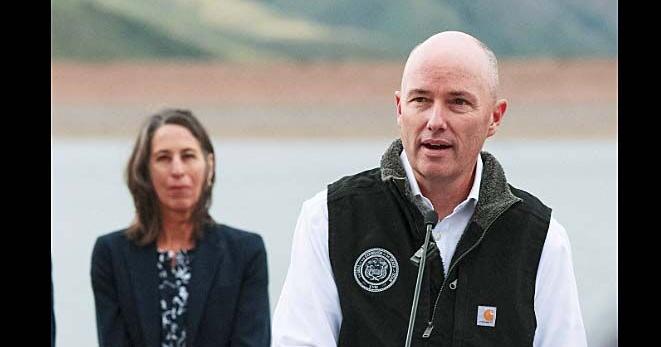
SALT LAKE CITY – As he signed an executive order addressing Utah’s drought, Gov. Spencer Cox painted a bleak picture of statewide water conditions.
“Our snowpack provides 95 percent of Utah’s water supply,” Cox explained at a May 21 press conference at Little Dell Reservoir east of Salt Lake City. “This winter, that supply fell far short of what Utah needs.”
After that snowpack peaked about three weeks early and was the lowest recorded since 1930, state officials say that all 29 counties are in severe drought, with 22 counties experiencing extreme drought conditions.
In response, Cox signed an executive order declaring a statewide drought emergency, activating Utah’s emergency response plans and coordinating the drought response efforts of agencies across the state.
The good news, according to Cox, is that Utah has spent years preparing for dry years by investing in reservoirs, conservation and planning.
The Little Dell Reservoir is a typical example of those preparation efforts. Created in 1993 as a joint venture between the U.S. Army Corp of Engineers, the Metropolitan Water District of Salt Lake City and Salt Lake County, the reservoir supports drinking water, flood control, and wildlife enhancement.
The reservoir and a nearby recreation area are operated and maintained by the Salt Lake City Department of Public Utilities.
“We are now relying heavily on reservoir storage, which remains at 70% capacity thanks to careful management during wetter years. But those reserves are being drawn down faster than we’d like.” the governors acknowledged.
Cox thanked Utahns who have already cut back on water usage, cities and water districts for leading by example as well as farmers and ranchers who are often the first to have their water supply reduced.
Through the Agricultural Water Optimization Program, statewide producers have invested more than $50 million of their own funds to improve water use and help protect Utah’s water resources and food supply.
“We have enough water to get through this year if we treat every gallon like the finite resource it is,” Cox emphasized. “We can’t control the weather, but we can control the tap.”
He urged all Utahns to follow the state’s weekly lawn watering guide, reduce outdoor water use, fix irrigation leaks and avoid watering pavement.”
Additional information about steps residents can take to cope with the water shortage can be found at www.Drought.Utah.gov