
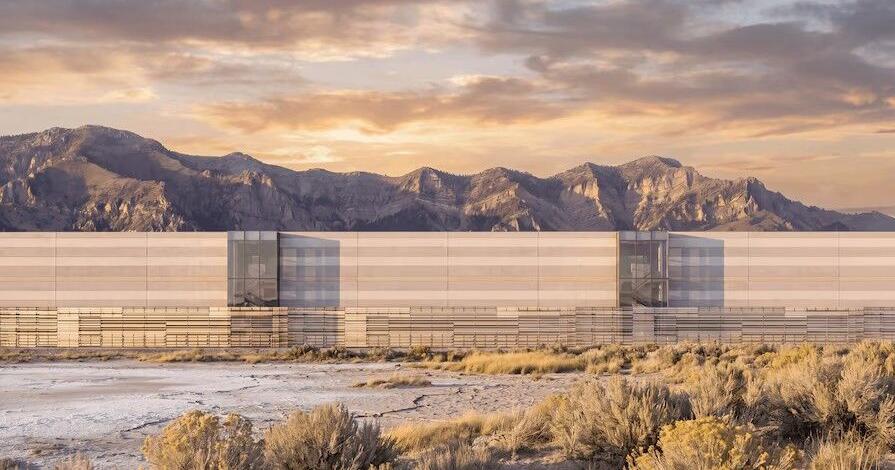
The massive Stratos data center project has generated immense interest beyond Box Elder County’s borders, and Utah officials say there are still opportunities for residents to share feedback.
Utahns clearly have concerns. A now-withdrawn water right request amassed nearly 4,000 protests, mostly from Utah residents. Another has seen dozens of protest letters in just a few days. Hundreds of opponents showed up for last month’s Box Elder County vote approving the project, and about 6,000 people signed a letter urging Gov. Spencer Cox to take action over the proposal.
Many expressed concerns about the data center’s water demands, Utah’s ongoing drought conditions and the neighboring Great Salt Lake, which could hit another record low this year. Others worry about the carbon emissions and other air quality concerns stemming from the complex’s natural gas power plant.
“I saw [this month] people seemed very scared, like they didn’t feel like they had a voice on air quality, on water quality,” said Tim Davis, commissioner of the Utah Department of Environmental Quality. “I want them to know they do. … We will have a public process, and it hasn’t even begun yet.”
The primary way Utahns have voiced their concerns so far has been through the Division of Water Rights. Applications filed there have sought a combined 1,911 acre-feet in Hansel Valley, where celebrity backer Kevin O’Leary plans to build the data campus, dubbed the Stratos Project.
More water applications will likely follow, as the project’s developers have said they will seek around 13,000 acre-feet. It costs $15 to file a protest with the division.
Under a new state law, however, the Division of Water Rights can only evaluate matters that directly relate to water availability and impacts to other water users. Issues like the Great Salt Lake, water quality and air pollution mostly fall under the umbrella of the Utah Department of Environmental Quality, or DEQ.
“A project of this size,” Davis said in an interview, “is not going to rush forward.”
The Stratos developers have not met with DEQ officials, Davis said. But he said they will likely need permits to comply with federal laws that the state is charged with enforcing, like the Clean Air Act and Clean Water Act.
While the Stratos Project’s backers have said the data center is a matter of national security, the data center would still need to comply with those requirements, Davis said.
Other data centers across Utah have filed for air quality permits for natural gas-powered generators and diesel-fired backup generators because they emit pollutants like the precursors that form the Wasatch Front’s wintertime inversion smog and summertime ozone haze.
The data center developers initially said the project would consume 9 gigawatts of power at full build, with all the electricity coming from an on-site natural gas plant. Energy experts have calculated it would raise the state’s emissions by as much as 64%, producing more carbon pollution than Utah’s entire transportation sector.
Amid public pushback over the project, Cox posted on X that the developer had committed to “pursue the deployment of renewable energy resources, energy storage, nuclear generation, or other low- or no-emissions solutions in addition to natural gas.”
The Stratos Project will be built in Hansel Valley, which lies outside of the Wasatch Front’s nonattainment area. For years, that area had been on the Environmental Protection Agency’s dirty air list before the feds recently took it off its list for inversion pollution. But Stratos opponents worry emissions blowing from the site will knock Utah’s urban core back on the list.
“We’ve been working really hard to get back into compliance,” Davis said. “We’re working hard on coming into compliance with ozone as well. We’re not going to let new areas of the state go into nonattainment.”
The Stratos developers will need to demonstrate they are using the best available pollution control technology, Davis said. They also will have to do a year of monitoring before they can even apply for a permit to establish baseline air quality, the commissioner said. There will then be a 30-day period for the public to submit comments at no cost, and the public can ask for a meeting.
“I can’t imagine that there will not be a requested public hearing,” Davis said, “so we will just plan to hold a public hearing.”
Stratos developers and state officials have said they plan to occasionally flush their cooling system and discharge water into the environment, which will eventually reach the Great Salt Lake. That, too, will require a process to regulate water quality. As with air quality, the department will issue a draft permit and open a 30-day comment period to the public.
DEQ could open a second comment period if they incorporate the public’s responses into revised permits.
Some scientists and environmental watchdogs have raised concerns about whether the water getting discharged from the data center could contain “forever chemicals” called PFAS, concentrated salts and other pollutants. They also have expressed worries over the potential discharge of hot water into a high desert environment, which could devastate the local ecosystem and potentially the Great Salt Lake.
DEQ will evaluate all those concerns, Davis said, before issuing a water discharge permit. The department has water temperature standards, nutrient and salinity standards and rules meant to specifically protect the water quality of the Great Salt Lake.
At roughly 40,000 acres once fully built, the sheer size of the campus likely means it will have to treat its own water to drinking quality standards for workers and visitors as well, a process regulated by DEQ. The department will also supervise stormwater discharge during construction, Davis said, which could take more than a decade. All those regulations include public participation during the permitting phase.
“We take the whole process very seriously,” Davis said. “We will do our jobs.”