
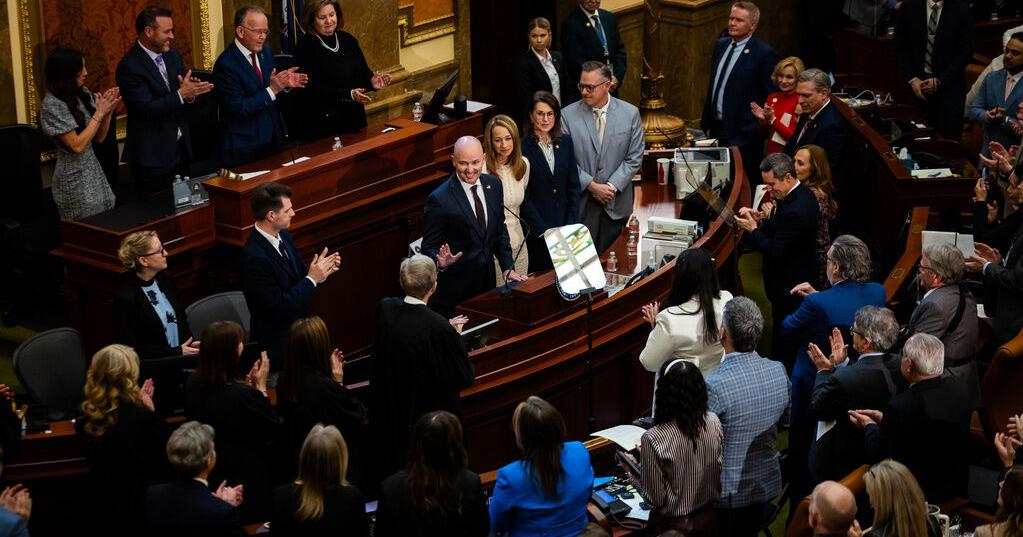
SALT LAKE CITY – The reaction of Democrats at state and national level to the State of the State address delivered by Gov. Spencer Cox on Jan. 22 was uniformly negative.
Ken Martin, the chair of the Democratic National Committee, issued his first attack before Cox’s speech even began, citing the familiar DNC theme that Republicans are more concerned with the welfare of billionaires than that of average Utahns.
“While Cox will try to gaslight Utahns and paper over his failures,” Martin said in a prepared statement, “it’s clear that Utah’s Republican leadership has failed working Utahns.”
Despite the high-minded rhetoric included in Cox’s remarks, Martin argued that the reality is that costs continue to rise, health care becomes more expensive and rural hospitals close under President Donald Trump and Cox.
Cox adopted a conciliatory tone in his address to Republican and Democratic lawmakers at the Capitol, avoiding partisan rhetoric and emphasizing the need for the Legislature to tackle issues of literacy, housing, mental health and social media concerns during its 2026 general session.
While Utah Democrats acknowledged those priorities, they criticized the governor’s record, saying that his current policies fall far short of the urgency the Beehive State needs.
“Tonight, Utahns heard a speech full of familiar talking points about virtue, character and the promise of Utah,” said Brian King, the chair of the Utah Democratic Party. “But too few concrete solutions to the challenges families are facing every day.
“We need action, not rhetoric,” he added.
The Democrats were prepared to pepper their criticism of Cox with dollar and cents examples.
They say that working families in Utah have absorbed more than $1,000 in higher costs due to inflation and are projected to lose another nearly $600 per year due to Republican policies tied to their Big Beautiful Bill and tariffs.
On health care, Democrats emphasize that nearly 400,000 Utahns are facing higher insurance premiums and another 150,000 are at risk of losing coverage due to Republicans’ refusal to extend Obamacare supplements.
“Utah families are working hard, but too many are struggling to afford the basics,” according to Sen. Luz Escamilla (D-SLC), the minority leader of the Senate.
Those basics include food on the table, a safe place to live, child care, health care and financial security, she explained.
In contrast to the high-minded rhetoric in Cox’s speech, the Democrats’ criticism espoused competitive teacher pay, classroom resources and policies shaped by real educators; safeguards for renters and long term investments in communities; and protected access to health care and expanded mental health treatment.
“Utah can do better,” King summarized following Cox’s address.
“If virtue is truly central to our state’s future,” he added, “then our policies must reflect it by lowering costs, strengthening public education, protecting health care and ensuring that government works for the people it serves.”