
When asked at the White House how he would feel if Janeese Lewis George won Tuesday’s primary in her campaign to become the new mayor of Washington, D.C., President Donald Trump’s response was clear.
“I wouldn’t like it,” Trump said. “Maybe we take back Washington and run it on a federal basis. We won’t put up with it.”

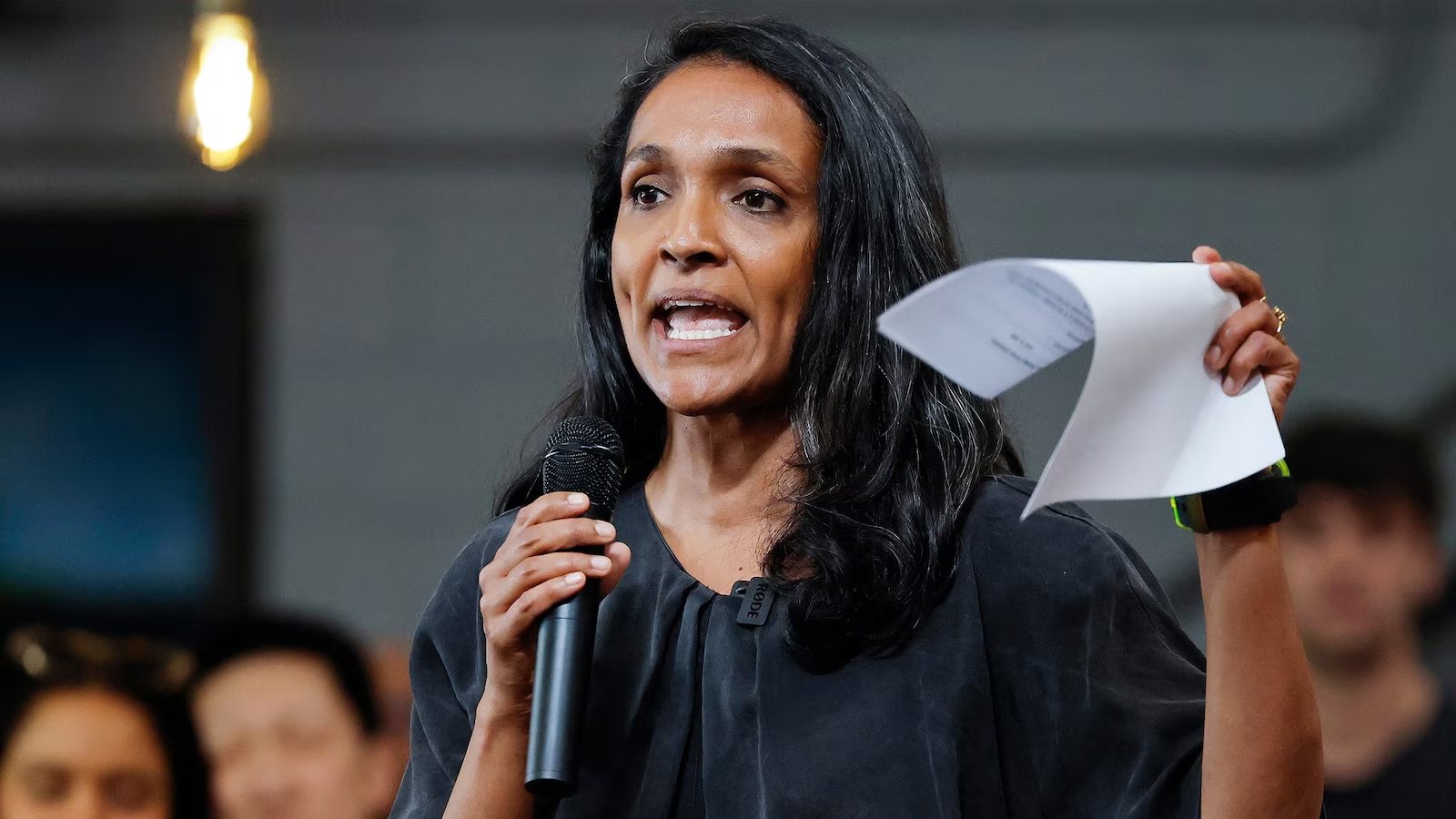
D.C. Council member Janeese Lewis George speaks during the D.C. Council hearing on the Fiscal Year 2027 budget at the Wilson Building, City Hall, June 9, 2026, in Washington.
Jose Luis Magana/AP Photo
Lewis George, a D.C. council member, is one of several democratic socialists running for office across the country who hope fatigue with Trump and frustration with Democrats will inspire voters to consider alternatives to establishment candidates. She advocates pushing back against the Trump administration, particularly when it comes to cooperation with Immigration and Customs Enforcement (ICE). A Washington Post-Schar School poll conducted earlier this month showed Lewis George with a double-digit lead over former D.C. council member Kenyan McDuffie, a Democrat.
A Fox News poll conducted in February and March found that 38% of voters believe it would be good for the United States to move toward socialism and away from capitalism. That is up 6 percentage points from 2022 and a new record high, but similar to 36% in 2018. In the same poll, nearly half said capitalism was working “not very well” or “not at all well.”
Voters’ financial struggles could factor in their decisions
The Fox News poll found that 53% of voters under 30 said they preferred socialism to capitalism.
Emily Ekins, a researcher at the libertarian Cato Institute told ABC News that young people “want affordable health care, more affordable housing, a fair economy, where the rich aren’t getting special favors from the government,” but argues that young people do not actually understand what socialism is.
Francesca Hong, a democratic socialist and former restaurant owner running for governor of Wisconsin, told ABC News that she thinks people struggling with bills and economic pressure are more likely to give candidates like her a chance.
“I think we’re showing there’s a path,” said Hong. “But you have to engage new voters, you have to bring in young voters, and you have to talk about actually wanting to change the system, because it’s not working for everyday people.”

Los Angeles City Councilmember and mayoral candidate Nithya Raman speaks at a campaign celebration with volunteers and supporters marking her advance into the general election on June 13, 2026 in North Hollywood, California.
Mario Tama/Getty Images
The Democratic Socialists of America (DSA) rose to prominence in 2018 when several members of the left-wing group, including Reps. Alexandria Ocasio-Cortez and Ilhan Omar, won seats in the House running as Democrats.
Since then, DSA has faced several setbacks. Prominent democratic socialist Sen. Bernie Sanders failed for a second time to secure the Democratic nomination for president. Several prominent DSA politicians, including Cori Bush in Missouri and Jamaal Bowman in New York, have lost seats their seats in Congress.
Prominent Democrats also sometimes decline to endorse DSA candidates. Senate Minority Leader Chuck Schumer of New York declined to endorse Zohran Mamdani in the New York City mayoral race, and Maryland Democratic Sen. Angela Alsobrooks opted to support McDuffie against Lewis George.
Some recent notable successes
But more recently, DSA candidates have seen notable successes in Democratic primaries. On May 19, Chris Rabb won in Pennsylvania’s 3rd Congressional District. Progressive Los Angeles city council member Nithya Raman bested reality TV star Spencer Pratt on June 8 to advance to the city’s general mayoral election against incumbent Democrat Karen Bass. If Raman and Lewis George both win their elections, New York, Los Angeles and Washington, D.C., would all have DSA mayors.
Messaging on the right frames democratic socialists as dangerously radical. Still, Lewis George told ABC News she doesn’t see the socialist label as a political handicap.
“Even moderate Democrats get called socialists from the Republican end,” Lewis George said.

Pennsylvania State Rep. Chris Rabb and Rep. Alexandria Ocasio-Cortez share the stage during a Rabb for Congress rally on May 15, 2026 in Philadelphia.
Matthew Hatcher/Getty Images
A risky strategy in purple states
Many notable DSA wins have been in liberal cities, including Mamdani’s election in New York City. Matt Bennett of Third Way, a center-left think tank, told ABC News that trying to recreate those successes in purple states could spell disaster for Democrats.
Bennett is concerned, for instance, that Hong could win her primary and then be defeated in November by Republican Tom Tiffany, fumbling the governorship of a swing state into the hands of a far-right Freedom Caucus member who dabbled in 2020 election conspiracy theories. According to an analysis by Third Way, “far-left” candidates have not flipped a seat in Congress from Republican to Democrat since Trump became president in 2017, whereas “moderate” Democrats have flipped 50.
“It’s easy to win in these places if you’re far-left,” Bennett said, referring to New York and D.C. “It is impossible to win in places like Wisconsin.”
Oliver Larkin, a candidate for Congress in Florida who told ABC News he wants to “tax billionaires out of existence,” disagrees.
“As the first DSA candidate for federal office in Florida history, what we’re doing really hasn’t been tried before,” Larkin said. “So it’s a little bit premature to say that it doesn’t have a track record of working.”
After his primary was disrupted by Florida’s redrawing its congressional map, Larkin had to move from running in Florida’s 23rd District, where he had already campaigned extensively, to the 25th District. The redistricting puts him at a heavy disadvantage against Rep. Jared Moskowitz, a moderate Democrat who previously worked in the Ron DeSantis administration. Still, Larkin remains bullish on DSA success in the general election.
“People should not buy that the election results from the last few years are a harbinger of what’s to come this fall,” Larkin said. “I think we are in a totally different environment.”