
The White House confirmed Wednesday that the U.S. is setting up a health facility in Kenya to receive Americans who are exposed to the Ebola virus in regions affected by the outgoing outbreak.
According to an administration official, the U.S. will establish what they called a “state-of-the-art facility” in Kenya “through a coordinated effort with the Departments of State, Health and Human Services, and War.”
The news was first reported by The Wall Street Journal.
Meanwhile, Secretary of State Marco Rubio said during a Cabinet meeting on Wednesday that the administration “will not allow any cases of Ebola to enter the United States.”
The official said that the purpose and design of the facility would be to “provide access to high-quality care for Americans who would need to quickly get out” of the Democratic Republic of Congo (DRC) to quarantine, and argued that it would cut down on the “risks of a lengthy transport back to the U.S.”
“Time is of the essence for Ebola patients, and this facility will enable Americans in the region who contract Ebola to receive lifesaving care as quickly as possible without 12-plus hours of medevac flight time,” the official said.
The official added that the treatment capabilities at the Kenya facility are “expected to be able to care for the full-spectrum of Ebola Virus Disease, including critical care needs,” but added that patients would be evaluated on a case-by-case basis for possible “forward transport” for more advanced care as needed.
The White House did not immediately respond to an ABC News request for additional specifics regarding patients who would be quarantined and treated at the facility.

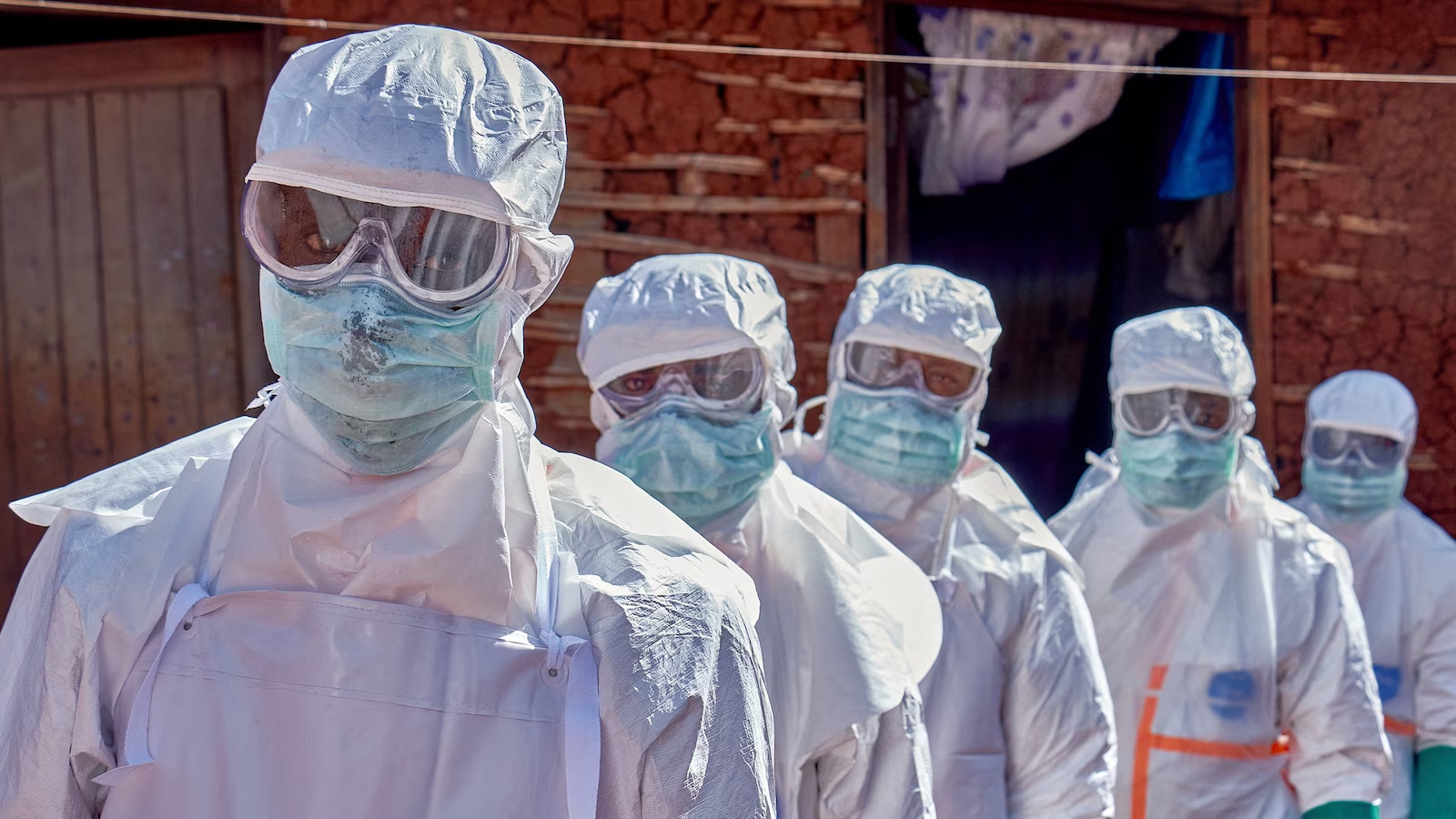
Red Cross workers wearing personal protective equipment stand in a formation to disinfect themselves after handling the body in Mongbwalu, Djugu Territory of Ituri province, Democratic Republic of Congo, May 24, 2026.
Gradel Muyisa Mumbere/Reuters
While delivering remarks during Wednesday’s Cabinet meeting, Rubio did not comment on the plan to set up a facility in Kenya but emphasized the administration is working to ensure the outbreak is “being contained.”
“The State Department and other agencies represented here, the Centers for Disease Control, HHS, others are working very, very hard to contain this crisis to the countries where it’s currently located, particularly the Democratic Republic of the Congo,” he said. “And so, we’ve searched assistance to make sure that that that is being contained there.”
Rubio also stressed what he said was the administration’s commitment to containing Ebola, saying that “the number-one priority of our foreign policy is to protect the American people.”
“We cannot and will not allow any cases of Ebola to enter the United States,” Rubio said, adding that “multiple agencies” were involved in “tracking people just to make sure that nobody comes into this country that has Ebola and creates a problem for us, and we feel like we’ve got good efforts in place to do that.”
The administration previously invoked its authority under Title 42, barring travel to the U.S. for non-citizens, with specific exceptions, who have visited the DRC, Uganda, or South Sudan within the last 21 days. The order was expanded last week to include U.S. green card holders.
American citizens who have visited those countries are being directed to specific U.S. airports for additional health screening, including Dulles International Airport, John F. Kennedy International Airport in New York, Hartsfield-Jackson Atlanta International Airport, and George Bush Intercontinental Airport in Houston.
The news comes as New York-based International Rescue Committee (IRC) aid organization warned on Tuesday that the ongoing Ebola outbreak in the DRC and neighboring Uganda is now spreading faster than responders can contain it and risks becoming “the deadliest on record” without urgent international action.
“The outbreak is spreading faster than the response, with over 900 suspected cases and at least 223 deaths already reported across DRC and Uganda, including in major transport hubs like Goma and Kampala,” the IRC wrote.