
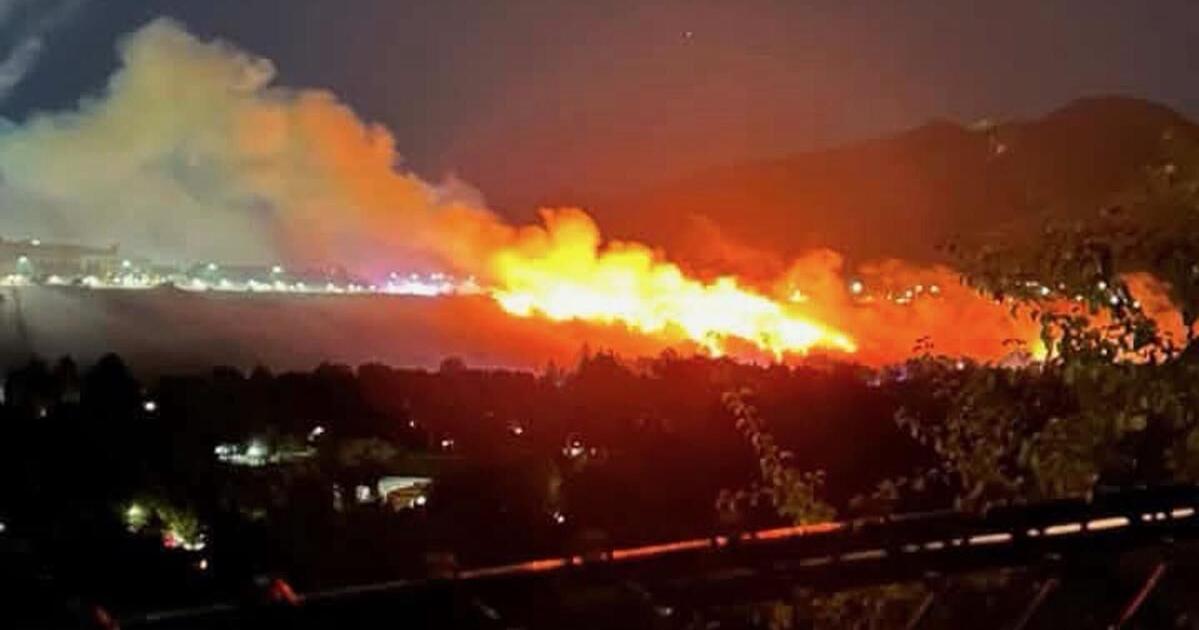
Utah entered 2026 with heightened concerns about the wildfire season, given the record-low snowpack. Those concerns materialized as wildfires burned across Utah, affecting nearly every corner of the state. The 2026 wildfire season might be better described as a wildfire year. For example, on January 22, the Beaver Canyon Fire started near Strawberry Reservoir in Wasatch County. At that time of year, the area should have been under several feet of snow.
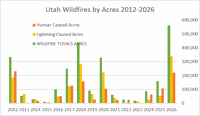
This is how 2026 stacked up against recent fire history in Utah:
-
More than half a million acres have burned in Utah in 2026, making it the state’s most severe fire season since 2007, when 629,212 acres burned. The next-highest total in recent history was 438,983 acres in 2018 (see Utah Wildfires by Acres 2012-2026 chart below).
-
This summer, Utah experienced several megafires, three of which made the list of the top 10 Utah wildfires since 2002 (see Largest Wildfires in Utah from 2002-2026 table below). These include:
#3 Widemouth 2 Fire – 129,741 acres burned on the Fishlake National Forest.
#5 Babylon Fire – 107,189 acres burned on the Manti-La Sal National Forest.
#7 Cottonwood Fire – 97,464 acres burned on the Fishlake National Forest. - This year’s fire season saw a shift toward larger fires at mid-to-higher elevations, particularly in timbered areas, rather than in lower-elevation rangelands where larger fires historically were more common.
- In Utah, 2005-2007 were major fire seasons, but these larger fires generally occurred on rangelands and Bureau of Land Management lands. Since the Brianhead Fire in 2017, most large fires have occurred in timber fuels on U.S. Forest Service lands.
-
Over the past 10 years, 41% of Utah wildfires were caused by lightning. Although the fire season is not over, 54% of our fires were lightning-caused, according to data from the Great Basin Coordination Center. As the monsoonal season slows and we transition into autumn, lightning generally decreases, but human-caused ignitions can increase.
- Several tragic incidents occurred during the 2026 fire season. On June 27th, five wildland firefighters from the Rifle Helitack crew were attacking the Knowles and Gore fires near the Utah-Colorado border when they were overtaken by extreme fire behavior linked to the Snyder and Jones fires, which had started eight miles away in Utah. Four firefighters died in the burnover. The last wildland firefighter fatality in Utah occurred in 2006, when Spencer Koyle was overrun by fire on the Devil’s Den Fire in Millard County. On August 7th, two pilots were killed on the Widemouth 2 Fire when their Skycrane helicopter crashed. Prior to this fire season, the last pilot fatalities on a Utah wildfire occurred in 2012, when air tanker pilots Todd Tompkins and Ron Chambless died fighting the White Rock Fire.
- Beyond these tragic fatalities, wildfires also caused extensive structural damage. Two-hundred and six structures have been documented as destroyed across six wildfires, including homes, cabins, and a major ski resort. In the Cottonwood Fire alone, 185 structures were destroyed, and the Eagle Point Ski Resort sustained significant structural damage. In 2018, the Dollar Ridge Fire destroyed or damaged 80 homes and nearly 400 trailers, sheds, and vehicles.
- The impacts of a wildfire often extend well beyond the flames. Post-fire flooding occurred in areas affected by the Cottonwood Fire near Beaver, and Pine Valley continued to flood after last year’s Forsyth Fire. In some burned areas, high-severity wildfires can damage soils, and recovery can take several years. Grazing impacts are also expected to be significant for the ranching community, with an estimated 11,575 cattle and 10,851 sheep affected over the next two years, as burned grazing allotments must be rested to allow vegetation to recover.
- With monsoonal moisture arriving from late August through early September, fire activity is expected to decline before winter snow arrives. Although wildfire activity and human-caused ignitions typically increase during hunting season, additional large fires are not anticipated this fall. The Great Basin Coordination Center’s Predictive Services Significant Wildland Fire Potential Outlook forecasts normal fire potential for the rest of the year. However, weather conditions can still influence late-season wildfire activity. A few Red Flag Warning days could elevate fire risk, while early snowfall could further reduce fire potential heading into winter.
Several factors contributed to increased wildfire activity this summer, including climate-related reductions in snowpack, ongoing drought, the exclusion of wildland fire (which has allowed fuels to accumulate), and continued population growth in the wildland-urban interface. Together, these factors increased wildfire impacts on ecosystems that evolved with fire.
Looking ahead, a strengthening El Niño pattern – described by some forecasters as a “Super El Niño” – is expected to increase snowpack in southern Utah and potentially statewide, helping reduce drought conditions. While improved moisture may reduce some wildfire risk, accumulated fuels, such as dead and downed trees and branches, and continued development in and near wildlands will remain significant factors shaping future fire seasons.
Our recent fire season underscores the need to build resilient landscapes, develop fire-adapted communities, and support safe, effective wildfire response.
This fall, USU Extension and the Gateway & Natural Amenity Region Initiative will host an online learning series,“Wildfire Ready Utah.” USU Extension experts developed the five-part webinar series, focused on community resiliency, for property owners in the wildland/urban interface, local elected officials and staff, and fire and emergency response personnel.
For further information, contact Brad Washa, USU Extension assistant professor of wildland fire science, Brad.Washa@usu.edu.
|
Largest Wildfires in Utah from 2002-2026 |
|||
|
Fire Name |
Year |
Acres |
|
|
1 |
Millford Flat |
2007 |
363,052 |
|
2 |
Goose Creek Fire* |
2018 |
132,220 |
|
3 |
Widemouth 2 |
2026 |
129,741 |
|
4 |
Clay Springs |
2007 |
107,847 |
|
5 |
Babylon |
2026 |
107,189 |
|
6 |
Pole Creek |
2018 |
102,191 |
|
7 |
Cottonwood |
2026 |
97,464 |
|
8 |
Rattle Complex |
2002 |
95,000 |
|
9 |
East Fork |
2020 |
89,765 |
|
10 |
Diamond Creek |
2002 |
88,400 |
* The majority of acres burned on Goose Creek Fire were in Nevada