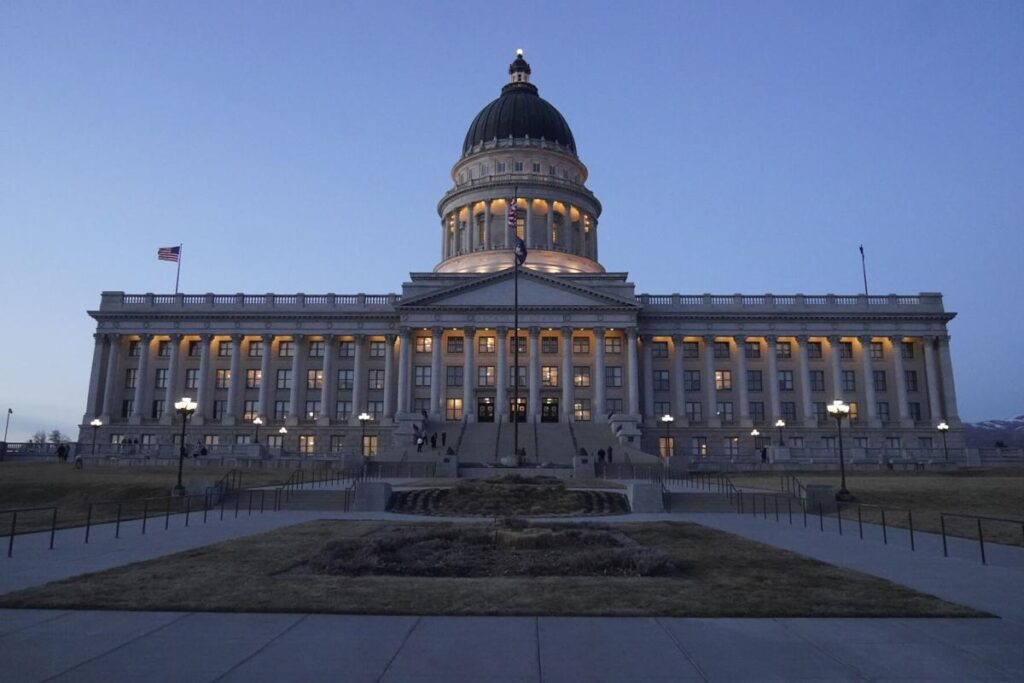
In what Democrats have labeled as a ‘cynical political game,’ Utah lawmakers are offering to eliminate the sales tax on food in exchange for the removal of a constitutional earmark funding public education (AP Photo/Rick Bowmer)
SALT LAKE CITY – Buried in the Legislature’s final week of proceedings are two landmark proposals likely to pass in the general session’s final moments.
Republicans call those measures a simple “tit for tat” tradeoff.
Utah Democrats condemn them as a sneaky bait and switch gambit.
“Throughout the past year,” says Sen. Scott Sandall (R-Dist. 1), “Utahns have informed lawmakers that removing the sales tax on food is a priority.
“In response, the Legislature is currently considering House Bill 101 Food Sales Tax Amendments, which removes the state portion of sales tax on food. That’s contingent, however, on removing the constitutional earmark for income tax revenue, as laid out in Senate Joint Resolution 10 (Proposal to Amend Utah Constitution – Income Tax).”
If the Legislature passes H.B. 101 and voters approve that change during the 2024 general election, Sandall explains, eliminating the state sales tax on food would result in a $200 million total tax reduction.
But those measures would also leave the Legislature free to raid the state’s education budget, according to Diane Lewis, chair of the Utah Democratic Party.
For years, Lewis says, Utahns of all political beliefs and backgrounds have strongly advocated for the removal of the state tax on food. But GOP leaders have ignored them and buried all attempts to make that happen.
“Now they’ve found a way to use this important issue as a political pawn,” she adds. “The Republican leadership (in the Legislature) has fast-tracked removal of the food tax on the monumental condition that voters in 2024 must approve a proposal to remove the constitutional earmark on the income tax.”
The constitution earmark allocating state income tax revenues strictly to fund public education has long been a thorn in the sides of lawmakers.
They began to chip at that mandate more than 25 years ago, however.
In 1996, voters approved expanding the constitutional earmark to include higher education as well. In 2020, they also approved expanding that mandate to include funding for programs for children and disabled persons.
Now lawmakers have proposed a deal to voters that would entirely eliminate that earmark in exchange for elimination of the hated tax on food.
It’s a simple matter of balancing the state budget, according to Senate Majority Whip Ann Millner (R-Dist. 5).
Which is no simple process.
“Over the past few years,” she explains, “we have made historic investments in education, showing our commitment to Utah students and the education community.
“Under the current budget structure, the sales tax on food helps to fund all state needs, including Medicare, homeless programs, public safety, courts, parks and other functions.”
To continue funding these needed programs without the sales tax on food, Millner says, lawmakers will need to restructure the budget.
Naturally, the proposed change is opposed members of the Utah Education Association and Democrats in general.
“Utahns are sick and tired of their legislators playing cynical political games when it comes to critical issues facing our state,” Lewis argues.
“First Republicans handcuffed crucial pay raises for our teachers to a harmful voucher program.
“Now they’re holding the removal of the food tax hostage unless voters give in to their demands” she charges.
The House defeated a Democrat-sponsored amendment to HB 101 that would have severed the food tax repeal from the constitutional amendment, an attempt that House Majority Leader Mike Schultz (R-Hooper) labeled as fiscally irresponsible.
Utah is the only state in the union that has a constitutional earmark guaranteeing education funding, observes President Rusty Canon Utah of the Taxpayer Association.
Cannon believes that the mandate has held Utah back and that it’s time for a change.