
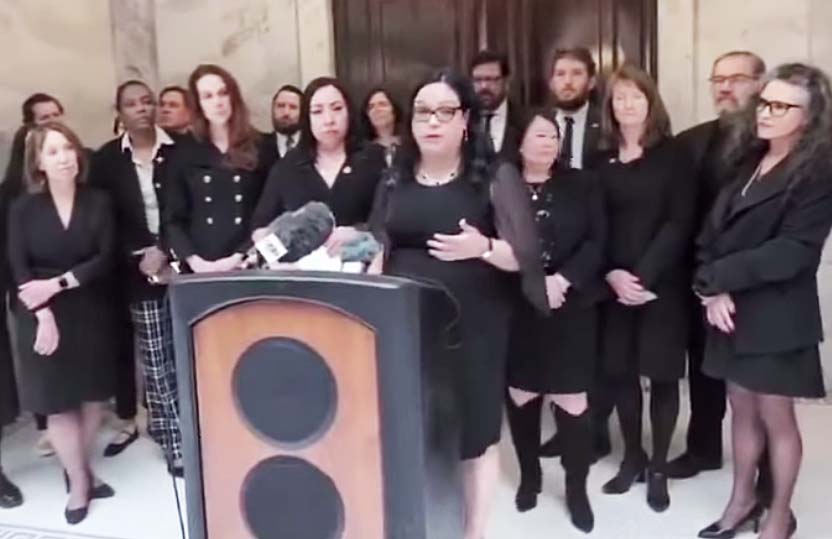
Democrats in the Utah Legislature wore black on Jan. 30 to mourn the passage of House Bills 261 and 257, which were later enacted by Utah Gov. Spencer Cox (Image courtesy of Facebook).
SALT LAKE CITY – Utah Democrats have renewed their criticism of Gov. Spencer Cox, condemning what they term the governor’s shift of support to the right-wing of the Utah GOP.
“While Gov. Cox might think that it’s no big deal to throw vulnerable Utahns under the bus to secure his party’s nomination (in the upcoming 2024 general election),” according to Utah Democratic Party chair Diane Lewis, “there are real consequences to these ‘culture wars’ and real impact that will be felt by communities of color and the LGBTQ community.”
Lewis’ blistering prepared statement came after Cox signed six bills from the 2024 general session of the Legislature into law on Jan. 30, including House Bills 261 (Equal Opportunity Initiatives) and 257 (Sex-based Designation for Privacy, Anti-bullying and Women’s Opportunities).
“We firmly believe that Utah is strong because of our diversity,” Cox told reporters after enacting those new laws, along with base budget bills for Higher Education (Senate Bill 1), Business, Economic and Labor Development (Senate Bill 4), Infrastructure and General Government (Senate Bill 6) and the National Guard, Veteran Affairs and Legislature (Senate Bill 7).
“We remain committed to keep our state a place where everyone can thrive,” he added. “Over the past three years, our administration has worked very intentionally with many community stakeholders to expand opportunities for all Utahns and we will continue to do so.”
But Lewis countered that HB 261 bans diversity, equity and inclusion programs from public institutions and HB 257 restricts transgender Utahns from using bathrooms in public facilities that are not in line with their chosen gender identify.
“Spencer Cox rushing to make these divisive bills some of the first that he signs this year is a perfect demonstration of the kind of governor he has become,” she charged. “Rather than placing common sense and good public policy over red meat culture wars, he has completely caved to the right wing of the Republican Party in an effort to keep his political career alive.”
But Cox defended the work of Utah lawmakers, saying that HB 257 ensures public facilities that are “… safe and accommodating for everyone.”
“We’ve been concerned about some DEI (Diversity, Equity and Inclusion) programs and policies,” he said referring to HB 261, “particularly with hiring practices. This bill offers a balanced solution.
“I’m grateful to the Legislature for not following the lead of other states that simply eliminated DEI funding with no alternative path for students who may be struggling. Instead, this funding will now be repurposed to help all Utah students succeed regardless of their backgrounds.”
But Lewis said that Cox signing those controversial bills amounts to nothing less than a complete political about-face.
In January of 2021, the newly elected governor joined other Republican leaders in signing the Utah Compact on Racial Equality, Diversity and Inclusion, which promised to advance solutions to racial ills by creating policies that provided equal access to education, employment, housing and healthcare.
In 2022, Cox also vetoed a ban on transgender youth participating in school sports.
But 2024 is an election year, Lewis emphasizes. Cox now faces eight competitors vying to replace him as governor. That potential opposition not only includes Democrat Brian Smith King and three third-party candidates, but also four more conservative members of Cox’s own party.
Lewis said that the governor’s pivot comes as he has faced mounting criticism from Republican activists.
“We deserve a governor who will work for the betterment of all Utahns,” Lewis’s statement concluded. “That’s why we’re working to defeat Spencer Cox and elect Brian King in November.”