
LUCIN — At the western edge of Box Elder County, where sagebrush stretches toward the horizon and the Nevada state line is less than eight miles away, the remnants of a railroad town called Lucin remain.
Today, there is little left of the town that once served as an important stop for the railroad. There are no busy streets, downtown shops or rows of houses. Instead, there are bugs, songbirds, sagebrush, antelope, rodents and one resident who has chosen to make the remote desert his home.
That resident is Ivo Zdarsky.
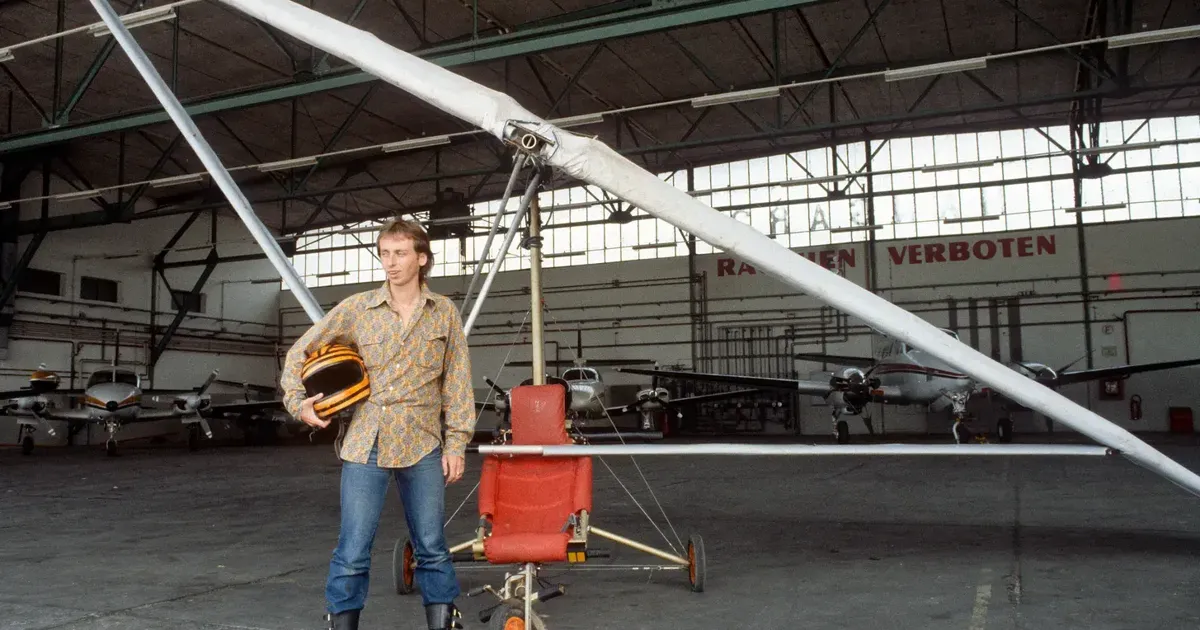
Zdarsky was born in Czechoslovakia and became known for an extraordinary escape from communist rule. His passion for aviation and invention eventually helped him leave the Iron Curtain behind.
The communist government frowned upon people building unauthorized flying machines, but Zdarsky continued to experiment. He built and crashed his first motorized hang glider before continuing to improve his designs.
In 1984, at age 24, he climbed into a three-wheeled flying machine he had built himself. Under the cover of darkness, he flew from communist Czechoslovakia to Vienna, Austria.
Zdarsky said he flew low over rooftops to avoid detection before landing safely at Vienna International Airport and seeking asylum.
“I sold my motorized contraption to a museum that wanted it for a display of how people escaped communism,” Zdarsky said.
He eventually moved to California, where his interest in aviation and invention continued.
While there, he developed the Ivoprop, a carbon-fiber propeller, and later started a manufacturing company to produce the propellers.
In Czechoslovakia, Zdarsky had lived behind the Iron Curtain. In California, he was surrounded by people, vehicles and buildings.
Eventually, he traded the busy surroundings of California for one of the most isolated places in Utah.
In Lucin, he can step outside his door and look across the seemingly endless Bonneville Desert without seeing a building or anything else blocking his view.
Lucin was founded by the Central Pacific Railroad around 1869 as a watering stop for locomotives. Water was piped in from nearby mountains to supply the steam engines traveling across the desert.
The railroad community later moved about 10 miles south when the Lucin Cutoff was constructed in the early 1900s. The cutoff included a trestle across the Great Salt Lake and allowed trains traveling between Ogden and Lucin to bypass Promontory Point, where the Golden Spike had been driven in 1869.
The new route saved hours of travel time.
More than a century later, Lucin has a very different claim to fame.
Zdarsky lives on a former World War II-era aerodrome, surrounded by hundreds of acres of open desert.
There are several stories about the airstrip’s history, Zdarsky said. One rumor claims it was used in secret during the last stages of World War II.
“There are several rumors about the airport,” Zdarsky said. “It was a secret landing strip for B-52s during the war. They would land there to set up formations when they were developing the bomb.”
Zdarsky said another story claims people were flown to the airstrip and then transported to Wendover, Nevada, where the atomic bomb was developed and tested.
“There is probably some truth to both of those rumors,” he said.
The airstrip is about 500 feet wide, which Zdarsky said is large enough to accommodate a B-52.
In 2006, Zdarsky purchased 400 acres and the airstrip. He had a large building constructed on the property, with half of the 100-by-50-foot airplane hangar converted into his living quarters.
“I bought 400 acres and the airstrip in 2006 and had them build the building,” he said. “Where was I supposed to live, in a cave?”
He moved to Lucin in 2007.
Some people have nicknames for the place he calls home, but Zdarsky has another name for it.
“Some people call my living area a man cave,” he said. “I like the word compound better.”
The other half of the hangar serves as a storage area for his camouflage-painted Cessna 172 Skyhawk, along with his vehicles and other equipment.
For Zdarsky, the airplane is more than something to admire. It is his transportation to civilization.
Brigham City is about two hours away by car, but Zdarsky can fly to Ogden in about 45 minutes. He also has an old 1990s Chevrolet Caprice station wagon and a Tesla Cybertruck for traveling the desert.
The road leading to his fenced property is marked with “Keep Out” signs and an alarm system alerts him when an unwanted vehicle enters the compound.
For someone who grew up living in crowded places, the isolation is part of the appeal.
“I like it here,” he said. “It has nice landscape, and there are some old mines and caves I like to explore.”
His vehicles give him a way to explore the desert, but Zdarsky said his Cybertruck has become his preferred choice.
“I used to take my Caprice station wagon,” he said. “Then I got a Cybertruck. The Cybertruck is much better for exploring.”
Inside the hangar, his living quarters are organized, clean and neat — a sharp contrast to the rugged desert outside.
When he is not exploring the Bonneville Desert, Zdarsky spends his time tinkering with his airplane, helicopter and other inventions.
For most people, Lucin is a place they pass through or is simply a name on a map, a remnant of Utah’s railroad history. But for Zdarsky, it’s home.