
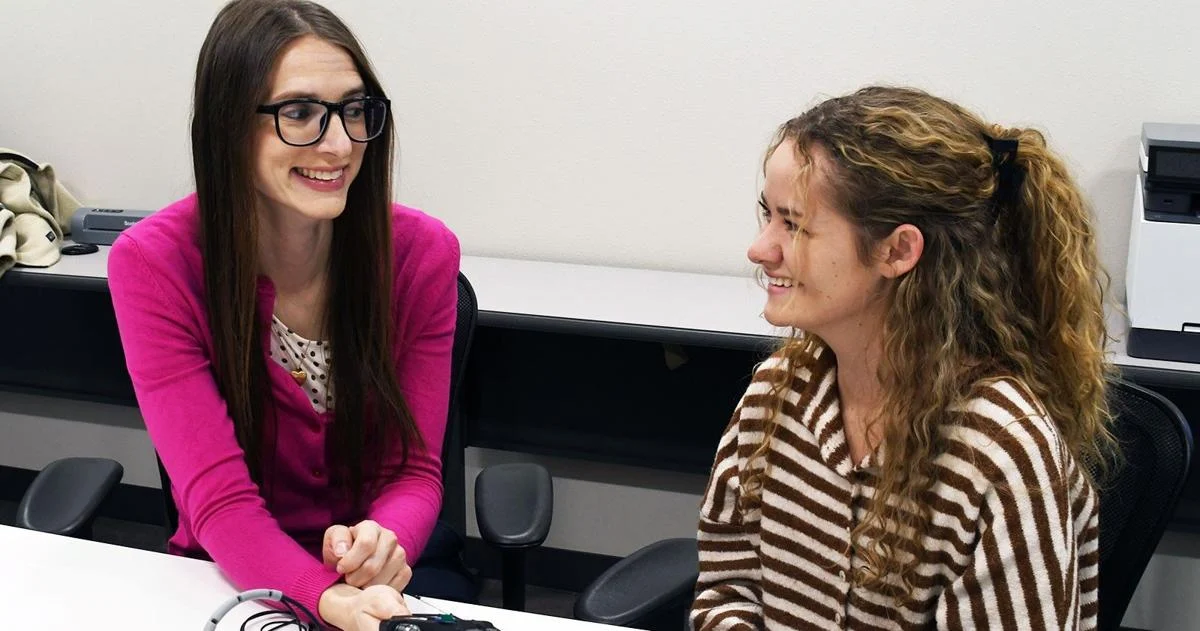
LOGAN – From her office in the Lillywhite building at Utah State University new assistant professor Camille Wynn directs work focused on helping people connect: she studies how autistic and neurotypical teenagers communicate, with the goal of making conversations easier and more meaningful for everyone involved.
A Utah native, she graduated from USU where she earned her undergraduate, master’s and doctoral degrees. After spending three years as an assistant professor at the University of Houston, she returned to USU to join the Department of Speech and Hearing Sciences in the Emma Eccles Jones College of Education and Human Services.
Wynn’s research is supported by a grant from the National Institute on Deafness and Other Communication Disorders, part of the National Institutes of Health. Her project examines how teenagers coordinate their speech during conversations and what factors make conversations successful between autistic and neurotypical peers. She works alongside co-investigator Alan Wisler, an assistant professor of mathematics and statistics at USU, and consultant Audra Sterling from the University of Wisconsin–Madison.
“There’s a stereotype that autistic people are poor communicators,” Wynn said. “But research shows that autistic people often have very successful conversations, especially with other autistic individuals. If we understand what makes conversations work for different people, we can help bridge communication gaps.”
Wynn’s interest in this work began while she was part of the Autism Support Services: Education, Research and Training (ASSERT) program at USU. During that time, she worked with Stephanie Borrie, a professor of speech-language pathology, whose research on communication disorders inspired Wynn to apply similar ideas to autistic children and teens.
Wynn says the most meaningful part of her work comes from the people involved. Parents often share that they participate because they’ve seen their children struggle with loneliness and hope this research can help others in the future.
One moment stands out to Wynn: two autistic teens who quickly connected during a study session and exchanged phone numbers afterward. “That’s my goal,” she said. “Helping people connect and creating moments like that.”
Families with children ages 9–17 who are interested in participating in the study are encouraged to contact Wynn directly.