
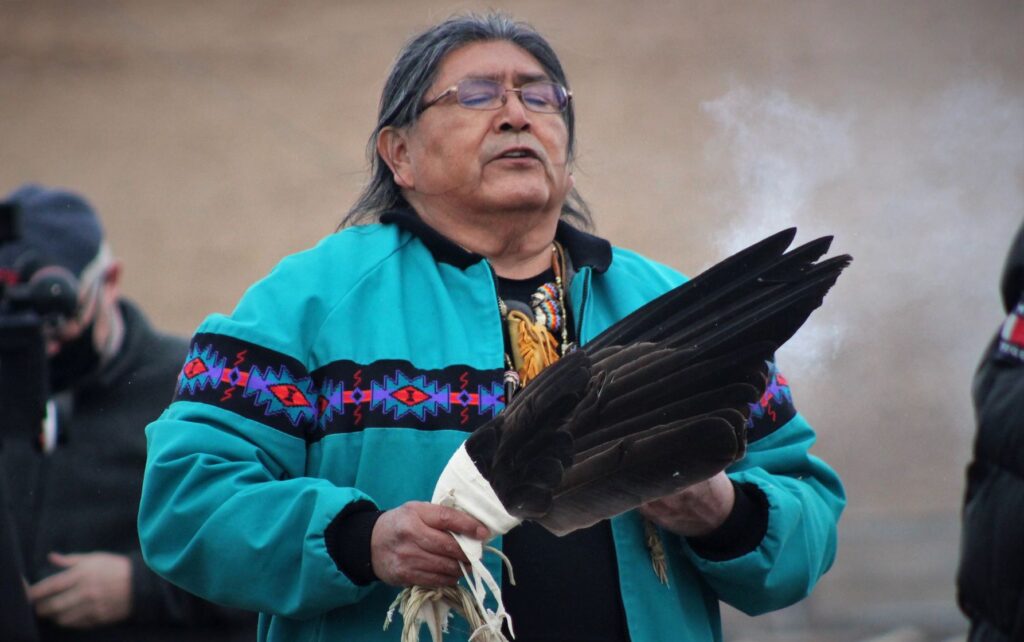
Rios Pacheco the tribes spiritual leader give the invocation holding an eagle wing and standing with his back to the audience facing the East as is customary for Shoshone prayers and blessings.
PRESTON – Despite a political climate of adversarial relationships between political parties, Darren Parry invited U.S. Representative Blake Moore – who ran against him for Utah’s 1st Congressional District – to speak at the ceremony commemorating the 158th anniversary of the Bear River Massacre.

Unlike the memorials in the past held on Highway 91 near the Daughters of the Utah Pioneer memorial site, this one was held on Hot Springs Road on a bluff near where the future $6 million interpretive center will be built. The number of people invited were down this year due to the pandemic.
Though political opponents for Rob Bishop’s seat in Utah’s 1st Congressional District, Moore praised Parry and took quotes from Parry’s recently published book during his part of the memorial ceremony.
Parry recently published a book, The Bear River Massacre: Shoshone History, about the events that happened over a century and a half ago. He gave the book to Moore.
“I told Darren I would read his book and I did,” Moore said. “When I finished his book I called him and asked him if there was an event connected to the anniversary of the massacre.”

The memorial was held Friday, overlooking the ground of the single greatest massacre of Indian lives in American history. On the cold morning of January 29, 1863, Col. Patrick Edward Conner and some 200 well-armed California volunteers attacked the winter camp of the Northwest Shoshone in the area north of Preston along the Bear River.
“I can’t change history,” Moore quoted. “I don’t want to change history, but I can change the future and so can you.”
Moore said being at the site in the winter clarified the part in the book about the massacre.
“It was really devastating and tragic,” Moore said. “Being there on that spot and it wasn’t as cold as it was then, but it was still cold. It became more real.”
Between 250 and 500 Shoshone men, women and children were killed and left there where they died. Their tepees were burned, supplies and horses were taken.
The politicians connected in each of their primaries and had mutual friends, so Moore reached out to him after both won their primaries.
Parry said they have become good friends.
“As I got to know him, I decided we are going to have differences of opinion, but unlike what is going on in Washington we could be good friends,” Parry said.
“I was at Washaki cemetery, he came and we planted trees for the people that were buried there.”

“Blake said he would come to the ceremony and I thought ‘he was too busy in Washington as a freshman congressman; he is going to be busy, there is no way’,” Parry said. “I was happy to see him at the ceremony.”
Rios Pacheco, the tribe’s spiritual leader, gave the invocation with his back to the audience.
“We always stand up for all blessings and prayers and face the East,” Parry said. “He was following the way Shoshone people are supposed to pray.”
Gwen Davis, a council woman of the tribe, gave an historical perspective of the Shoshone people and Alicia Martinez read some 60 tribal names who were killed at the massacre.
“The names were found in the Logan Temple. A former tribal chief Sagwitch performed their temple work,” Parry said. “He recorded them on a temple ledger.”

Michael Gross sang a song written about the tribe and the massacre. The Tribal council wanted Brian Parry, Darren’s uncle to speak.
Dennis Alex, from the Pocatello tribe, is the new chairman. He is a retired tribal police officer in Minnesota, and he grew up at Washaki.
“I thought the ceremony went really well,” Parry said. “This year they also unveiled a new plaque at the Daughters of the Utah Pioneers marker. They asked me to dedicate it; that was really special.”