
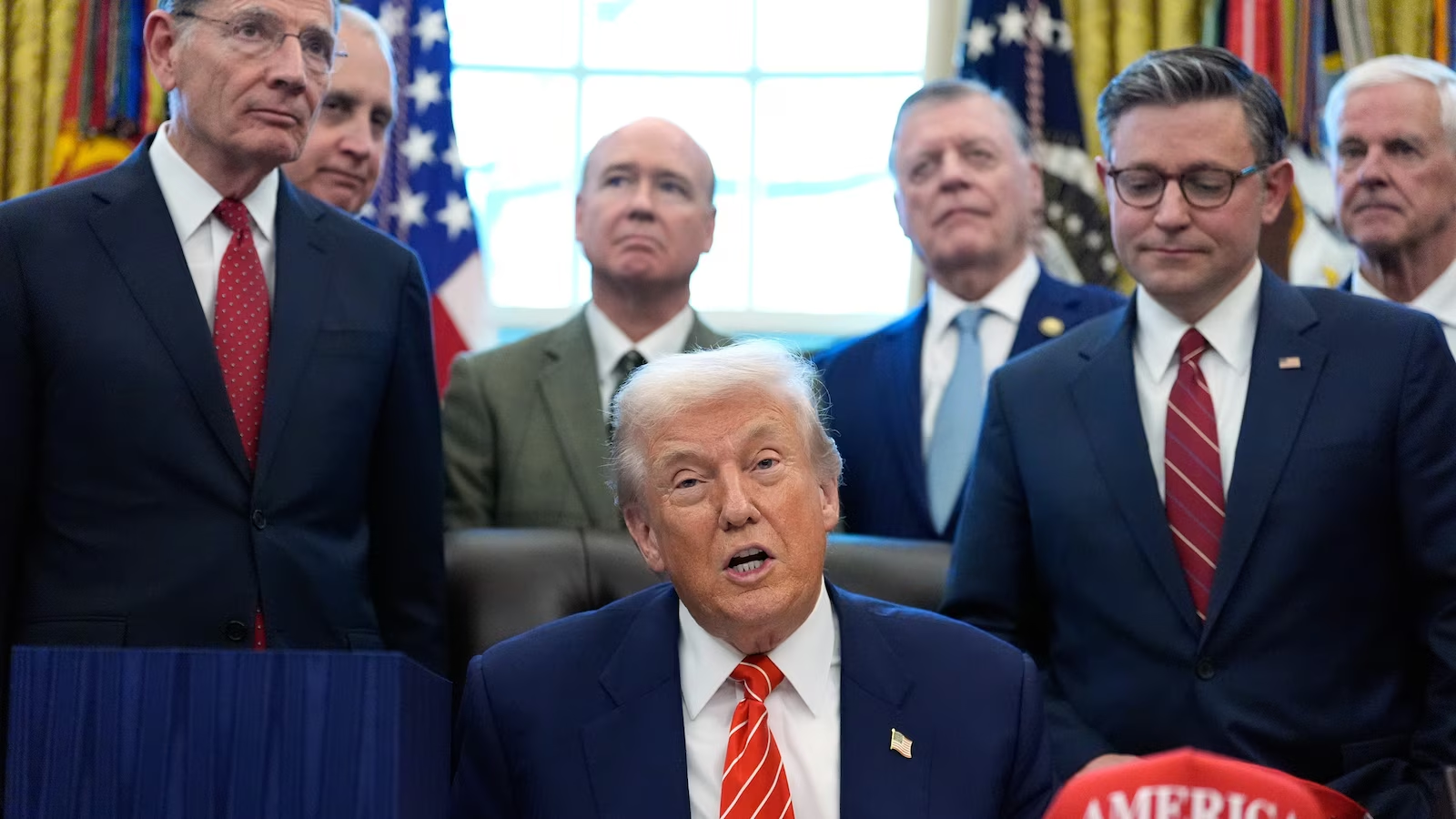
President Donald Trump on Tuesday doubled down on his controversial suggestion that Republicans “nationalize” elections as he continued to make false claims of widespread voter fraud and refused to accept his 2020 defeat.
“If a state can’t run an election, I think the people behind me should do something about it,” Trump said as he held a bill signing in the Oval Office surrounded by Republican lawmakers. “Because, you know, if you think about it, the state is an agent for the federal government in elections. I don’t know why the federal government doesn’t do ’em anyway.”
Trump added that, in some cases, “The federal government should get involved. These are agents of the federal government to count the votes. If they can’t count the votes legally and honestly, then somebody else should take it over.”

President Donald Trump speaks in the Oval Office of the White House, Tuesday, Feb. 3, 2026, in Washington, before signing a spending bill that will end a partial shutdown of the federal government.
Alex Brandon/AP
He repeated unfounded claims about the 2020 election, listing Detroit, Philadelphia, and Atlanta after raising what he alleged to be “rigged, crooked elections.”
The Constitution gives states the authority to run and administer federal elections, subject to laws passed by Congress.
The White House earlier Tuesday had sought to soften Trump’s similar comments from Monday — after Republican congressional leaders poured cold water on his idea.
Democrats, too, quickly blasted his remarks, with Senate Minority Leader Chuck Schumer likening them to that of a dictator.
White House press secretary Karoline Leavitt on Tuesday told reporters that Trump still supports states’ constitutional authority to administer elections and that he was referring to the SAVE Act when he advocated for nationalizing elections.
“I don’t think any rational person who’s being honest with themselves would disagree with the idea of requiring citizens of this country to present an ID before casting a ballot in a federal election, or, frankly, in any election, and that’s something the president wants to see happen,” Leavitt said.
“The president believes in the United States Constitution, however, he believes there has obviously been a lot of fraud and irregularities that have taken place in American elections,” she said.
On Tuesday, when a reporter reminded him that the Constitution dictates states should administer elections, Trump responded, “You know what, they can administer the election, but they have to do it honestly.”
The Trump administration’s sought to make several changes ahead of the 2026 midterms, including mid-decade redistricting in order to gain additional House seats and pressing at least 24 states to turn over voter data.

White House Press Secretary Karoline Leavitt speaks to the members of the media outside the White House in Washington, February 3, 2026.
Evelyn Hockstein/Reuters
The GOP’s SAVE Act would require states to obtain proof of citizenship before registering a person to vote for a federal election. Schumer has said the bill is a nonstarter in the Senate, where it would need 60 votes to advance over a Democratic filibuster.
Noncitizens are already prohibited from voting in federal and state elections, though some cities and localities allow noncitizens to vote in some local elections.
Trump’s alleged undocumented immigrants have improperly influenced elections, but experts insist such instances are incredibly rare, and voter roll audits leading up to the 2024 election uncovered very few instances of noncitizen voting.
Several Republican hard-liners in the House wanted to tie the SAVE Act to the government funding package that passed on Tuesday, but ultimately did not tie up the legislation.
House Speaker Mike Johnson, who was in the Oval Office with Trump on Tuesday afternoon, called the bill a “top priority” earlier in the day.
“The president is expressing his frustration about the problems that we have in some of these blue states, where election integrity is not always guaranteed,” Johnson said at a news conference. “We have to figure out solutions to that problem.”
When pressed whether that means a federal takeover is warranted, Johnson replied, “No, no, no.”

Speaker of the House Mike Johnson, speaks during a press conference with members of the House Republican leadership at the U.S. Capitol February 3, 2026 in Washington.
Win McNamee/Getty Images
Senate Majority Leader John Thune, when earlier Tuesday asked about Trump’s comments about nationalizing voting, also pointed to the SAVE Act.
“I think the president has clarified what he meant by that, and that is that he supports the SAVE Act. So with respect to whether or not that signifies ensuring that only citizens of this country vote in our elections, that’s something I think we all agree with,” Thune said during his weekly leadership press conference.
“There are other other views, probably when it comes to nationalizing and federalizing elections, but I think on, at least on that narrow issue, which is what the SAVE Act get that — I think that’s what the president was addressing,” Thune added.
Thune vowed to put the SAVE Act on the floor for a vote while throwing cold water on ending the filibuster to pass the legislation — something Trump has advocated for.