
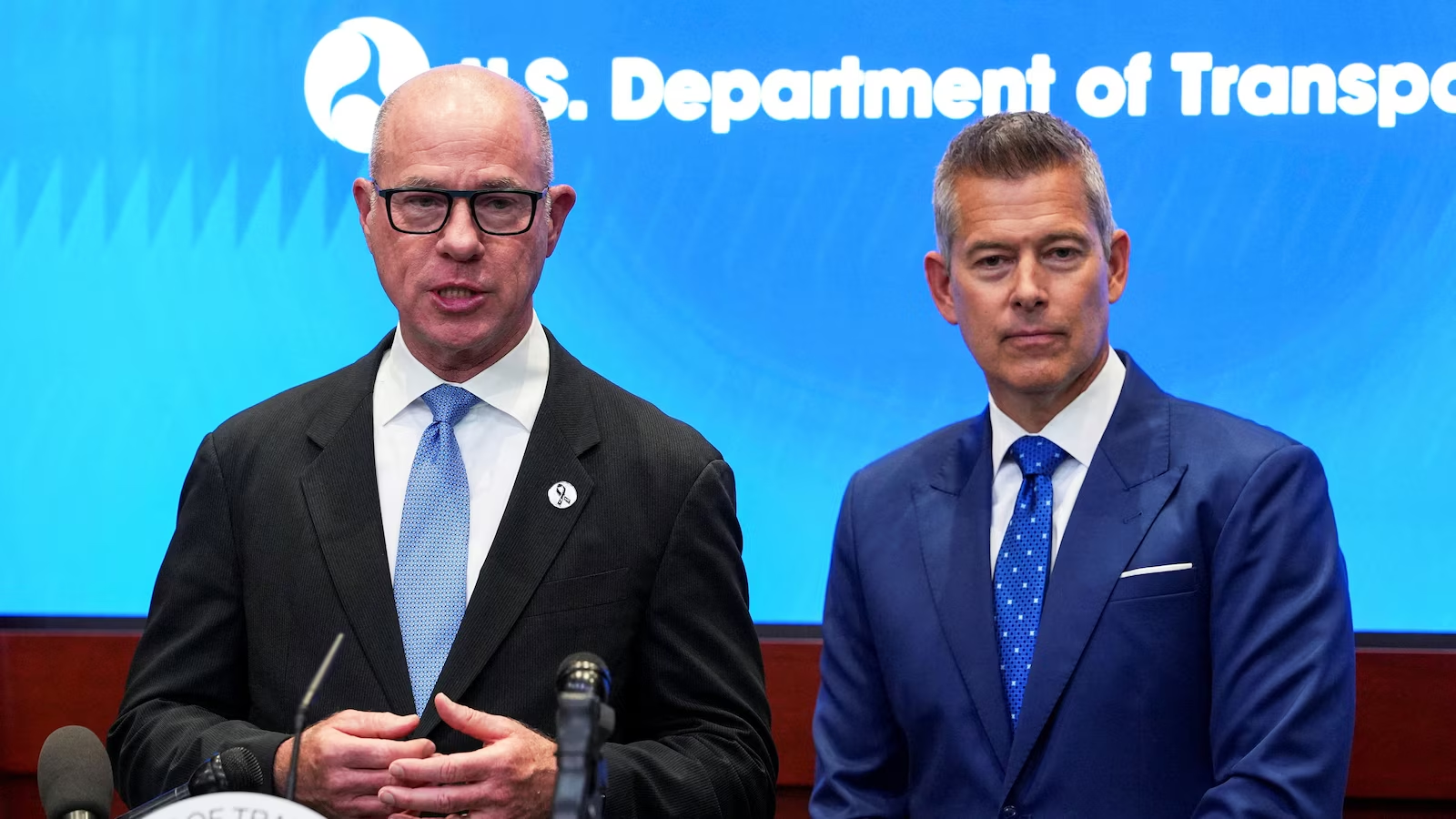
Democrats on the Senate Commerce Committee sent a letter to Transportation Secretary Sean Duffy and Federal Aviation Administration’s Bryan Bedford on Tuesday demanding an explanation for Friday’s nationwide ground stop and calling for briefings before there are additional changes to the air traffic control system.
It comes the same day the Department of Transportation has officially submitted its $50.1 billion budget funding request — a marked increase — to fix a system Duffy and President Donald Trump say is broken. The budget breakdown includes more than $10 billion for the completion of a reliable digital architecture, more than $10 billion to overhaul outdated airport infrastructure, $10 billion to build five new air traffic control centers and another $10 billion to build and improve up to 140 air traffic control towers.
Duffy has said the $50 billion funding ask, which is in addition to the $12.5 billion that was appropriated by Congress, is needed to fix the issues that led to the ground stop.
“This is an emergency,” he told reporters Friday night. “I want Congress to give us emergency funding. This is bipartisan. This is American. I want $50 billion.”
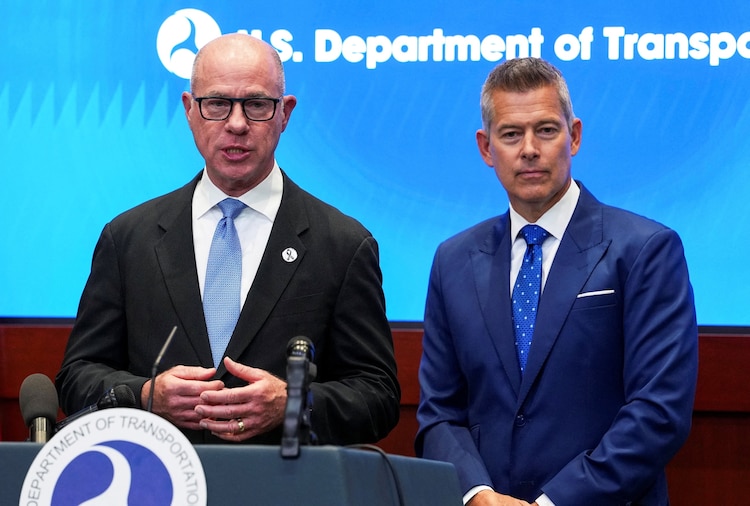
Administrator of the US Federal Aviation Administration (FAA) Bryan Bedford speaks, as US Secretary of Transportation Sean Duffy listens during a press conference after the FAA issued a national ground stop yesterday, at the Department of Transportation in Washington, D.C., on Nov. 14, 2026.
Eric Lee/Reuters
In their letter, Democrats said that Friday’s ground stop “disrupted air travel across the country, eroded public trust in our aviation system, and raised serious questions” about the FAA and its ability to ensure reliable operations.
“Congress expects clear, fact-based answers about the root cause of this disruption and why existing safeguards failed to prevent it,” the 13 Democrats on the committee wrote in the letter.
The senators addressed Duffy’s funding request — noting that the increase from $30 billion to $50 billion following Friday’s ground stop “is notably $20 billion more than the request from DOT and the Office of Management and Budget (OMB) that was sent on Thursday, November 12.”
“DOT, FAA and OMB must provide Congress with a complete account of what happened and how additional funding would address the vulnerabilities presented on November 13,” the senators wrote.
Ahead of a meeting with Duffy on Tuesday, Republican Sen. Thom Tillis said the funding request needs to be detailed.
“If you want $30 billion or $50 billion, you better damn sure have a long list of initiatives and planning that went into it versus ‘give me a number and I’ll figure out how to spend it.’”
GOP Sen. John Cornyn said when it comes to FAA funding, he would like to know “what they have, why they haven’t spent it and why they need more.”
The Democratic senators also raised questions about devices from Juniper — the company that manufactured the routers believed to be central to the ground stop — as well as L3 Harris, a government contractor that provides technology and IT support for the FAA and that worked with Hewlett Packard Enterprise and Juniper to install the routers.
The ground stop happened because of a telecommunications issue, both Duffy and Homeland Security Secretary Markwayne Mullin said on Friday; FAA Administrator Bedford added that it was the result of faulty equipment.
Duffy told ABC’s “This Week” Sunday that work was being done to replace outdated copper wire with fiber cables in El Dorado, Arkansas, when the router communication believed to have caused the ground stop occurred. When the router in that area was turned on, “we saw that in Amarillo, Texas, a system we had replaced about three weeks earlier, that started to flood our system as well,” Duffy explained.
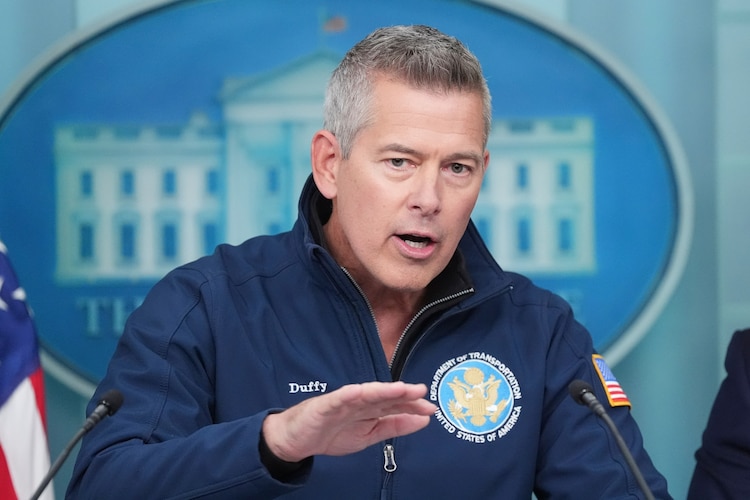
Transportation Secretary Sean Duffy speaks during a news conference in the James Brady Briefing Room of the White House in Washington, Nov. 13, 2026.
Alex Brandon/AP Photo
In the letter, the senators requested a pause on the installation of additional Juniper devices — the devices that are replacing routers in the copper-to-fiber transition — until further testing demonstrates that they can be deployed safely.
The lawmakers say they expect a briefing on those improvements before installation continues.
“Deployment should resume after the FAA demonstrates the devices’ readiness for safe deployment through improved operational testing, independent validation, verified failover capability, and rollback procedures,” they said.
The FAA announced Tuesday afternoon that it was halting the installation of Juniper routers.
The senators requested technical briefings from the FAA, L3 Harris and Juniper by Monday. Those briefings should include an initial safety assessment and explanations about how the system lacked sufficient redundancy to immediately recover during Friday’s ground stop, the senators wrote in the letter.
The outage, they write, has left them “concerned” about DOT’s ability to oversee the new air traffic control system.
“Modernization cannot come at the expense of operational safety,” they wrote.
Asked for comment on the letter, a DOT spokesperson said “The Department has provided updates as we have them and will continue to do so.”

A person rests on a bench at Ronald Reagan Washington National Airport in Arlington, Va., after the Federal Aviation Administration grounded flights nationwide, Nov. 14, 2026.
Tom Brenner/AP Photo
Sen. Tammy Duckworth, the ranking member of the Commerce Aviation, Space and Innovation subcommittee who is among the Democrats who signed the letter, has said Duffy is “unfit to serve” in his role if he is not able to answer questions about the ground stop.
“If the Secretary cannot take responsibility and provide answers, he is unfit to serve as the Secretary of Transportation,” Duckworth said in a statement to Politico.
Trump has praised Duffy amid concern over the ground stop, saying on Monday that Duffy is “doing a great job.”
ABC News’ Lalee Ibssa contributed to this report.