
LONDON — As Russian attacks on Ukraine’s energy grid intensify ahead of winter, Hanna Grishkevich fears for her elderly mother, whose Kyiv apartment building depends entirely on electricity. When the power goes out, so do the heat, gas and water.
Grishkevich’s mother gets electricity for only a few hours a day and relies on power banks the rest of the time, according to her daughter. But as temperatures fall, Grishkevich worries the batteries will do little to keep her mother warm through a Ukrainian winter, when average temperatures can drop below freezing.
“The biggest fear of old people is to freeze to death,” Grishkevich said.

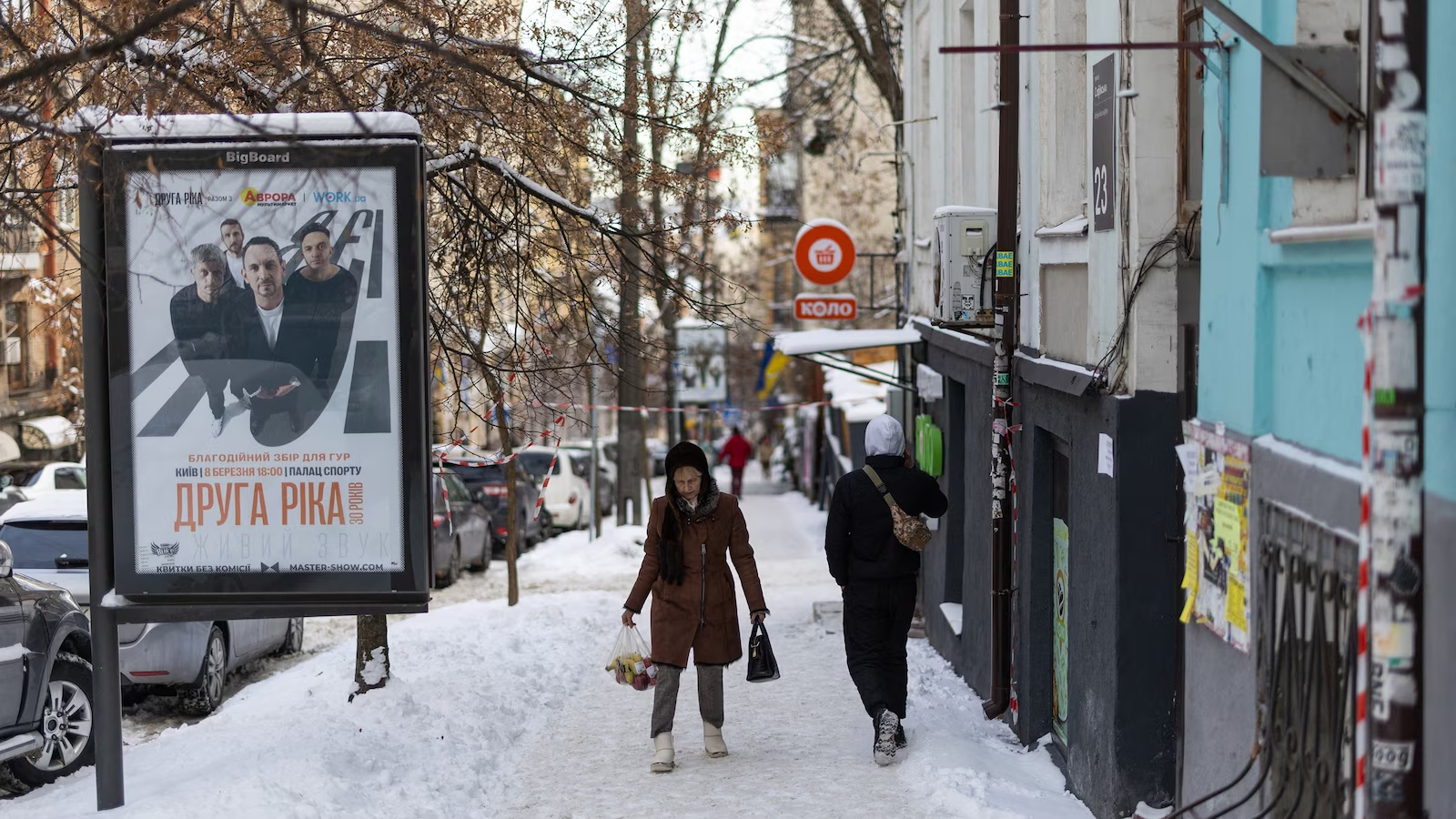
A woman carries a shopping bag of food in the snow in central Kyiv on February 17, 2026, amid the Russian invasion of Ukraine.
Henry Nicholls/AFP via Getty Images
Ukrainians are facing scheduled power cuts as Russia escalates attacks on the country’s energy system in a conflict that started with Russia’s full-scale invasion in 2022. Ukraine’s Ministry of Energy says Russia has launched more than 1,000 strikes on the sector since September, targeting substations that route electricity across multiple regions. The cuts are intended to conserve power for essential facilities.
“In most regions of Ukraine, hourly power outage schedules are in effect,” Ukrainian Minister of Energy Artem Nekrasov said in a post on Telegram, translated from Ukrainian. “Due to ongoing Russian attacks, the electricity supply situation can change rapidly.”
Ukraine has responded with strikes on Russian oil refineries that have disabled more than half of the country’s refining capacity, President Volodymyr Zelenskyy said in a post to social media.
The attacks happened on the same week Russian President Vladimir Putin met President Donald Trump and Chinese President Xi Jinping at a summit in China. The three leaders met for around 90 minutes and produced a four-point joint declaration on “peace,” as Putin wages his full-scale war in Ukraine.
Russian forces hit three substations and a thermal power plant overnight Thursday, according to a post by the Russian Armed Forces on Telegram.
This comes after Russia struck 12 Ukrainian regions overnight Wednesday, targeting power substations in the Zhytomyr, Chernihiv and Mykolaiv regions, Ukrainian Prime Minister Serhiy Koretsky said on social media. Ukraine’s Ministry of Energy confirmed that residents in five regions — Dnipropetrovsk, Zhytomyr, Zaporizhzhia, Mykolaiv and Sumy — were left without power as of Thursday morning.
The strikes are the latest in a punishing campaign against Ukraine’s energy grid. In Dnipropetrovsk, Kyiv, Sumy and Zhytomyr — regions Ukrainian authorities say have each been hit by more than 100 strikes since September — the damage has caused widespread blackouts and controlled power outages, leaving residents without electricity, heat and water for hours at a time.

Commuters walk through the snow as they disembark a bus in Kharkiv, February 4, 2026, in Ukraine.
Ivan Samoilov/AFP via Getty Images
The blackouts are lasting hours as repairs are happening, but some areas are being repeatedly targeted. As a result, many of the regions are enacting controlled power outages for conservation — this is reportedly an ongoing process.
Russia is increasingly coordinating strikes on Ukraine’s energy, transport and heating infrastructure. The attacks are systematic, overwhelming the country’s ability to repair damage and disrupting essential services and industries, said Oleksandr Danylyuk, a RUSI associate fellow for military sciences.
“The objective is cumulative economic damage and urban destabilization,” Danylyuk said.
In the first week of November alone, there were 278 Russian attacks on civilian infrastructure, according to Armed Conflict Location & Event Data Project (ACLED), a global conflict monitor.
DTEK is Ukraine’s largest private energy company. On Nov. 3, Russian strikes stopped electricity generation at three of its five thermal power plants, causing blackouts, the company said.
An attack on Nov. 7 damaged power connections and the Northern Bridge in Kyiv, disrupting electricity supplies in the capital.

Cars drive along a snow-covered road in central Kyiv following overnight snowfall, February 16, 2026, in Ukraine.
Genya Savilov/AFP via Getty Images
On Nov. 10, Russia targeted six major substations, as well as railways, triggering outages across multiple regions. State grid operator Ukrenergo said in a post on Telegram that residents in eight regions — Dnipropetrovsk, Zhytomyr, Zaporizhzhia, Kyiv, Rivne, Kharkiv, Odesa and Chernihiv — were affected.
Repair crews are working to restore electricity to regions hit by the strikes, but repeated attacks are complicating those efforts.
“The enemy is deliberately targeting energy infrastructure — specifically facilities where repair work was nearing completion,” Nekrasov said.
“These attacks constitute acts of aggression and a deliberate escalation. Moscow appears to be testing NATO’s willingness and readiness to respond,” Danylyuk said.
The Council of the European Union on Monday approved nearly 8 billion euros for Ukraine, its largest single payment, as the country works to repair critical infrastructure ahead of winter.
But for families like Grishkevich’s, the need extends beyond restoring power before winter. Her family has replaced roofs and windows and rebuilt entire homes, yet the damage seems never-ending.
“Helping someone in Ukraine is like dropping money into a well that has no bottom. It’s a black hole,” Grishkevich said. “The war is still in its active phase.”