
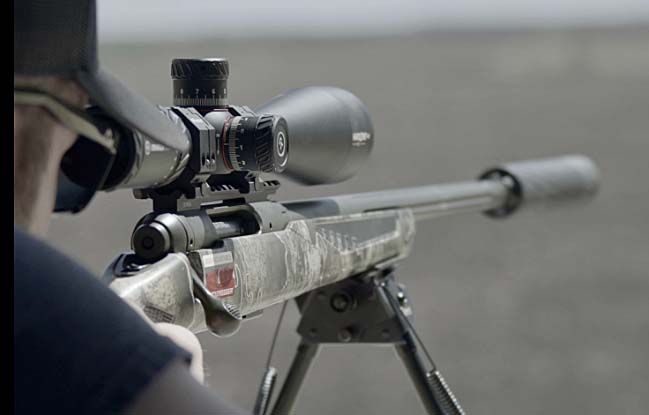
A hunter zeros a suppressed deer rifle at a firing range (Image courtesy of Facebook/Silencer Central).
WASHINGTON, D.C. – U.S. Rep. Blake Moore (R-UT) has proposed legislation that would enhance wildlife and habitat conservation/recreation programs by reallocating tax stamp funding from the Bureau of Alcohol, Tobacco, Firearms and Explosives (ATF).
Moore and U.S. Rep. Jared Golden (D-ME) jointly introduced the bipartisan Tax Stamp Revenue Transfer for Wildlife and Recreation Act into the 118th Congress here on Nov. 9.
“This bill represents a transformative step in funding our nation’s wildlife conservation while streamlining federal processes,” Moore said.
The congressman added that the bipartisan proposal “…underscores our commitment to conserving America’s natural heritage, investing in outdoor recreation and making ATF’s processes for law-abiding citizens more efficient.”
Under the National Firearms Act of 1934 (NFA), all applicants seeking to transfer a suppressor for their firearms – also known as a silencer — are required to undergo a background check and pay a $200 tax stamp.
This funding is currently deposited into the U.S. Treasury without any specific direction, even though total revenues generated from this tax are expected to approach $200 million this year.
The thrust of Moore’s legislation would be to reallocate those tax funds more strategically.
Specifically, 15% of the total tax revenue would go to the ATF’s NFA division, aimed at expediting the processing of suppressor applications, thus better servicing law-abiding citizens.
The remaining 85 percent of the tax revenues would be split further.
Eight-five percent of the remaining funds would be allocated to the Pittman Robertson Wildlife Restoration Trust Fund to support wildlife conservation, law enforcement, hunter recruitment and other related lawful activities.
The other 15 percent would be provided for the development, maintenance and operation of recreational shooting ranges. These dedicated ranges enhance safety, reduce environmental impact and contribute to the recruitment and retention of ethical hunters and shooters.
The proposal by Moore and Golden has earned praise from Joel Ferry, the executive director of the Utah Department of Natural Resources.
“This bill dedicates significant resources that would accelerate wildlife conservation and restoration efforts, such as habitat improvement, research and education,” according to Ferry.
“It’s a powerful commitment to conservation. It also improves ATF application efficiency, which will improve processing time for those seeking to legally obtain a suppressor.”
Their proposed legislation has also earned support from the Mule Deer Foundation; the Sport Alliance of Maine; Silencer Central; the National Sports Shooting Foundation; Delta Waterfowl; the Association of Fish and Wildlife Agencies; the Congressional Sportsmen Foundation; the Safari Club International; the National Wildlife Federation; and the Theodore Roosevelt Conservation Partnership.
Without changing the criteria for obtaining a suppressor, members of Moore’s staff emphasize, the Tax Stamp Revenue Transfer for Wildlife and Recreation Act would build upon America’s rich conservation heritage by increasing conservation funding while also enhancing the capacity and efficiency of the ATF and FBI in the processing of applications for suppressors.