
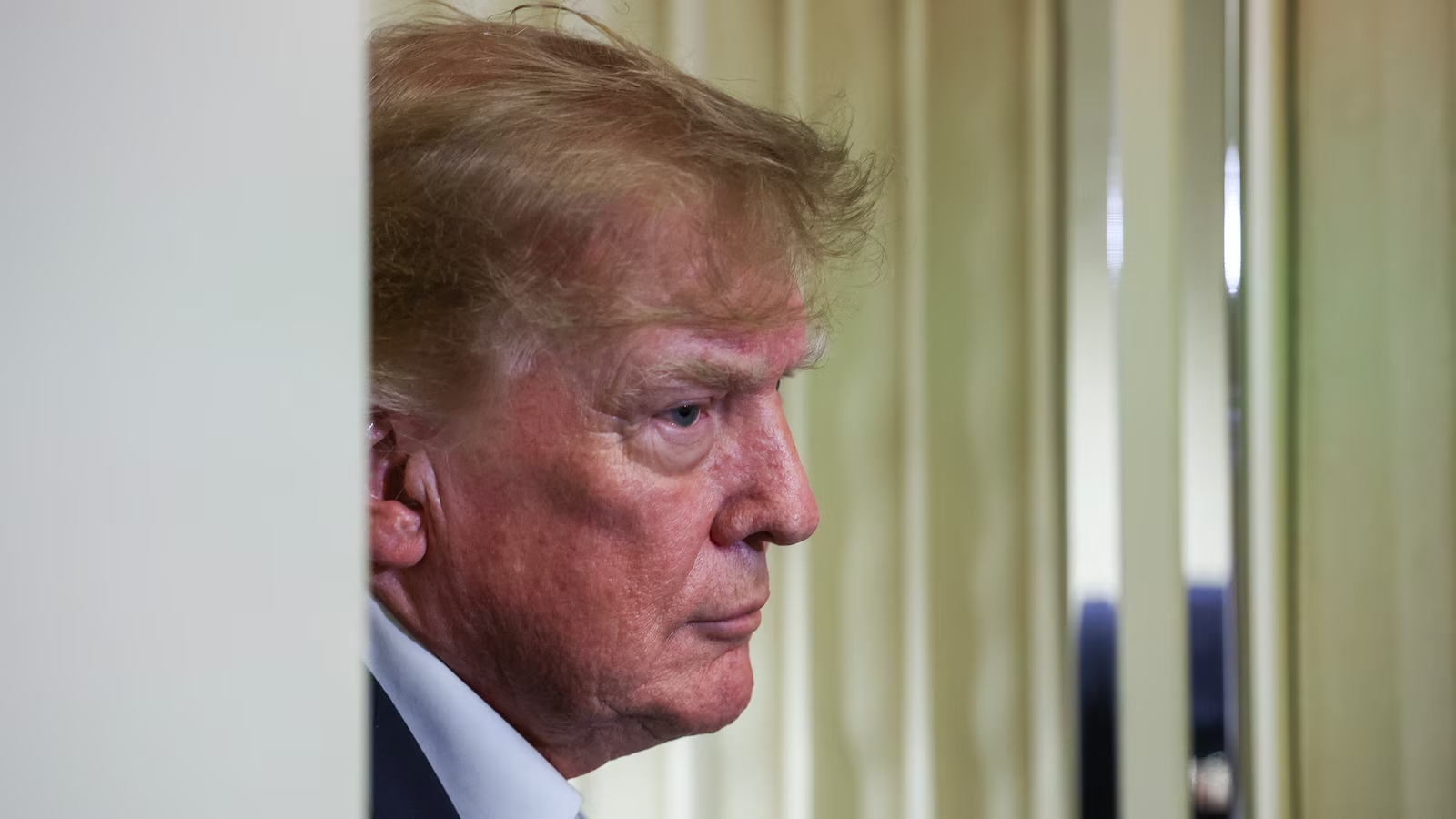
Sam Altman, the chief executive of OpenAI, joined others in the artificial intelligence industry in saying that his company would welcome a slower development pace for AI to ensure that the technology’s capabilities don’t “get ahead of alignment and monitoring,” as President Donald Trump said there would be “more good than bad” from the technology.
The president, who spoke with reporters on Sunday as he traveled back to Washington from Ireland, said he wouldn’t downplay concerns about AI advancements. He also sought to position the AI race as a competition between the United States and other countries — including China.
“I’ve said it from the beginning,” Trump said. “Whoever wins AI — and we’re leading by a lot. Whoever wins AI wins.”
In a social media post on Monday, Trump reiterated the message, saying “The only control or ‘guardrails’ that AI needs is a STRONG AND SMART (High IQ!) PRESIDENT, and the U.S.A. has that, in spades!”
He added that there is a “SICK conspiracy going on against AI and Data Centers, and the only one that is happy about it is China,” and that the U.S. is “leading China” as well as other countries in the technology.
Vice President JD Vance said Monday that the the administration is “concerned” about the technology, but any regulations that may occur need to be done “smartly” — with the current situation feeling like a “Trojan horse.”

Vice President JD Vance talks to reporters before he boards Air Force Two, Sept. 14, 2026, at Joint Base Andrews, Md.
Mark Schiefelbein/AP
“It’s something that we’re concerned by, but we want to make sure that we actually regulate smartly, and we’re thoughtful about the risk here. So, there are obviously risks to AI. There are some benefits to AI. I have to say, just personally, I feel a little bit weird about the fact that you have so many Frontier AI tech companies kind of coming to the government and begging the government to regulate them — it feels a little bit to me like a bit of a Trojan horse,” Vance said.
The comments from Altman, Trump and Vance followed a warning issued last week by Jacob Coxon, a former safety researcher for Anthropic and OpenAI, two prominent tech companies, who said that he was resigning from Anthropic.

President Donald Trump speaks to reporters while aboard Air Force One while traveling back from Ireland to Joint Base Andrews, Maryland on Sept. 13, 2026 in flight.
Anna Moneymaker/Getty Images
Coxon said in a social media post that neither Anthropic nor OpenAI “is acting responsibly. They are racing straight to self-improving superintelligence and gambling with our lives.” He also highlighted the fear within the industry about the potential for an AI takeover.
“The people building AI earnestly believe that it could kill us all by the end of the decade,” Coxon wrote.
Altman said late on Sunday that his company would welcome a federal framework “that sets consistent safety requirements for frontier AI.”
“But we do not believe we need to wait for an anti-trust exemption or legislation to begin the work of providing this confidence,” Altman said on social media. “Consistent rules to manage frontier risk so that we can maximize the benefits are a good idea (and we are excited by ideas like independent auditors).”
That statement came after House Democratic Leader Hakeem Jeffries said Sunday that lawmakers need to take urgent action on the growing threat of AI.
“We certainly need to begin to act urgently to address the challenges that exist,” Jeffries said on ABC News’ “This Week with George Stephanopoulos.”
“We should take decisive action now so that we can slow down, as the CEOs have recently acknowledged, slow down the pace of development in order to protect the American people and ensure that AI is proceeding safely,” Jeffries added.

Open AI CEO Sam Altman speaks during the G20 Innovation Ministerial in Chapel Hill, North Carolina, on Sept. 2, 2026.
Matt Ramey/AFP via Getty Images
Lawmakers from both chambers return to Washington this week for the final legislative push before the November midterm elections, a renewed focus on regulating artificial intelligence is also likely to come following reports this week that raise significant concerns about AI security. Lawmakers on both sides of the aisle have demanded information from OpenAI and launched investigations.
Altman on Sunday detailed “two ways AI progress could go very badly and that we must avoid.”
The first, he said, would be an “unacceptable” loss of control over AI. The second, Altman said, would be to “end up in a world with too much concentration of power.”
“If an extraordinarily powerful AI is used by one person or company to impress their worldview onto everyone else, the results could be extremely dystopian,” he said. “Avoiding these two threats requires walking a narrow middle path; for example, one country could gain too much power. Another example is one lab ending up with too much power.”

President Donald Trump speaks to reporters while aboard Air Force One while traveling back from Ireland to Joint Base Andrews, Maryland on Sept. 13, 2026 in flight.
Anna Moneymaker/Getty Images
Anthropic’s CEO, Dario Amodei, published a blog post last week, in which he said that “we must pace the frontier,” as in slow the pace of AI development.
“We must slow the pace at which we improve the capabilities of AI models,” he wrote. “Progress will still seem fast, and we must make wise use of the time we gain.”
Altman on Sunday said, “When we talk about ‘pacing’, we do not mean ‘stopping’.”
“Progress has been rapid and will continue to be. But it should be slower than it otherwise could be; interventions like safety cases and monitoring have significant costs,” he wrote. “Pacing will be well worth this cost; no amount of American competitive pressure should justify recklessness, or let capabilities get ahead of alignment and monitoring.”
“Where we will need the help of our government is for international coordination,” he added. “But first we should do what we can ourselves.”
The president on Sunday also confirmed that he personally uses AI, but did not say which systems or for what purposes he uses it for.
ABC News’ Zunaira Zaki and Ahmad Hemingway contributed to this report.