
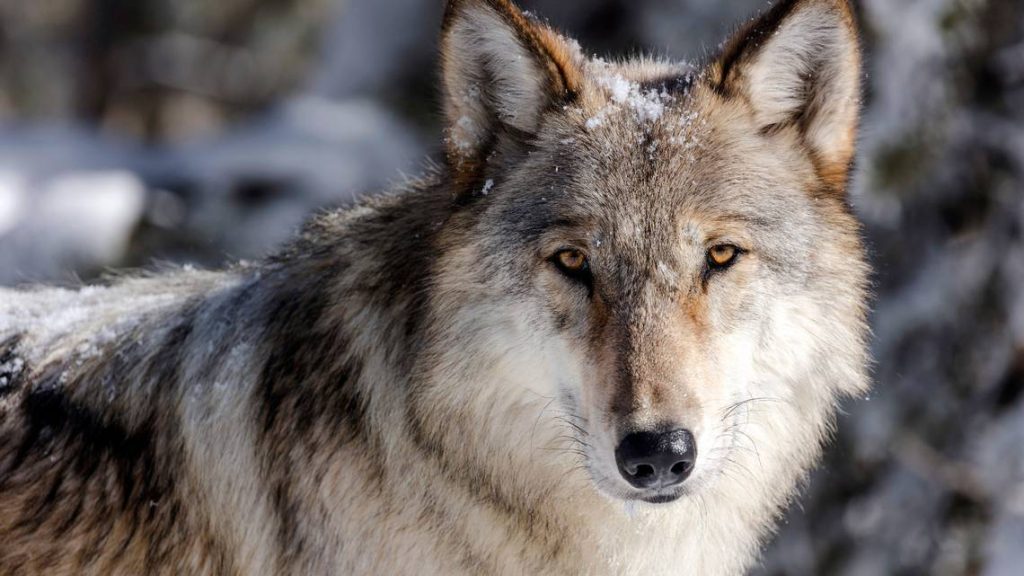
Three wildlife conservation groups have petitioned the U.S. Forest Service to ban the hunting of wolves from aircraft in national forests in Idaho (Image courtesy of Jacob W. Frank/National Park Service via Asssociated Press).
BOISE, ID – In a new chapter of the continuing Idaho battle over wolves, wildlife conservation groups have filed a petition with the U.S. Forest Service to ban shooting wolves from helicopters.
The petition – jointly filed by International Wildlife Coexistence Network, the Center for Biological Diversity and Western Watersheds Project on Nov. 29 – is aimed at thwarting controversial efforts by the Idaho Wolf Depredation Control Board to allow private contractors to hunt wolves from aircraft across millions of acres in central and southeastern Idaho.
The state wolf control board recently approved three of five proposals suggested by private contractor Trevor Walch, who operates the so-called Predator Control Corp. One of those suggestions was for wolf-hunting by helicopter.
The members of the state board claim that killing wolves is necessary to protect livestock as well as elk and deer populations.
In their petition to the Forest Service, however, the conservation groups insist that many of the areas where the board approved wolf hunting have not experienced recent wolf attacks on livestock and have elk and deer populations that exceed objectives set by the state of Idaho.
“This is essentially illegal sport hunting from aircraft,” according to Talasi Brooks of the Western Watersheds Project. “There is no reason for the government to allow the state’s anti-science bloodlust for wolves to be slaked on federally managed land.”
The battle over Idaho’s wolf population has been simmering since 2015, the last year that state officials were required to report on pack numbers after wolves were removed from the Endangered Species Act.
In March of 2018, for example, federal officials killed 10 wolves in northern Idaho at the request of the Idaho Department of Fish and Game. The reason for that hunt, which was conducted from a helicopter, was allegedly to boost elk numbers and state officials predicted that more wolves might have to be killed the following winter.
Nor is the fight against wolf-hunting confined to Idaho.
In November of 2022, two conservation groups filed a lawsuit seeking a state court injunction against officials in neighboring Montana to halt a wolf hunt there.
That lawsuit alleged that Montana officials violated federal law by relying on “stale and insufficient scientific data” in order to authorize the killing of roughly 40 percent of the state’s wolf population.
The two-month-old open season of wolves in Montana in 2022 had already claimed 55 of those animals.
Walch and the conservation groups in Idaho are old and bitter enemies.
Wolf advocates alleged that public records in Nevada show that Walch violated numerous wildlife protection laws there, including leaving animals suffering in unattended traps for up to 13 days.
“Killing wolves from helicopters is barbaric and scientifically unjustifiable,” said Andrea Zaccardi, the carnivore conservation legal director at the Center for Biological Diversity. “We can’t let it happen in our national forests.”
Brooks added that the state control board even authorized wolf killing in areas without any recent conflicts with livestock or elk and deer populations.
“That just shows how bogus this whole effort is,” she emphasized.
The groups’ legal petition asks the Forest Service to immediately ban the shooting of wildlife from aircraft.
If the Forest Service fails to grant that petition, the groups’ representatives said they may consider legal action in federal court.
The International Wildlife coexistence Network is a non-profit group that provides expert interdisciplinary assistance, training, collaboration and shared research to enable communities around the world to coexist with wildlife.