

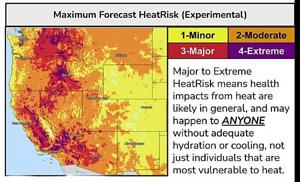
HOUSTON, TX – With the continental United States in the grip of a massive heat wave, home- and business-owners are seeing red from more than just the rising temperatures.
The cost of energy for air conditioning across much of the U.S. is skyrocketing, according to experts at Texas Electricity Ratings, with no end of the heat wave in sight.
Based on analysis of data from the Energy Information Administration — which tracks estimated cooling levels, average residential usage, kilowatt per hour prices and inflation adjustments – researchers at TER estimate that the average homeowner will pay an extra $36.79 a month for electricity during this extended heat wave.
That’s average across 50 states, of course.
Estimates of additional energy costs in selected areas, like here the Southwest, are much higher.
“Sizzling temperatures are expected to linger around the U.S. until at least August,” according to Karl Trollinger, the CEO Texas Electric Ratings. “This soaring heat means skyrocketing cooling bills, with states like Arizona feeling the financial strain more than others.”
In Arizona, for example, where temperatures have exceeded 105 degree Fahrenheit for much of July with no relief in sight, residents are projected to pay an additional $100.15 a month on top of their regular monthly bill of $134.38. That’s a projected average total of $234.53.
Nevada ranks second for the worst temperatures and projected energy costs, with experts predicting that the average resident there will pay $227.07 for energy as long as the heat wave lasts; that’s $100.05 additional on top of their $127.02 regular monthly bill.
Texas is another notorious hotspot, ranking third for recent temperatures. The TER analysts suggest that the average Texan will pay $229.54 monthly for energy this summer, or about $80.00 on top their average monthly bill of $149.76.
It may not feel like it, but forecasters at the U.S. Weather Service are predicting that Utahns may be due for something of a break from the unrelenting heat gripping the Southwest. After midweek – when daytime temperatures will hover around 100 degrees Fahrenheit – the thermometer is expected to drop into the low-90s and stay there until early August.
But that change will have little impact on the price of electricity here in Utah. The researchers at TER predict that average Utahns will pay an additional $40 per month for electricity during the continuing heat wave, on top of their average bill of $77.49 for a total of $117.24.
“The good news is there are ways to be smart about energy use,” Trollinger explains. “Simple steps like optimizing natural ventilation, using shades to keep out the sun and avoiding heat-producing appliances can significantly reduce cooling costs without sacrificing comfort.”
Until recent years, the average heat wave in major U.S. urban areas has been about four days long, about a day longer than the average heat wave in the 1960s.
The average heat wave season across 50 cities in the U.S. is now about 46 days longer now than it was in the 1960s, however.
The hottest air temperature ever recorded in Death Valley, at Furnace Creek, was 134 degrees Fahrenheit on July 10, 1913. During the heat wave that peaked with that record, five consecutive days reached 129 degrees or above.
As of January 2024, Death Valley still holds the record for the hottest place on earth.
But record heat isn’t a major problem in desolate, desert area like Death Valley. But baking temperatures are deadly in built-up urban areas.
Heat waves tend to occur more frequently in urban spaces compared with surrounding rural landscapes due to the unique micro-climates created by cities. This phenomenon is called the urban heat island effect.
Between 2004 and 2018, the Centers for Disease Control in Atlanta recorded 10,527 heat-related deaths in the US, which averages to 702 per year.
This includes deaths where heat was the underlying cause and deaths where it was a contributing factor.
In 2023, the U.S. set a record for heat deaths, with 874 deaths in Arizona, 450 in Texas, 226 in Nevada, 84 in Florida, and 83 in Louisiana.