
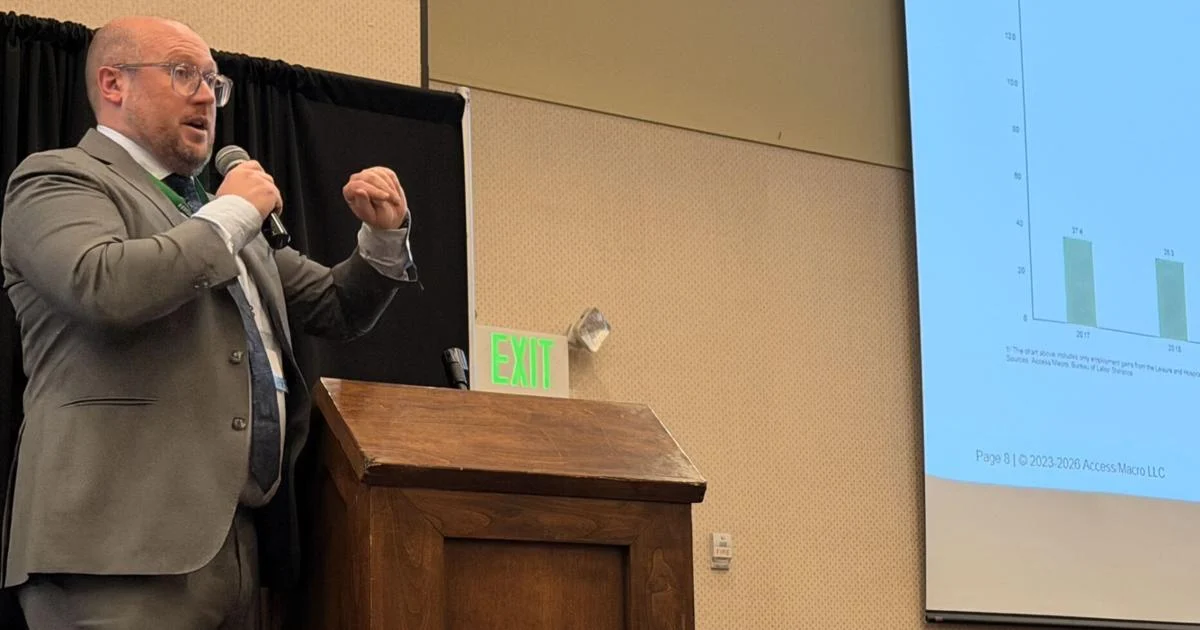
LOGAN — Access/Macro Chief Economist Tim Mahedy told a Cache Valley business audience Tuesday that the Federal Reserve is still wrestling with stubborn inflation — and may be doing so longer than many Americans expect.
Mahedy spoke at the 2026 Greater Cache Valley Economic and Business Summit, sponsored by the Cache Chamber of Commerce, on Tuesday, Feb. 10, at the Riverwoods Conference Center in Logan.
After noting that consumer spending helped keep growth strong even amid policy swings, Mahedy said inflation remains the central challenge for policymakers and businesses. He said the United States is “going into the sixth year, six years where inflation has been above” the Fed’s 2% target.
“The last mile will be the hardest,” Mahedy said, describing the difficulty of pushing inflation from around 3% down to 2%. He told the audience that progress on core inflation has been slow, calling the situation “not an abstract kind of just play in a number situation.”
Mahedy emphasized the difference between inflation’s month-to-month pace and the year-over-year measures that dominate headlines. He compared the month-to-month data to how fast a driver is going “in the last minute or two,” while the 2% target is akin to the speed averaged “over the last hour.”
Even as inflation has moderated in recent months, he said the Fed has reason to be cautious.
“The work is not done on inflation,” he said, pointing to forces he described as structural rather than temporary.
One of those forces, he said, is the labor market — and specifically what he called a labor supply problem. Mahedy said demographic changes are tightening the workforce, telling the audience the economy is “getting older,” and citing the Congressional Budget Office’s view that the United States could reach “zero net birth rate by 2031.” He also pointed to reduced immigration as another factor constraining labor supply.
In that environment, he said, the economy may not need the same level of monthly job creation it did before the pandemic to keep the unemployment rate steady. But he warned that job growth has become heavily concentrated in one area.
Mahedy highlighted health care and social assistance as a dominant source of new jobs, describing a “balancing act” in which “the labor market is kind of on one foot.” If that sector weakens before other sectors pick up, he said, broader labor-market risks could follow.
His concerns about health care extended beyond hiring patterns to costs that feed inflation. “I’m very worried about health care,” Mahedy said. He told the audience that health insurance premiums increased sharply, saying premiums for people on the exchange rose “15% on average,” and “11% for small businesses.” He said those increases can echo through the economy and make it harder to reach the Fed’s target.
“Our model has some of that in there and it’s elevated,” Mahedy said. “It’s not a 5% inflation story but it is a hard to get to 2% inflation story.”
Mahedy also tied the inflation fight to what he described as a broader shift in financial markets: a return of “risk” and a return of volatility. He said longer-term borrowing costs no longer behave the way they did in the decades leading up to the pandemic, when interest rates trended downward for roughly 40 years.
“We’ve entered the new world,” he said. “It’s a world of risk.”
He said investors are now demanding more compensation to hold long-term debt because of heightened uncertainty — from geopolitics to policy swings to fiscal pressures — pushing borrowing costs higher “almost organically irrespective of what the fed does.”
Looking ahead, Mahedy encouraged business leaders and investors to think differently about turbulence. Rather than treating volatility as purely threatening, he urged them to “nurture a growth mindset” and look for opportunity as markets shift.
“They realize that with the volatility, there’s opportunity in that,” he said, advising businesses to keep reserves but avoid hiding from change. “This is the time.”