
Democrats on the House Oversight Committee on Wednesday released still images and videos of the Virgin Islands estate of convicted sex offender Jeffrey Epstein, on the same day that attorneys for Epstein associate Ghislaine Maxwell argued against the release of grand jury materials in her criminal case.
The images — which do not show any people — were taken by the government of the U.S. Virgin Islands in 2020 during civil litigation against the Epstein estate. Some of the material appeared similar to material previously published by Project Veritas founder James O’Keefe several months ago.
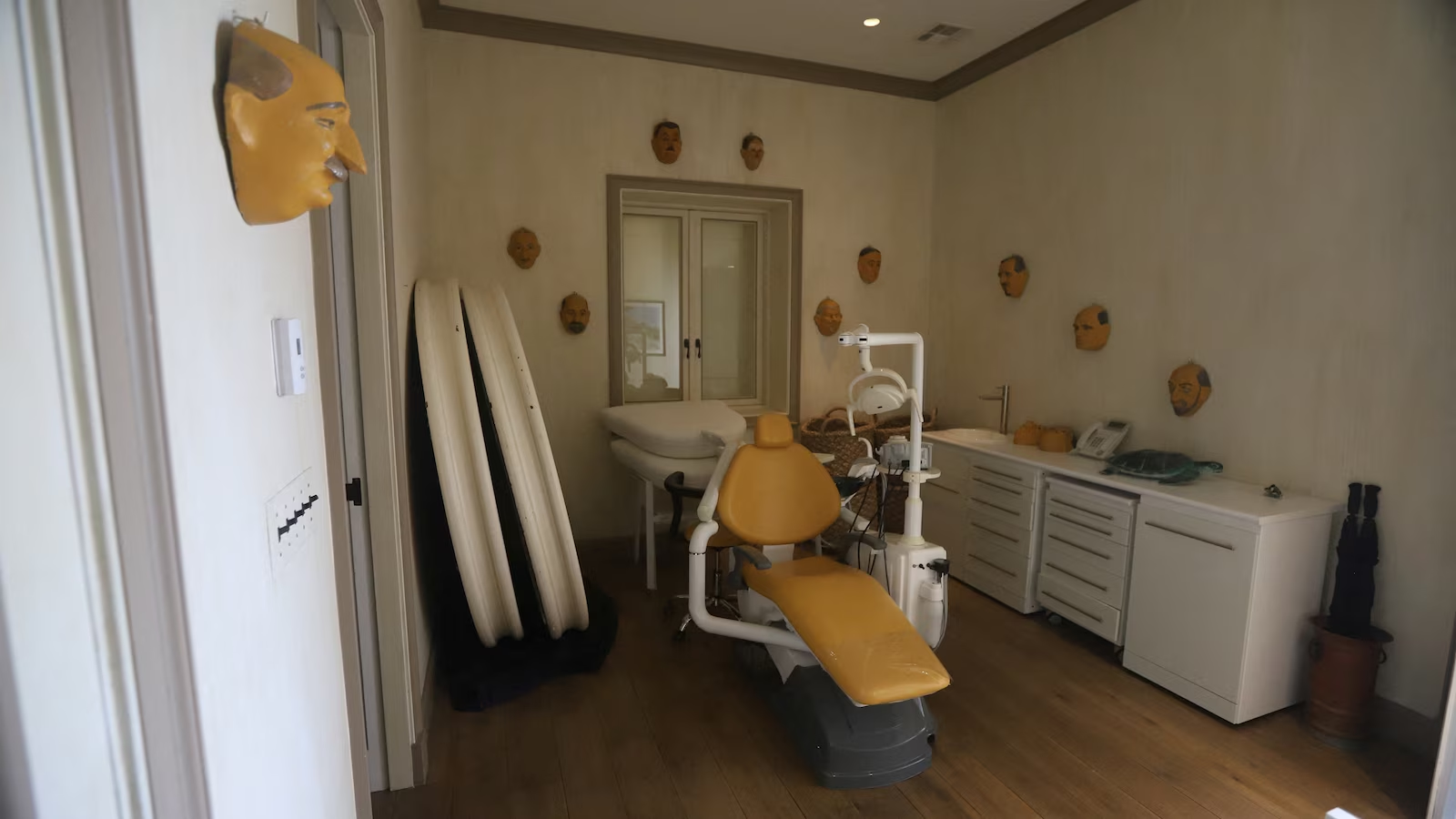
Included in the collection is an image of a room with a dentist chair in the middle and several masks on the wall, as well as a photo of a blackboard containing the words “Power,” “Deception,” “Intellectual,” “Political,” and “Music,” along with several other words that are redacted.
Epstein was known to have dental chairs in his homes, and a video from a police search of Epstein’s Palm Beach home in 2005 also showed a room with a dental chair and equipment.
In another image released Wednesday, a large “No Trespassing” sign is seen leaning up against a rock near the beach. A photo containing a closeup of a telephone shows speed dial buttons for several of Epstein’s employees.

A handout photograph described as an interior image from the property on Little St. James, once owned by the late financier and convicted sex offender Jeffrey Epstein, released by Democrats on the House Oversight Committee in Washington, D.C., December 3, 2025.
House Oversight Committee via Reuters
The short videos show walk-throughs of a bedroom and bathroom, the coastline and helipad, and the pool area.
After the initial release of a dozen images and four short videos, Republicans on the House Oversight Committee slammed the committee’s Democrats for “chasing headlines” by releasing the materials as “never-before-seen” when similar material had been published previously. A subsequent release contained more than 100 additional images and videos.
Committee Democrats did not immediately respond to a request for comment from ABC News.

A handout photograph described as an exterior image from the property on Little St. James, once owned by the late financier and convicted sex offender Jeffrey Epstein, released by Democrats on the House Oversight Committee in Washington, D.C., December 3, 2025.
House Oversight Committee via Reuters
A spokesperson for the committee’s GOP majority also criticized the Democrats for again releasing only a small subset of the records.
“The House Oversight Committee has received approximately 5,000 documents in response to Chairman Comer’s subpoenas to J.P. Morgan and Deutsche Bank, as well as his request to the U.S. Virgin Islands,” the GOP spokesperson said. “The Majority is reviewing these materials and will make them public soon, just as the Committee has already done with the more than 65,000 pages produced during this investigation.”
“It is odd that Democrats are once again releasing selective information, as they have done before,” the statement said.
The Epstein estate in 2022 agreed to settle its litigation with the U.S. Virgin Islands, paying the government $105 million plus a percentage of the proceeds from the sale of Epstein’s property, and a repayment of tax breaks that Epstein’s companies had received over the years from the USVI.
Maxwell’s attorney on Wednesday told a federal judge in New York that she takes no formal position on the Justice Department’s latest request to unseal grand jury transcripts from her criminal case — but she also argues that release of the materials would impact her ability to potentially get a fair retrial.

A handout photograph described as an interior image from the property on Little St. James, once owned by the late financier and convicted sex offender Jeffrey Epstein, released by Democrats on the House Oversight Committee in Washington, D.C., December 3, 2025.
House Oversight Committee via Reuters
“Understanding that President Trump has signed the Epstein Transparency Act into law, Ms. Maxwell does not take a position regarding the government’s request to unseal the grand jury transcripts and modify the protective order,” wrote Maxwell’s attorneys, David Markus and Melissa Madrigal.
“At the same time, Ms. Maxwell respectfully notes that shortly she will be filing a habeas petition pro se. Releasing the grand jury materials from her case, which contain untested and unproven allegations, would create undue prejudice so severe that it would foreclose the possibility of a fair retrial should Ms. Maxwell’s habeas petition succeed,” the lawyers wrote.
Maxwell, who is currently serving a 20-year prison sentence after she was convicted in 2021 on five counts of aiding Epstein in his abuse of underage girls, was unsuccessful in her appeals of her 2021 conviction at the 2nd U.S. Circuit Court of Appeals and the U.S. Supreme Court, but she and her lawyers have indicated that she intends to file a habeas petition in the Southern District of New York.

A handout photograph shows a sign described to be at the property on Little St. James, once owned by the late financier and convicted sex offender Jeffrey Epstein, released by Democrats on the House Oversight Committee in Washington, D.C., December 3, 2025.
House Oversight Committee via Reuters
Epstein, the wealthy financier and convicted sex offender, died by suicide in a New York jail in 2019.
The Epstein Transparency Act, passed last month by Congress and signed by President Donald Trump following blowback the administration received from MAGA supporters seeking the release of the materials, contains exemptions that would allow the DOJ to withhold records that “would jeopardize an active federal investigation or ongoing prosecution, provided that such withholding is narrowly tailored and temporary.”

A handout photograph described as an interior image from the property on Little St. James, once owned by the late financier and convicted sex offender Jeffrey Epstein, released by Democrats on the House Oversight Committee in Washington, D.C., December 3, 2025.
House Oversight Committee via Reuters
Prior to the exhaustion of Maxwell’s direct appeals, the DOJ had cited her ongoing case as justification for declining a public records request, according to court records in a Freedom of Information Act case pertaining to the DOJ’s Epstein files.
It’s not clear if the DOJ would seek to withhold records based on the unlikely prospect of Maxwell getting a new trial.
The DOJ has, however, already cited the possibility of a Maxwell retrial in other litigation as a justification for withholding certain records related to the Justice Department and FBI searches and redactions of the Epstein files.
In response to a lawsuit filed earlier this year by Bloomberg reporter Jason Leopold, the DOJ cited a FOIA exemption that allows withholding of records that, if released, could “reasonably be expected to interfere with enforcement proceedings.”

In this Sept. 20, 2013, file photo, Ghislaine Maxwell attends an event in New York.
Laura Cavanaugh/Getty Images, FILE
“Although Ms. Maxwell’s direct appeal rights have been exhausted, her lawyer has stated that she intends to seek habeas relief,” the DOJ wrote in a court filing on Nov. 24 — five days after Trump signed the Epstein Transparency Act.
“[L]ogic suggests that the existence of a pending motion … makes it reasonably foreseeable that an enforcement proceeding (i.e., a new trial) might take place, leading to the expectation that Exemption 7(A) may apply to protect materials whose release could reasonably be expected to interfere with that new trial,” the DOJ wrote.
ABC News’ Lauren Peller contributed to this report.