
Following the historic midterm election sweeping Democrats into majority control of the House and Senate, Congress returns Monday for a five-week lame-duck session, with a long to-list to tackle before the end of the year and dozens of lawmakers ending their tenure in the House, and at least 17 senators heading home as well.
The lame-duck session kicks off Monday with a two-week legislative period wrapped with freshman orientation for members-elect who will be seated in the 120th Congress on Jan. 3. There are still several races that are too close to call, but as it stands Friday, at least 109 incoming House freshmen will be seated — the largest pre-convening freshmen class in the lower chamber in almost 100 years — since the 73rd Congress convened in 1933.
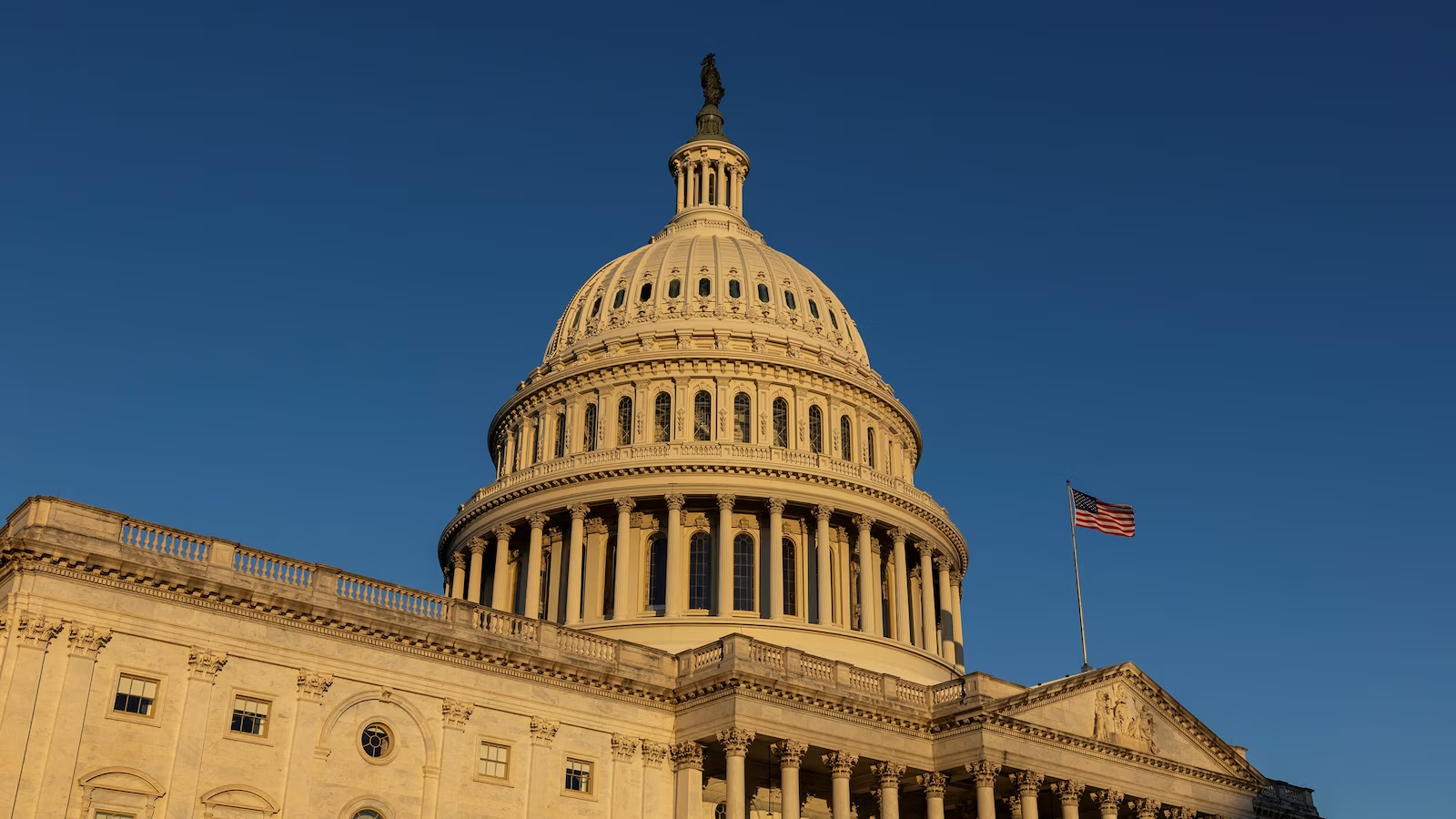
The US Capitol building in Washington, November 4, 2026.
Umit Bektas/Reuters
On the floor, House Speaker Mike Johnson is already hearing it from his own conference after GOP leadership plans to advance just one piece of legislation under a rule next week — continuing the frustrations voiced by some of his members earlier this fall when the speaker dismissed lawmakers for a six-week campaign blitz rather than put Republican legislative wins on the floor.
Massie pushes for Hegseth impeachment
Johnson’s designs for the lame-duck session could be quickly derailed as Republican Rep. Thomas Massie, who lost a GOP primary months ago, is expected to reintroduce a privileged resolution to impeach Secretary of Defense Pete Hegseth.
Massie has a resolution with eight articles of impeachment against Hegseth, who is staring down consternation at both ends of Pennsylvania Avenue in the wake of Tuesday’s Democratic victories. President Donald Trump said Thursday he intends to keep Hegseth in his job amid assessments from several Republicans — including Vice President JD Vance — that the Iran war led to the party’s midterm losses.
In a video posted Thursday, Hegseth proclaimed that he will not back down — doubling down on the Iran war and his cultural agenda at the Pentagon while drawing a parallel to Trump.
“This is not about me, but of course the other side, they’re obsessed. A disgruntled, defeated congressman, along with all his Democratic allies has also dropped sham articles of impeachment against yours truly. Just like they tried against President Trump twice.”
Massie could move as early as Monday, teeing up a showdown midweek on Hegseth impeachment.
Epstein files 2.0
Speaking of Massie, the president’s primary intraparty detractor is on the brink of having his latest Epstein discharge petition ripen with 218 signatures — this effort squarely aimed at Attorney General Todd Blanche.
Massie already has amassed 216 signatures, including four fellow lame-duck GOP signatures (himself, Reps. Nancy Mace, Ralph Norman and Brian Fitzpatrick) on the petition. Much to the chagrin of Speaker Johnson, Massie now needs just two more Democrats to endorse the petition to force floor consideration of the Epstein Transparency Act II — a bill that empowers state attorneys general, victims and members of Congress to sue the U.S. Attorney General in federal court for unlawfully withholding or redacting Jeffrey Epstein and Ghislaine Maxwell investigative records.
In response to allegations that Blanche and other department officials deliberately mishandled the release of millions of files from the Justice Department’s past investigations of deceased convicted sex offender Epstein, the attorney general acknowledged “mistakes” in failing to properly redact certain names of some victims but testified that the department immediately sought to fix those issues.
“Whenever we learned that any victim’s name had been improperly non-redacted, we immediately took the document down and fixed it as soon as we could,” Blanche testified July 15 at the Senate Judiciary Committee. “That doesn’t excuse the mistakes of which I take full responsibility, but it does mean that we tried to fix them. We — we complied with the act.”
New GOP leadership elections
Johnson announced he won’t run for GOP leader in the next Congress, pitting Majority Leader Steve Scalise against Judiciary Chairman Jim Jordan in a race for House Republican leader on Tuesday. Meanwhile, House Democrats have set their leadership elections for Nov. 18, when Hakeem Jeffries is expected to secure the speaker nomination from the Democratic caucus.

Volunteers applaud as US House Democratic leader Hakeem Jeffries gives a thumbs up at a Democratic Congressional Campaign Committee midterm election night phone bank and watch party at a hotel in Washington, November 3, 2026.
Tom Brenner/Getty Images
Senate Republicans are currently scheduled to hold closed-door election to select their party leaders on Tuesday morning.
All current members of the Senate GOP leadership team are seeking to retain their positions, and no major shake-ups are expected at this time. Still, things could change as people close to Trump question whether an overhaul is needed. Only the remaining incumbents and newly elected incoming Republican senators will vote in that secret ballot, closed-door leadership election. Outgoing members will not.
Democratic leadership has not yet announced a date for their leadership elections as Chuck Schumer lines up support for majority leader.
Freshmen orientation
House new-member orientation kicks off on Sunday with events scheduled throughout the week, highlighted by a new member photo opportunity on the House steps on Thursday morning.
Senate new-member orientation is also scheduled for the first half of the week, when members-elect are also expected to be on the Hill.
In the Senate, at least 17 senators are leaving, bringing in a new generation of freshmen to take the oath. Even more new members will join the ranks eventually as incumbent senators Marsha Blackburn and Amy Klobuchar head to their respective state’s governor mansions and appoint their successors.
The Alaska and Mississippi Senate races have yet to be projected, but Democratic wins in those states would further grow the Senate freshmen class.
Legislative to-do list
The challenges facing the lame-duck Congress are stacking up.
Government funding runs out after Dec. 11 and lawmakers are far from striking a deal to avert a government shutdown. The House and Senate must pass the National Defense Authorization Act, the annual Pentagon policy bill, before the end 2026. Disputes about funding for the war in Iran could come to a head as the deadline to pass the bill approaches. Reauthorizing Section 702 of Foreign Intelligence Surveillance Act (FISA) and passing the expired Farm Bill are also on lawmakers’ long to-do list.

The sun sets on the U.S. Capitol on Election Day evening on November 3, 2026 in Washington.
Kevin Dietsch/Getty Images
Senate Republicans will also attempt to move quickly to confirm Trump’s remaining nominees before losing control of the chamber in January — challenging Republican Sen. John Thune to schedule sufficient floor time to overcome Democrats who may be unwilling to agree to unanimous consent time agreements during the lame-duck session.
Senators will also continue consideration of permitting reform legislation, the bipartisan package overhauling federal laws and regulations to streamline infrastructure projects. On Monday, the Senate will hold a procedural vote — which will provide an indication of whether the negotiations that were gaining steam ahead of the midterm recess will hold, or if Democrats seek to punt the issue to the next Congress when in majority control.