
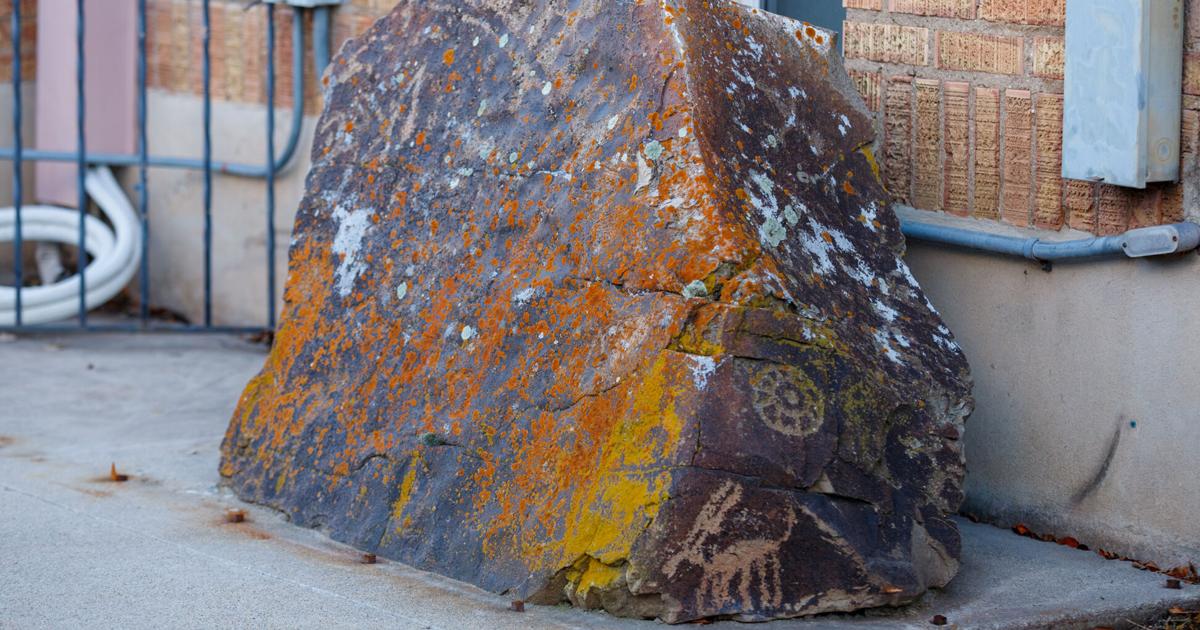
BOX ELDER COUNTY — A 2,500-pound sacred rock bearing petroglyphs created by the Fremont people more than 1,200 years ago has been returned to its original home, concluding a multiyear repatriation effort between the Northwestern Band of the Shoshone Nation and The Church of Jesus Christ of Latter-day Saints.
The artifact, which features ancient carvings created by the ancestors of the Shoshone, was airlifted to a remote location near the Utah-Idaho border on Dec. 11. Its return marks the end of an 80-year displacement that began when the stone was removed from the mountains by a group of local men or Boy Scouts and hauled to a Church meetinghouse in Tremonton.
“Putting it back for us is putting a puzzle piece back into place,” said Brad Parry, vice chair of the Northwestern Band of the Shoshone Nation. “Our history is so fractured. To have these positive things now that are coming out — it’s rebuilding our history. I can’t overstate that.”
For decades, the massive stone sat outside the Tremonton chapel, first near a flagpole and later on the north side of the building. Church historians said the exact reason the stone was originally brought to the site remains a mystery, likely taken out of a lack of understanding rather than malice.
The path toward repatriation began in 2011 when amateur archaeologists used a 1937 rock-art survey to identify the stone at the meetinghouse and trace its origins. While the Church had no legal obligation to return the artifact, Ryan Saltzgiver, a curator for the Church History Department, said officials felt a “moral and ethical obligation” to return a sacred object to its rightful owners.
Before the stone was returned to the earth, it underwent a rigorous preservation process. Specialized art handlers moved the rock to Provo, where objects conservators from the Midwest Art Conservation Center used steam, nontoxic biocide, and bamboo tools to painstakingly remove decades of lichen growth that had obscured the ancient designs.
The cleaning was designed to make the spiritually significant carvings visible again without damaging the delicate surface of the stone.
“This rock was meant to be here,” Parry said as the artifact was lowered into place alongside companion petroglyphs. “It’s like this rock knows it’s home.”
The final ceremony included a blessing from tribal spiritual leader Rios Pacheco, who offered prayers in the Shoshone language for those who assisted in the project. Historians present described the moment as one of profound reconciliation.
“I felt a strong impression that the eyes of our ancestors were upon us in that moment,” said David Bolingbroke, a Church research historian. “They were pleased with our efforts to bring this stone back and put it in its rightful place.”
To ensure the artifact remains undisturbed, officials said the exact location of the site will not be disclosed to the public.