
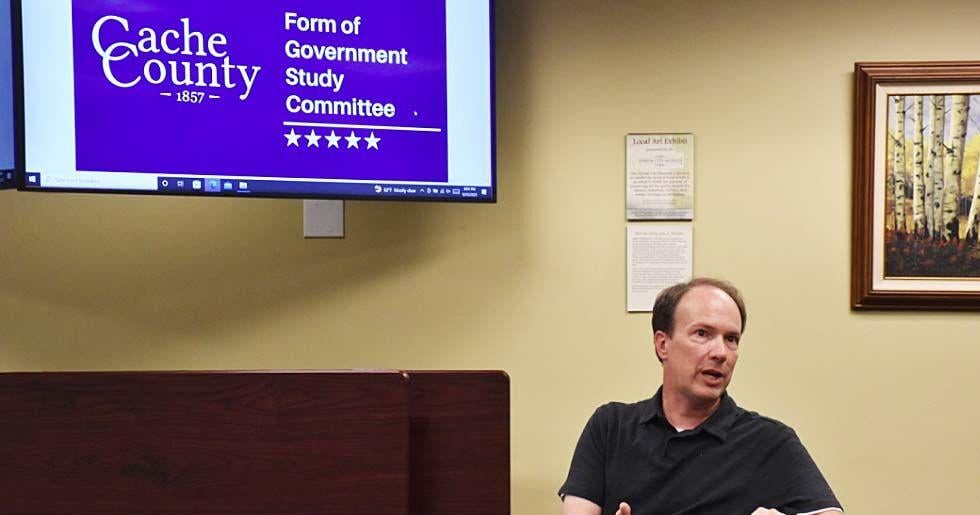
HYRUM – The members of the public finally got a chance to participate in the proceedings of the Cache County Form of Government Study Committee here on Sept. 25.
Held at Hyrum City Hall, the meeting was casual, with members of the study committee and a relative handful of Cache County residents tentatively sharing ideas about the pros and cons of a proposed change in the county’s form of government.
The meeting began with a lengthy explanation of the forms of county government allowed under Utah laws, delivered by Dr. Damon Cann, the chair of the Political Science Department at Utah State University, who is assisting members of the study committee.
Those options include a full-time, three-member commission elected at-large; a part-time five- to seven-member commission elected either by districts or at-large; the current council-executive system with part-time council members and a full-time elected executive; and a part-time county council with a county manager appointed by the council.
Each of those forms of government have advantages and disadvantages, Cann explained.
For example, the three-member commission form of government vests both legislative and executive authority in its commissioners, making it flexible and quick to react to changing situations. Here in Utah, 20 of 29 counties operate under this form of government, Cann said.
Three Utah county employ the council-manager form of government, which Cann emphasized comes up short in term of separation of powers in favor of increased accountability.
Only Cache and Salt Lake County presently employ the council-executive form of government.
Present at the meeting were study committee chair Jack Draxler and members Jordan Mathis from the Bear River Health Department and mayors Ed Buist from Mendon and Blake Wright from River Heights.
The gathering in Hyrum also took place under the watchful eyes of Cache County Council chair Sandi Goodlander and council member Nolan Gunnell. Although they chose not to speak, their presence in the audience may have contributed to making the exchange of ideas somewhat subdued.
The Cache County Council informally decided to organize a study committee to consider changes to the county’s form of government at their regular meeting on March 18.
The decision was influenced by discussions surrounding House Bill 356 (County Governance Amendments) passed by the 2025 general session of the Utah Legislature, which initially sought to restrict certain forms of county government.
In the study committee’s previous proceedings since June, Draxler said that its members had discovered that was the little advantage in terms of cost savings to any of the forms of government being considered.
Given that, Providence Mayor Kathleen Alder asked what problems or issues the study committee intended to solve by proposing a new form of county government.
Draxler confessed that he didn’t know the answer to that question and tossed it to the audience.
The only suggestion that audience members could offer was that “personalities” tend to get in the way of efficient county functioning.
Emphasizing that no form of government is perfect, Draxler explained that the study committee is expected to deliver its recommendations to the Cache County Council by December of this year. If approved, the changed form of government would then be referred to a voter referendum at some point in the future.
The committee members have reviewed materials from other Utah counties that have explored their government structures and met with local and state officials who have experience in different county set-ups.
Draxler added that the study committee had also surveyed county employees; local cities; employees of adjacent county services (e.g. the Bear River Association of Governments, the Bear River Health Department, etc.); and former elected officials to identify their concerns about the county government.
Cann added that an online survey would be opened for members of the public to explain their concerns, but only if they had previously attended one of the scheduled public input gatherings.
Additional public input meetings scheduled by the study committee include a Thursday, Oct. 16 meeting at Logan City Hall and a final public session on Thursday, Oct. 23 in Smithfield City Hall. Those meetings are set to begin at 7 p.m.
The Logan City Hall is located at 290 North, 100 East in Logan. The Smithfield City Hall is located at 96 South Main Street in Smithfield.
For additional information about the Cache County Form of Government Study Committee, residents can review the committee’s progress at https://www.cachecounty.gov/study-committee/