
SALT LAKE CITY – What started as an innocuous “he-said, she-said” here in Utah is now beginning to acquire national political implications.
On April 16, Utah’s Republican leadership – include Gov. Spencer Cox, Senate President Stuart Adams and House Speaker Mike Schultz – announced that they have launched an independent investigation into an alleged inappropriate relationship between a Supreme Court justice and a lawyer involved in the state’s super-heated redistricting case.
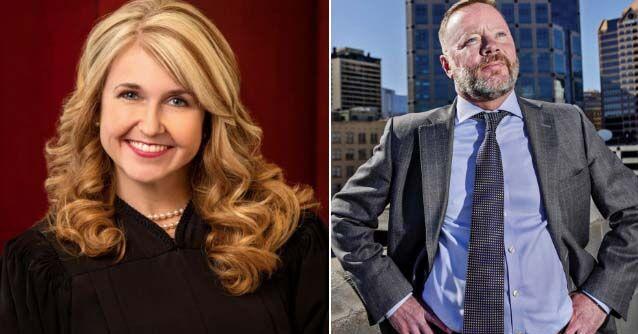
From Washington, U.S. Rep. Blake Moore (R-UT) has also weighed in on the controversy in support of the state probe into the alleged relationship between Utah Supreme County Justice Diana Hagen and attorney David Reymann, one of the lawyers who represented the League of Women Voters in their suit against the Legislature.
“The Supreme Court’s decision in the League of Women Voters case and other rulings related to redistricting have raised questions for many Utahns about the role of the judiciary in shaping congressional maps,” according to Moore.
“Yesterday, a troubling allegation involving a sitting Utah Supreme Court Justice was reported … If these allegations are true, they could represent a breach of public trust and undermine the credibility of the judicial process.”
Moore and other Republican have latched onto the unsubstantiated allegations about Hagen and Reymann as another way to dispute the validity of the court-ordered Democratic enclave in Salt Lake County.
Back in 2018, Utah voters passed the Proposition 4 ballot initiative, which created an independent redistricting commission to redraw state congressional maps.
In 2020, the Utah Legislature repealed and replaced the ballot initiative with a law that made the commission purely advisory. The legislature then drew its own congressional maps in 2021 that ignored the commission’s recommendations, especially slicing up Salt Lake City to carefully dilute Democrats’ influence.
That led an advocacy coalition, comprised of the League of Women Voters and the Mormon Women for Ethical Government, to sue the Legislature.
In November of 2025, Judge Dianna Gibson of the Third District Court rejected the congressional district map proposed by the Utah Legislature in favor of one proposed by the local voting-rights groups.
As proposed by the Utah Legislature, Map C would have split three cities (North Salt Lake, Millcreek and Pleasant Grove) and three counties (Davis, Salt Lake and Utah) in an effort to preserve the status quo of the state’s delegation in Congress.
But Gibson directed the state to accept the plaintiff’s Map 1 that includes a Democrat-leaning district anchored in northern Salt Lake County and the Utah Supreme Court has consistently upheld that decision in the months since then.
Those Supreme Court rulings are now at the center of the recent controversy that is even drawing fire from President Donald Trump.
Both Justice Hagen and Reymann strongly deny any inappropriate relationship or romantic involvement. The state’s Judicial Conduct Commission looked into the rumors, which first came to light during Hagen’s 2025 divorce, finding nothing substantial on which to proceed.
But Trump credits Utah’s Republican leaders for not buying it.
“When a sitting justice (allegedly) gets cozy with the attorney reshaping the state’s political map to help one party over the other, it reeks of the swampy insider games conservatives have warned about for years,” according to Trump in a statement released by the White House.
“Utahns deserve legislators and judges who are transparent, accountable, free from conflicts of interest and carry themselves with dignity,” Moore argues.
‘I fully support Gov. Cox. Senate President Stuart Adams, House Speaker Mike Schultz and the Utah Legislature as they investigate these claims.”