
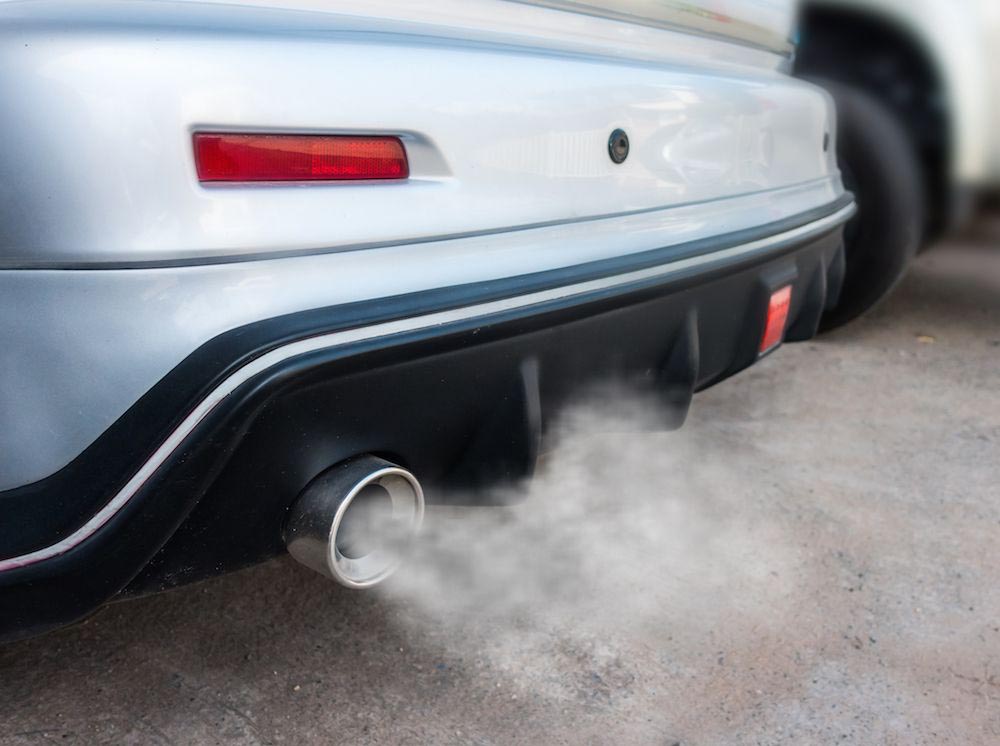
The members of the Logan City Council are considering tightening the city’s anti-idling ordinance to limit the number of warnings that law enforcement must issue prior to imposing a fine on offending motorists (Image courtesy of LiveScience.Com).
LOGAN – Now that a hint of spring is finally in the air, Logan officials are reminding residents not to add air pollution into that mix.
“Thanks to the ongoing – and record-breaking – storm systems this winter, our air quality has been pretty okay this winter, for the most part,” observes Emily Morgan Malik, a public information officer for the Logan Environmental Department.
“Unfortunately, winter is not the only time that we need to worry about air quality in Logan,” she adds.
While thanking city residents who did their part to keep Logan’s air as clean as possible during this past winter’s week-long inversion, Malik says that city officials are also encouraging residents to be mindful of air quality in the spring and summer months as well.
In a scholarly paper published on the city’s website, Dr. Jeff Bennett of the Deseret Research Institute listed the most common and dangerous air pollutants as ozone, particulate matter, carbon monoxide, lead, sulfur dioxide and nitrogen oxide.
“While an air purifier or air sanitizer can temporarily cleanse indoor air of some of its pollutants, it is far more difficult and complicated to resolve the problem of outdoor air pollutants,” Bennett writes. “A successful campaign against air pollutants must involve the mutual participation of government and citizens from nations worldwide.”
But that effort should begin at home, according to Logan officials, with something as simple as reducing the idling of motor vehicles.
“For the health of our residents,” Malik says, “Logan City has a two-minute idling limit. We encourage all residents to be idle-free year round.”
The city is also considering putting some “teeth” into its ordinance against idling.
At their regular meeting on April 4, city civil attorney Mohamed Abdullahi proposed to members of the Logan Municipal Council that city Ordinance 23-12 be strengthened to comply with recent changes to the state’s idling law made by the Utah Legislature.
Rather than requiring law enforcement to issue three warning citations for excessive idling, that change would reduce the number of warnings to one prior to the imposition of a $40 fine.
The members of the city council may vote on that changed ordinance at their next meeting on April 18.
Bennett’s paper notes, however, that idling is by no means the only source of outdoor air pollution.
“People can make a conscious decisions to reduce or eliminate personal activities that contribute to this problem,” he suggests. “This includes altering their driving habits by consolidating driving trips (e.g. running a day’s errands in a single trip), joining a carpool to work, bicycling or riding public transit.”
Malik says that Logan City also encourages residents to be mindful of how using gas-powered yard care equipment can also contribute to air pollution. As an alternative to those traditional power tools, residents may want to consider changing to electric yard equipment like lawn mowers, hedge-trimmers and edgers.
“We also suggest that residents keep an eye on air quality by using the Utah Air application at www.air.utah.gov and the Air Now application at www.airnow.gov throughout the spring and summer months,” Malik adds.
The Desert Research Institute (DRI) is a world leader in basic and applied environmental research.
Since 1959, the Nevada-based institute has advanced scientific knowledge on topics ranging from humans’ impact on the environment to the environment’s impact on humans.