
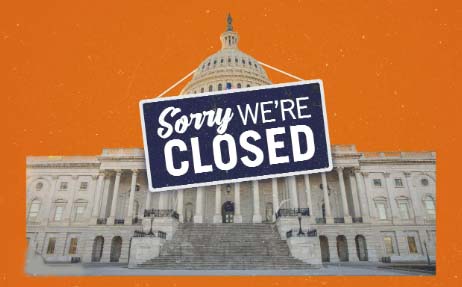
WASHINGTON, D.C. – When — and if — the U.S. Government shuts down on Sunday, Oct. 1, the world as we know it will end.
Not really, despite all the hand-wringing and drama on Capitol Hill.
The staff of Roll Call, the inside-the-Beltway website that covers Congress, has been keeping a running total of which government services will be impacted when the federal money runs out with the start of the new fiscal year.
If nothing else, it will surely be inconvenient, folks.
For retirees here in Utah, the best news is that their monthly Social Security allotments will not be delayed or postponed. Because the funding for those checks is considered to be part of “mandatory” federal spending, it will not be interrupted by the government shutdown.
Nor will Medicare payments for retiree health coverage be affected, for the same reason.
Closer to home, however, Utah’s tourism industry will take a hit to the tune of an estimated $7.1 million a day when federal funding for the Beehive State’s busy national parks is cut off.
“Our tourism economy is … of vital importance,” Utah Gov. Spencer Cox said Sept. 28. “We’ve communicated to Interior Secretary (Deb) Haaland our plan to keep Utah’s national parks open if she is willing to work with us.”
Utah is home to five national parks — Zion, Arches, Bryce Canyon, Capitol Reef and Canyonlands – as well as numerous federal recreation areas. Utah officials have identified short-term funding options to keep those national parks open on a limited basis during the looming government shutdown.
But the workers at those parks and recreation areas are Department of Interior employees and Haaland has not yet agreed to allow Utah to fund their work during the shut down.
Cox admitted that he hopes that any state funds expanded to keep those facilities open would be reimbursed by the federal government when the fiscal crisis is over.
In a Sept. 27 letter to Haaland, Sen. Mike Lee (R-UT) urged her to utilize the provisions of the Federal Lands Recreation Enhancement Act (FLREA) to fund uninterrupted essential park operations with entrance fee dollars, a procedure that was utilized during the 2018-2019 government shutdown.
Lee also demanded prompt restitution to Utah for any state funds to national parks expended during the shutdown.
If the government shuts down, Roll Call reports, its non-essential functions would cease.
The people most responsible for the federal shutdown — members of Congress and President Joe Biden — would continue to be paid. But they’d be lonely on Capitol Hill and in the White House, since the majority of their staff members are considered non-essential.
Federal workers – including military members — wouldn’t get paychecks for the duration of the shutdown. Most federal workers would be sent home, but service members would be required to continue to report to their duty stations without compensation.
With few exceptions, the bulk of Department of Defense civilians and other federal employees of cabinet departments will be placed on furlough without pay.
Millions of contractors working for federal agencies will also go without pay during the shutdown.
The U.S. Postal Service would not be affected by the government shutdown, however. That agency is funded through the sales of products and services, not taxpayer dollars.
Many households across the nation would not receive usual federal assistance, including WIC benefits.
The Special Supplemental Nutrition Program for Women, Infants and Children (WIC) provides federal grants to states for supplemental foods, health care referrals and nutrition education for low-income pregnant, breastfeeding and non-breastfeeding postpartum women. The program also benefits infants and children up to age 5 who are found to be at nutritional risk.
“In Utah,” Cox said, “our number one priority is our families and we will not let down the families who depend on the WIC program.”
State official report that WIC benefits will be available to eligible families, including more than 44,000 Utah mothers and children, throughout the month of October using funds from the U.S. Department of Agriculture.
Experts says that food assistance through the federal Supplemental Nutrition Assistance Program (SNAP) is on a better footing than WIC, which would likely be affected within days of a shutdown. But SNAP benefits would also be at risk if a shutdown persists for more than a couple weeks.
About 90 percent of employees of the U.S. Department of Education will be furloughed for the duration of the shutdown, which will delay the recently resumed processing of student loan payments.
The federal government is poised to enter a shutdown this year because hard-line conservatives in the Republican-controlled U.S. House of Representatives are using the threat of a shutdown to force deep cuts in federal spending.
As of Sept. 28, the House was scheduled to vote on four funding bills that would bankroll defense and national security agencies, but those bills are dead on arrival in the Senate, which is controlled by Democrats.
The Senate has been working in a bipartisan manner to craft a continuing resolution to fund the government through Nov. 17. That measure could pass that chamber in the coming days, though perhaps not before the weekend shutdown deadline.
But conservatives in the House have already said that they will not vote for that stopgap measure.
There have been 14 shutdowns for similar reasons since 1980. The most recent was a partial shutdown in 2018-19. It was also the longest, lasting 34 days.
A shutdown affects “discretionary” spending. “Mandatory” spending – like Social Security, Medicare and interest payment on the national debt – is spared because it doesn’t require annual congressional approval.
Discretionary spending accounted for only about 27% of the $6 trillion federal budget in fiscal year 2022, according to the Congressional Budget Office.
Travelers can expect delays during the pending shutdown.
Personnel like air traffic controllers and Transportation Security Administration workers are generally considered essential, but may not keep coming to work after a few weeks without pay. Such absenteeism was a problem during 34-day shutdown in 2018-19.
Delays can also be expected in obtaining veterans benefits, farm loans and home mortgage closings that require federal flood insurance.
“It’s extremely disappointing that Congress is unwilling to fulfill its most basic obligation of funding the government,” Cox complained.
“But Utah is prepared to step up and do what it takes to reduce the impact of a federal shutdown on Utah families.”