
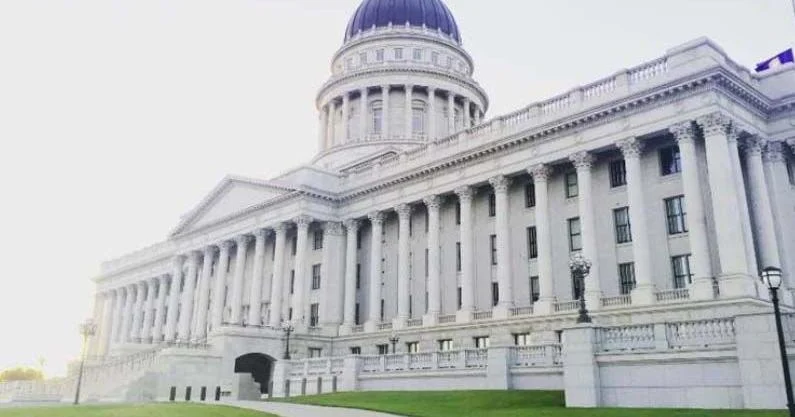
SALT LAKE CITY – On Jan. 31, Gov. Spencer Cox quietly signed the first 10 bills passed by the Utah Legislature during its current general session.
Nine of those bills were routine base budget amendments, but the last measure has succeeded in enraging Democrats.
Senate Bill 134 (Court Amendments) was jointly sponsored by Sen. Chris Wilson (R-Logan) and Rep. Casey Snider (R-Paradise). It increases the number of justices on the Utah Supreme Court, the Court of Appeals and District Courts.
Utah is one of the fastest-growing states in the nation, according to Wilson. Over the years, Utah has added district court judges to respond to population growth, while the appellate courts and Supreme Court have remained the same size for decades.
“As Utah’s population has grown and legal issues have become more complex,” the Logan senator explains, “these courts are now managing significantly heavier caseloads. This has led to delays, backlogs and longer wait times for decisions that directly affect Utah families and businesses.”
SB 134 will add two justices to the Utah Supreme Court, increasing its size five to seven jurists; add two judges to the Court of Appeals, up to nine justices from the current seven; add one judges each to District Courts 3, 4 and 5; and will provide additional staff to support the work of the judiciary.
Utah Democrats reacted by accusing their Republican colleagues of trying once again to “pack the courts.”
“Nobody is against fixing real backlogs …” the Utah Democrats argued in Feb. 1 social media post. “That’s all reasonable.
“But what’s happening now goes far beyond that. Packing the courts right after decisions on redistricting and fair (congressional) maps feels less like a solution and a lot like payback.”
The Democratic lawmakers are also reportedly concerned about other legislative proposals that to will impact the courts. In a Feb. 1 social media post, they raise red flags about those measures that include Senate Joint Resolution 3; House Joint Resolutions 5 and 13; and House Bills 262 and 392.
SJR 3 (Joint Resolution Amending Rules Relating to the Practice of Law) would limit how the Utah Supreme Court and the State Bar set and use attorney-licensing fees.
Democrats contend that the proposed law would change who controls the legal system by shifting power from the judiciary to the Legislature.
HJR 5 (Judicial Nomination Amendments) would allow the governor to appoint judges without recommendations from the Utah Judicial Commission.
That would weaken Utah’s merit-based judicial selection system and shift power to the executive branch, Democrats argue.
HJR 13 (Judicial Retention Amendments) would allow lawmakers to call a special election for any judge they deem unfit or incompetent.
Democrats also oppose that measure, saying it threatens judicial independence by blurring the line between accountability and political pressure.
One obvious target of HJR 13 would be District 3 Judge Dianna Gibson who threw out the Legislature’s congressional map plan in November and directed the state to adopt a map that includes a Democrat-leaning district anchored in northern Salt Lake County.
HR 262 (Judicial Election Amendments) would raise the number of votes needed for judges to retain their seats on the bench.
Democrats charge that proposal would make it easier for organized political campaigns to oust judges.
Finally, HB 392 (Constitutional Court Amendments) would create a new state trial-level Constitutional Court to hear challenges to state laws.
This proposal would allow lawmakers to pack the new court with justices that align with their ideologies, according to Democrats.
In a recent newsletter to constituents, Wilson defended the Legislature’s intent to return stability to the system of checks and balances within Utah’s government.
“Court delays have created uncertainty for communities, counties and candidates,” he wrote. “Local election officials cannot plan effectively when maps are changed suddenly.
“Utahns deserve a process that is predictable and reliable. Our goal is to restore stability, protect the voice of the people and ensure that Utah’s future is governed by Utahns—not outside interests.”
Democrats continue to disagree, however, saying that the proposed new laws set a dangerous precedent.
“When the highest court can be reshaped whenever someone disagrees with it decisions,” they argue, “trust in our judicial system takes a serious hit.
“Independent courts aren’t a luxury,” they add. “They’re the backbone of our democracy.”