
Iran’s Ministry of Foreign Affairs claimed in a letter to the U.N.’s International Maritime Organization (IMO) that the Strait of Hormuz, the critical maritime passage for the oil and shipping trades, is open to “non-hostile” vessels.
In the letter, dated March 22, the Iranians define “non-hostile” ships as those from countries that “neither participate nor support acts of aggression against Iran” posed by the United States and Israel. The letter goes on to say that non-hostile vessels passing through the strait must “fully comply with the declared safety and security regulations,” which the Iranians didn’t specify.
“It is further underscored that vessels, equipment, and any assets belonging to the aggressor parties — namely the United States and the Israeli regime — as well as other participants in the aggression, do not qualify for innocent or non-hostile passage,” the Iranians said in the letter.

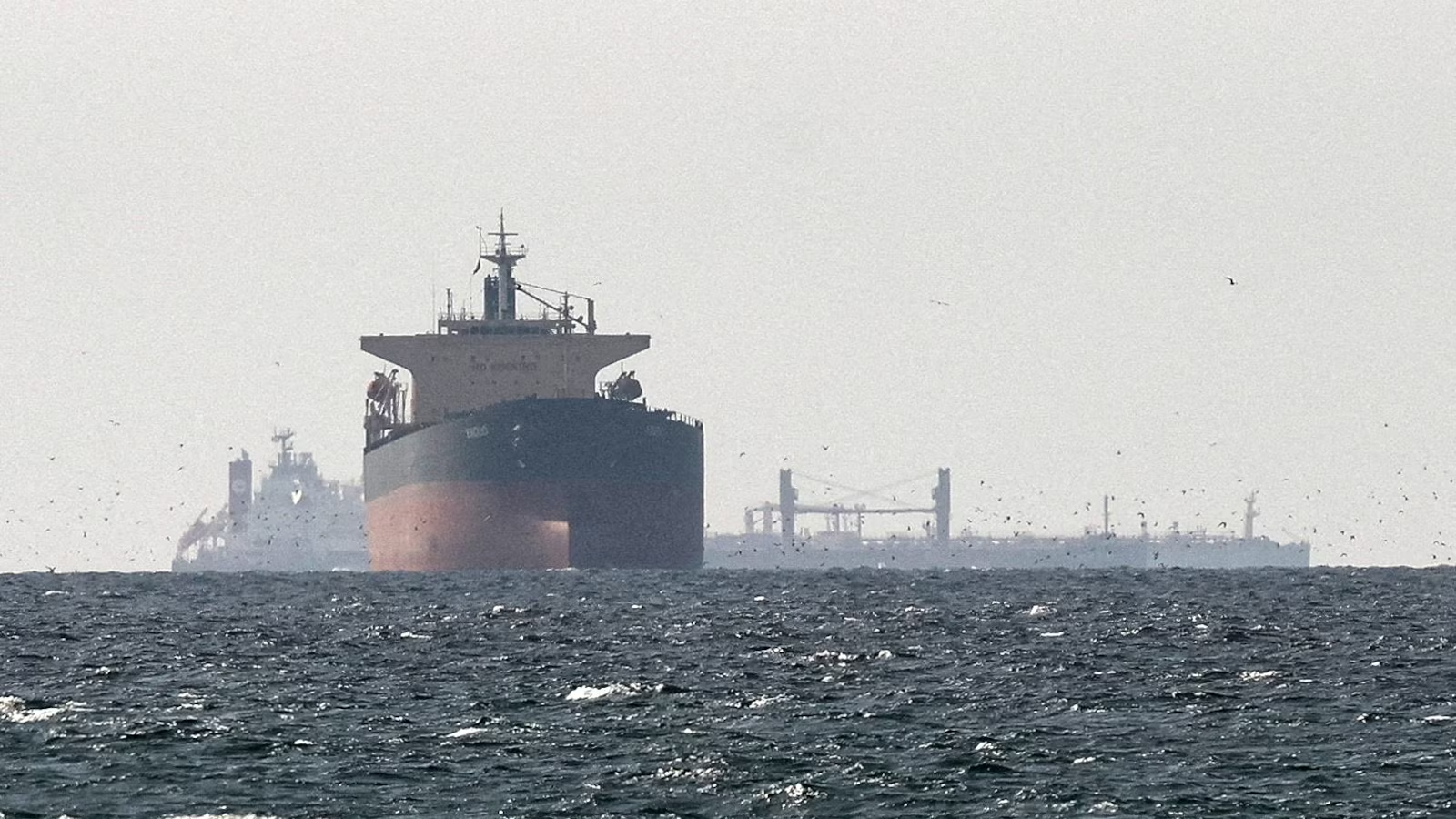
An LPG gas tanker at anchor as traffic is down in the Strait of Hormuz, amid the U.S.-Israeli conflict with Iran, in Shinas, Oman, March 11, 2026.
Benoit Tessier/Reuters
The letter goes on to say that in the interest of self-defense, Iran has, “in addition to targeting U.S. military bases and facilities in the region, taken necessary and proportionate measures to prevent the aggressors and their supporters from exploiting the Strait of Hormuz in advance of hostile operations against Iran.”
The move by Iran comes at the same time the Trump administration has sent the Iranian regime a 15-point plan to end the military conflict, which began on Feb. 28 with a joint attack by the U.S. and Israel.
On Wednesday, Press TV, Iran’s English-language state media, quoted an Iranian official saying Iran has rejected the proposal.

Map of the Strait of Hormuz
Anadolu via Getty Images
“Iran will end the war when it decides to do so and when its own conditions are met,” the Iranian official said. According to Press TV, Iran’s conditions include recognition of its sovereignty over the Strait of Hormuz.
In a separate interview, the Iranian Foreign Minister Abbas Araghchi said on state TV that “Iran’s power is the Hormuz Strait.”
“I also want to say here that, from our point of view, the Hormuz Strait is not completely closed; it is closed only to our natural enemies,” Araghchi said. “We are in a wartime situation; the region is a war zone. There is no reason to allow the ships of our enemies and their allies to pass, but it is free for the rest.”
During a briefing on Wednesday, White House press secretary Karoline Leavitt emphasized the administration’s commitment to addressing the escalating oil crisis, saying “our military also remains laser focused on eliminating the regime’s threat to the free flow of energy through the Strait of Hormuz.”
“Over the weekend, we dropped several 5,000-pound bombs on an underground facility used to store equipment, including anti-ship cruise missiles and mobile missile launchers positioned along the coastline of the strait. Our military efforts grow more successful with each passing day, steadily degrading Iran’s ability to terrorize merchant ships,” Leavitt said.
Asked when the oil tankers can be expected to travel freely through the strait, Leavitt declined to provide a timeline.
On Tuesday, Iran’s Defense Council threatened to deploy naval mines across the “entire Persian Gulf” if the U.S. sends ground troops into Iran.
It remained unclear on Wednesday whether Iran’s letter to the IMO will convince shipowners who meet Iran’s “non-hostile” definition to risk sending vessels through the strait.

Smoke rises from the Thai bulk carrier ‘Mayuree Naree’ near the Strait of Hormuz after an attack, March 11, 2026.
Royal Thai Navy/Reuters
An IMO spokesperson verified on Wednesday that 18 commercial ships in the Persian Gulf near the Strait of Hormuz had been targeted in strikes, killing seven seafarers and one port worker.
At least five oil and gas tankers have already been targeted by Iranian strikes in the Persian Gulf, according to an ABC News analysis.
The IMO spokesperson said some 20,000 seafarers are stranded in the Persian Gulf due to the strait being closed and are “facing mental strain, fatigue and decreasing supplies.”
Ed Finley-Richardson, a shipping investment analyst for Contango Research, told ABC News on Wednesday that Iran’s letter to the IMO “is clearly disingenuous.”
“Iran has targeted neutral commercial vessels with no ties to the U.S. or Israel in order to create an atmosphere of terror which prevents an essential trade corridor from functioning,” Finley-Richardson said.
In 2024, an average of about 20 million barrels of oil per day passed through the strait, which amounts to roughly 20% of liquid petroleum consumed worldwide, according to the U.S. Energy Information Administration (EIA).

Luojiashan tanker sits anchored in Muscat, as Iran vows to close the Strait of Hormuz, amid the U.S.-Israeli conflict with Iran, in Muscat, Oman, March 7, 2026.
Benoit Tessier/Reuters
The vast majority of oil that passes through the strait, the critical narrow passage between the southern coast of Iran and the northern coast of Oman that leads into the Arabian Sea, is bound for Asian markets. Nearly 5 million barrels of oil arrived in China via the strait each day in 2024, the EIA said, while about 2 million barrels of oil per day ended up in India.
According to data provided by MarineTraffic, which tracks global ship traffic, some activity may be resuming in the strait. Nine vessels — including those bearing the flags of India, Palau, Comoros, Curacao and Panama — have all safely crossed the strait since Tuesday, according to MarineTraffic.
“We are also now seeing occasional passage granted to Indian and other Asian vessel owners, but it seems to be on an unpredictable, ad hoc basis,” Finley-Richardson said.
Ramanan Krishnamoorti, a professor of petroleum engineering at the University of Houston, told ABC News on Wednesday that Iran appears to be trying to appease countries like China and India by opening up the strait to their vessels.
“I think those are the countries that have not been in the crosshairs of the Iranians because they’re looking to trade with them and they’ve got partnerships with them. And, in fact, a lot of their oil goes to China and India,” he said.
But at the same time, Krishnamoorti said Iran seems to be determined to create “economic war between the U.S. and China and India.”
“In some ways, the Iranians are playing this global game of appeasing certain groups to make sure that they aren’t seen as the villains of the world,” Krishnamoorti said.
He said Iran could also be attempting to add “fissures to the links between the United States and Europe,” which also greatly depends on oil shipped through the strait.
“Some of this is going to relieve the stress on Europe. Europe has been steadfast in its approach that this is not their war,” Krishnamoorti said.
He noted that the Iranians are “playing a very strong political game here.”
“So, we might have decapitated a lot of the leadership, but they are still able to find ways to create fissures in our ecosystem,” he said.