
After President Donald Trump declared the memorandum of understanding between the U.S. and Iran was “over” on July 7, he threatened heavy strikes on Iran whenever commercial vessels were hit in the Strait of Hormuz or the Bab al-Mandeb Strait.
But after nearly two weeks of escalating strikes by Iran with no announced military responses by the U.S., the president hasn’t carried through his earlier threats of retaliation.
Trump posted on his social media platform on July 22 that, “From this point forward,” any time Iran shoots at a ship in the Strait of Hormuz, the U.S. will “bomb and destroy ONE BRIDGE OR POWER PLANT, including those located next to, or in, the Capital City of Tehran.”

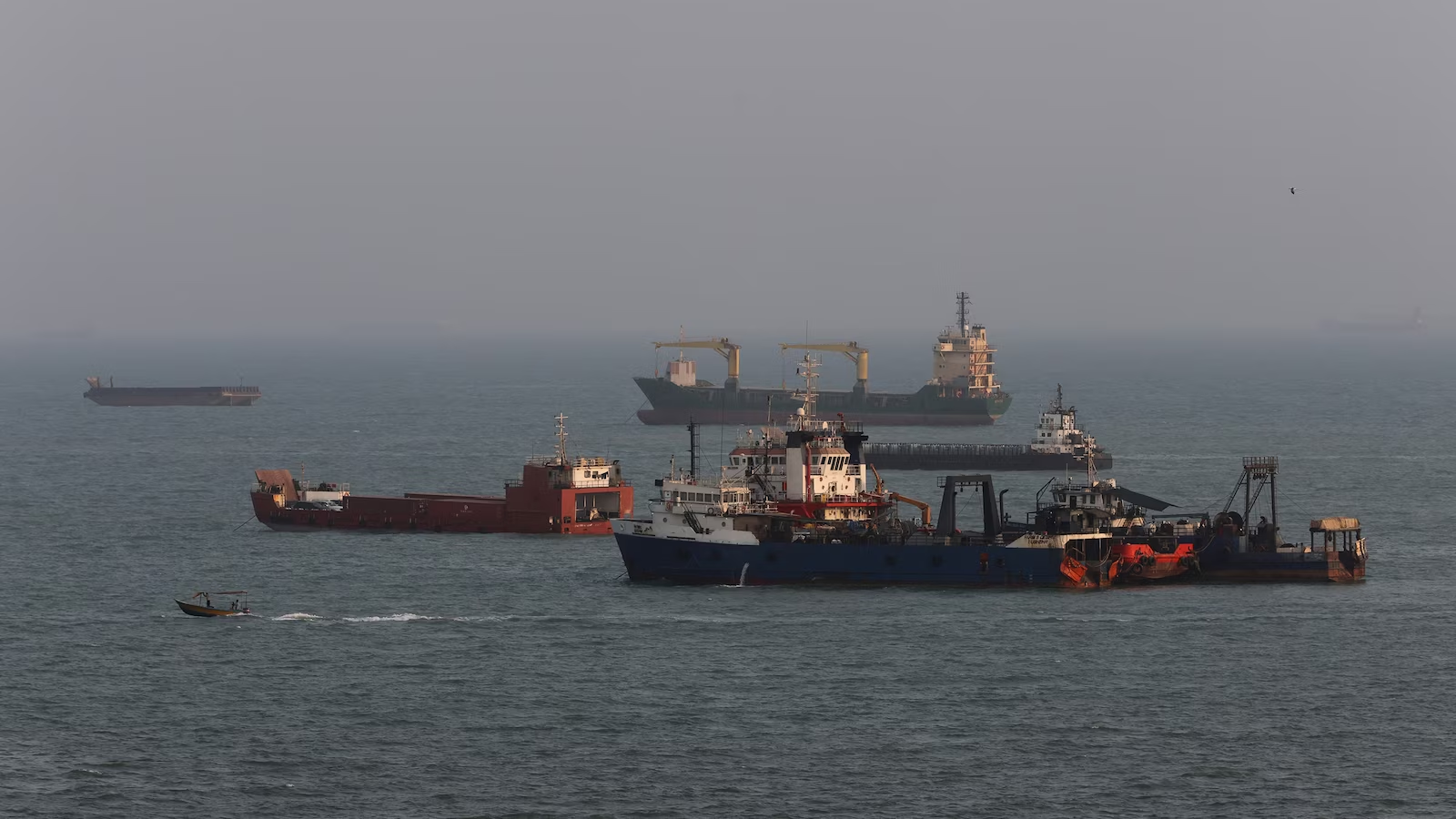
Ships are anchored in the Strait of Hormuz, Aug. 10, 2026, off the coast of Bandar Abbas, Iran.
Ali Saeedi/Getty Images
The president has since shifted his messaging.
On Wednesday, he downplayed attacks on commercial vessels in the Strait of Hormuz, saying they were only of “nuisance value.”
That is a break with a standard the U.S. set throughout the conflict, in which it regularly retaliated to protect freedom of navigation in the strait.
Trump continues to assert that the U.S. has “complete control” of the strait despite ongoing attacks and dramatically reduced commercial shipping traffic.
Since the last reported U.S. strike on Iranian targets on July 29, there have been 11 commercial vessels hit in the Strait of Hormuz or the Bab al-Mandeb Strait, resulting in multiple casualties to crews, according to the United Kingdom Maritime Trade Operations (UKMTO) Centre.
U.S. Central Command (CENTCOM), which oversees American forces in the Middle East, has not announced any U.S. military operations in response to the continuous strikes that the president dismissed on Wednesday. The last retaliatory strikes publicized by CENTCOM were in late July.

President Donald Trump speaks to the press at the construction site of a helipad on the South Lawn of the White House in Washington, August 19, 2026.
Manuel Balce Ceneta/AP Photo
On Tuesday, crossings of the Strait of Hormuz declined 17% from the previous day to 10, with six vessels exiting the Persian Gulf and four entering, according to ship tracker Kpler.
The U.S. military restraint contrasts with Trump’s strategy earlier this summer, in which the U.S. conducted strikes on Iran as “retribution” beginning on July 7 following Iran’s attacks on three commercial vessels in the Strait of Hormuz, marking the end of the memorandum of understanding the two countries agreed to in June.
From the time when Trump declared the MOU “dead” to the last U.S. strike on July 29, there were approximately 17 commercial vessels struck in the Strait of Hormuz or the Bab al-Mandeb Strait. During that time, the U.S. responded to these attacks for 16 days in total, including a period of 13 consecutive nights of strikes on Iran.
“We just hit them very hard, and I say we hit them 20-1. Every time they hit us, we’re going to hit them 20,” Trump told reporters on July 7. “And when they hit, we hit back much harder.”
Trump continued to express escalating U.S. military operations in response to strikes on commercial shipping through July.
Top Trump officials, including Secretary of Defense Pete Hegseth and Secretary of State Marco Rubio, reiterated Trump’s military strategy several times.
“The president’s policy is a head for an eye. I mean, honestly, that’s what it’s going to be. I mean, they will pay a very heavy price,” Rubio said on July 22 at The Association of Southeast Asian Nations summit in the Philippines.