The Supreme Court on Tuesday sided with a group of mostly Republican-led states and ordered the Trump-era public health protocol known as Title 42, which allows the expulsion of migrants at the border, to remain in place pending a hearing before the justices.
The 5-4 decision reverses lower court rulings that Title 42 had to end in December and means that the policy will remain in effect until a final ruling.
The Supreme Court scheduled oral arguments on the appeal for February but said in a statement that “the stay itself does not prevent the federal government from taking any action with respect to that policy.”
In other words, in the court’s view, the Biden administration still has the power and prerogative to discontinue the policy on its own if it so chooses.
The court said it was preparing to examine a narrow, procedural question unrelated to the merits of Title 42 itself: whether the states challenging the policy may intervene to challenge the district court’s summary judgment order. Justices Samuel Alito, Brett Kavanaugh, Amy Coney Barrett, John Roberts and Clarence Thomas, all members of the conservative wing, agreed to grant a hearing on the appeal.
Justices Sonia Sotomayor and Elena Kagan indicated that they would have denied the application from the states. Justices Neil Gorsuch and Ketanji Brown Jackson also would have denied the application, writing in dissent that “we are a court of law, not policymakers of last resort.”

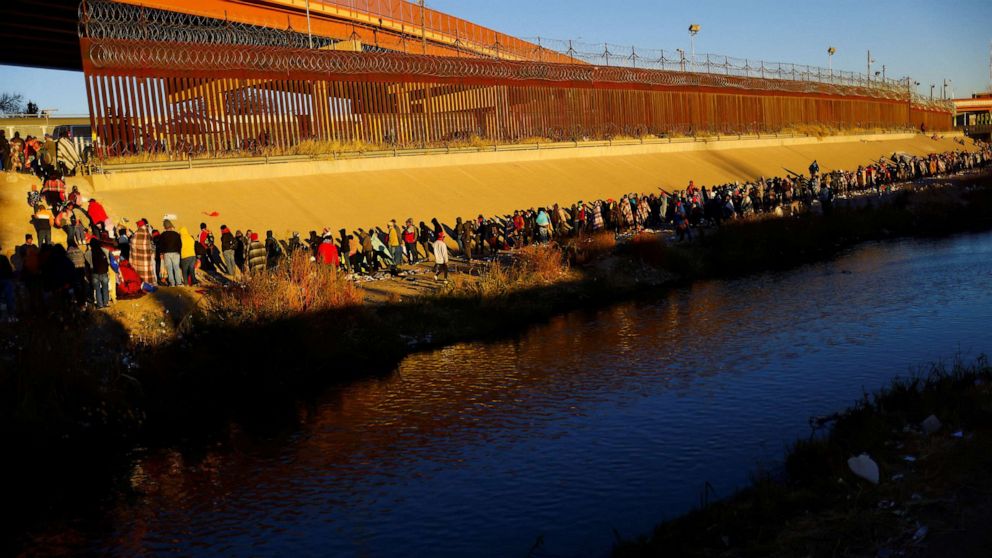
Migrants queue near the border wall after crossing the Rio Bravo river to turn themselves in to U.S. Border Patrol agents to request asylum in the U.S. city of El Paso, Texas, as seen from Ciudad Juarez, Mexico, on Dec. 14, 2022.
Jose Luis Gonzalez/Reuters
U.S. District Judge Emmet Sullivan previously set a Dec. 21 deadline to terminate the fast-track expulsion order, finding it “arbitrary and capricious,” with minimal public health impact.
That date will now be pushed back for several months until the Supreme Court holds its hearing and issues its ruling.
Nineteen states intervened after Sullivan’s decision in November. They have contended that Title 42 ending would create a “crisis” of unauthorized migration that would unduly burden law enforcement, education and health care services.
Their appeal was denied in December and the states filed an emergency application with Supreme Court Chief Justice Roberts on Dec. 19.
Roberts, who oversees the appellate circuit handling the case, initially granted a temporary stay later that day, allowing the court time to consider the application.
The justices have now agreed to hear the states’ appeal and issued a longer stay until after their decision on Title 42’s fate.
Migrant and civil rights advocates argue Title 42 illegally prevents people from making asylum claims while trying to enter the U.S.
This is a developing story. Please check back for updates.