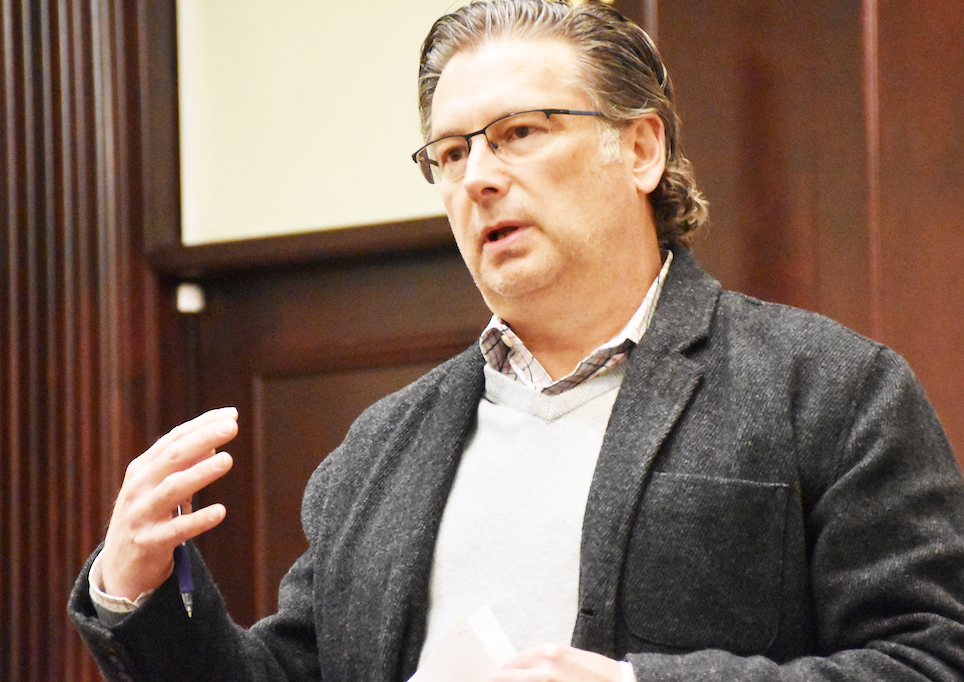
During a town hall meeting with local residents Tuesday at the Cache County Historic Courthouse, Utah Sen. Chris Wilson (R-Dist. 25) discussed funding priorities for the upcoming 2023 Legislature.
SALT LAKE CITY — More than six weeks prior to the start of the 2023 Legislature, lobbyists and special interest groups here are already arguing about how to cut up Utah’s supposed $3.3 billion budget surplus next year.
“I’m not sure where that figure came from,” admitted Sen. Chris Wilson (R-Dist. 25), the chair of the Senate’s Infrastructure and General Government Appropriations Subcommittee.
“As far as I know, the Legislature is preparing to deal with a $1.3 billion surplus,” Wilson added, prior to a town hall meeting in the Cache County Historic Courthouse on Tuesday evening.
Wilson’s candid remarks jibe with a recent joint announcement of a budget surplus by Gov. Spencer Cox, Senate President J. Stuart Adams and House Speaker Brad Wilson.
That mid-November release indicated that lawmakers will have an additional $130.2 million in the General Fund and $1.235 billion in the Income Tax Fund to appropriate during the next session of the Legislature.
“Strong fiscal policy and Utah’s entrepreneurial spirit have created an optimistic economic forecast for our state,” said Cox in the prepared statement.
“Many anomalies – included unparalleled federal funding – have led to this surplus revenue,” he added.
State funds in 2023 will also benefit from an 11 percent increase in income tax revenue and additional increases in revenue from sales tax, federal mineral leases and oil and gas mining severance taxes, according to officials.
Speculation about the possibility of a growing budget surplus was fed by media reports reminding lawmakers that the $1.3 billion is on top of nearly $2 billion that was previously set aside as reserves for the next fiscal year.
But Wilson downplayed that hype, noting that most of those additional funds are already committed to state purposes, including funding public education.
During meetings in late November, Utah’s Revenue and Taxation Interim Committee approved draft legislation that would reduce the state’s income tax rate from 4.85 percent to 4.8 percent.
The Utah Taxpayers Association has also weighed in with a proposal to reduce the income tax to 4.5 percent, which could be accomplished even after providing healthy increases to education spending and other priorities.
Other possible uses for surplus funds being discussed in legislative interim committee meetings include higher pay for teachers and other state employees as well as increasing the exemption that residential homeowner receive on their property taxes.
On Tuesday night, however, Wilson suggested that much of this discussion was premature.
“The Senate’s top three priorities,” he explained, “will be increasing teacher salaries; continuing to cope with the state’s water crisis; and cutting income taxes.”
Uncertainty about the funding surplus remains because Utah faces an unpredictable future, he said, including the possibility of an economic recession.
Adding to that uncertainty is the fact that much of the budget surplus is the result of inflation, economic volatility and income tax payments related to stock market and real estate capital gains in 2021.
Echoing the Cox statement on the budget surplus in mid-November, Wilson also warned that much of the anomalous $1.3 billion budget windfall is one-time funds that must be handled carefully by lawmakers.
“State leaders will use caution in spending these funds,” Cox promised earlier. “We remain committed to fiscal responsibility as we seek to fund projects that will serve our state now and for generations to come.”
That careful emphasis on fiscal responsibility, Cox explained, will include the use of one-time money for one-time costs only.