
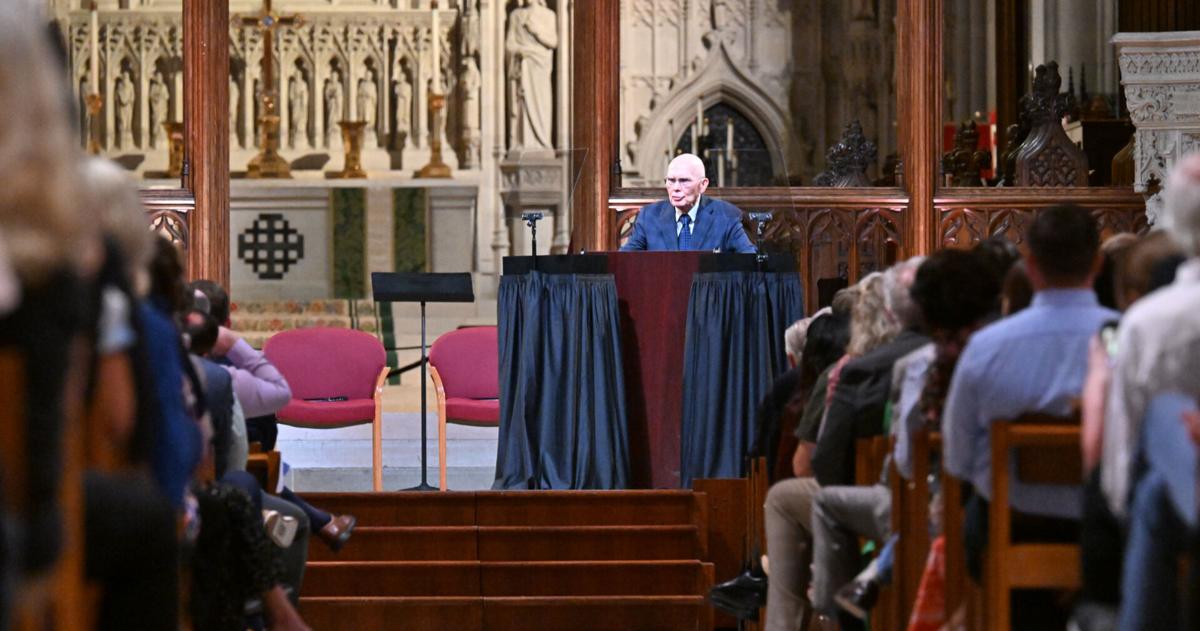
SALT LAKE CITY — President Dallin H. Oaks of The Church of Jesus Christ of Latter-day Saints delivered a historic address on religious freedom Wednesday at the Washington National Cathedral, characterizing the U.S. Constitution as a vital mechanism for civic peacemaking in a polarized nation.
Speaking on the eve of Constitution Day, Oaks became the first president of the faith to address the national cathedral. The event, titled “Faith, Freedom and the Common Good,” was presented as part of the cathedral’s “A Better Way” speaker series in partnership with Brigham Young University’s Wheatley Institute.
Oaks, who served as a Utah Supreme Court justice and clerked for U.S. Supreme Court Chief Justice Earl Warren, brought seven decades of constitutional study to his remarks. He told attendees that the nation’s founding document actively pushes opposing political factions toward constructive compromise.
“The Constitution compels a divided people to build coalitions to allow them to act together,” Oaks said. “‘Compels’ is a strong word, but it is exactly what the Constitution does. It puts what we now call ‘peacemaking’ at the heart of the Constitution’s process for achieving freedom and unity, and fairness for all.”
Reflecting on the Church’s history as a religious minority, Oaks explained that Latter-day Saints became advocates for compromise out of necessity after facing early persecution and expulsion in the 19th century. He pointed to the 2015 “Utah Compromise”—state legislation that simultaneously extended nondiscrimination protections and religious liberty guarantees—as a prime model of constitutional negotiation where opposing sides achieved a win-win outcome without sacrificing core principles.
Oaks encouraged Americans to view contentious societal issues as opportunities to listen to and learn from fellow citizens, emphasizing that maintaining a democratic society requires living peacefully alongside those holding different values.
“All of us should accept the reality that we are fellow citizens who need each other,” Oaks said. “We should make every effort to understand the experiences and concerns of others, especially when they differ from our own.”
He also highlighted global humanitarian disaster response as a practical form of peacemaking, noting that volunteers assist those in distress regardless of religious background because basic human needs take precedence over ideological divisions.
Oaks concluded by stating that recognizing humanity’s divine identity as children of God provides the moral framework needed to overcome racism and prejudice, closing his address with a prayer for unity.