
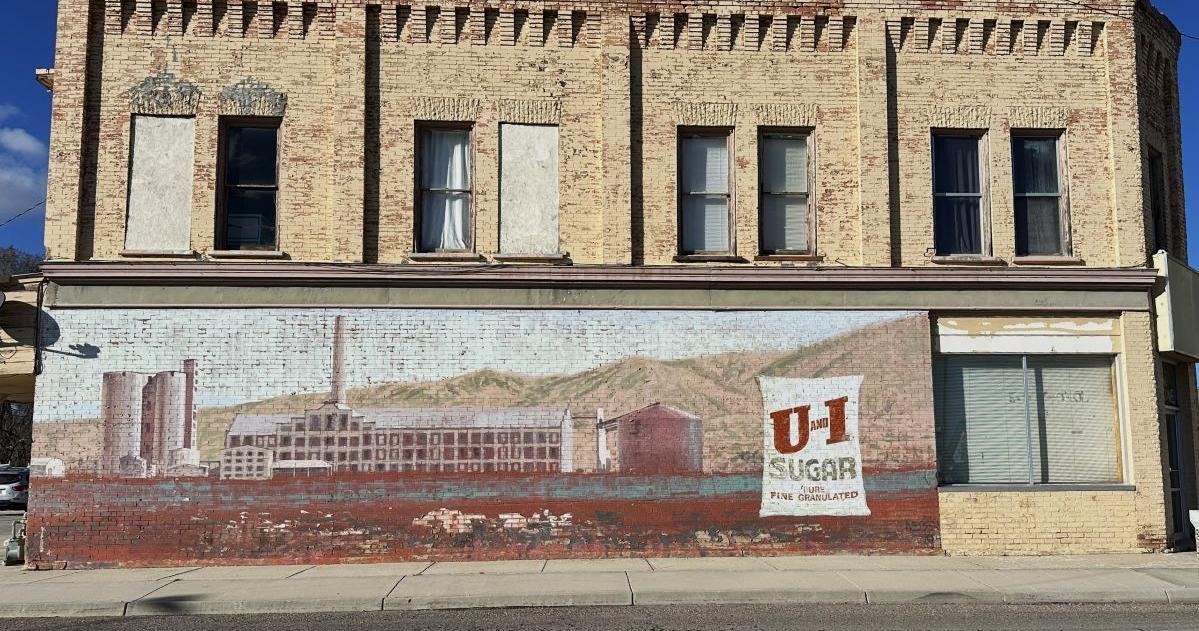
GARLAND – A city located on the east bank of the Malad River, and 25 miles west of Logan is Garland. It is an interesting dichotomy of a town. Some of Garland is a ghost town that died while some still thrives.
The skeleton of Garland Sugar Beet Refinery, with its large smokestack, is a reminder of the once-flourishing industry. The factory employed hundreds if not thousands from 1903 until 1978 as part of the Utah-Idaho Sugar Company.
The sugar beet industry spread to Utah from France and Germany. In 1891, the Utah Sugar Company was organized and the Church of Jesus Christ of Latter-day Saints invested heavily in building sugar processing plants along the Wasatch Front and beyond.
The sugar industry developed in 1891 and had a tremendous impact on the growth of Utah and Garland when the sugar beet refinery came to town. In the beginning there was 2,000 acres of sugar beets planted in the Garland area. By the time the sugar factory shut own there was 7,500 acres of sugar beets planted in the area.
The sediment from the ancient Lake Bonneville left rich soil deposits for farmers from Garland and surrounding areas to grow sugar beets and other crops.
The sugar factory closed after the harvest in 1978.
When the factory closed, Garland’s 57 businesses began to dry up. The refinery was the last of the west’s sugar factories to close and when it shut down the deterioration of most businesses began.
Sugar factories began to close in the mid 1920’s, some of them made it to the 1960’s but the Garland one outlasted them all.
The ghost of the Bank of Garland still marks the east corner of Main Street and Factory Street. Peering in the window can be a step back in time with the small lobby with bars over the counter where at one time clerks would exchange checks for cash. The safe door can still be seen through the glass window.
The doctor and dentists’ offices which took the second floor adjacent to the bank have all been abandoned. There is a sign over where the Garland Billiard Parlor that shares a wall with the old bank is.
A stand-alone movie theater, The Main Theatre, located at Factory St. opened around 1930, said Cinema Treasures, a group of enthusiasts who track theaters across the country. According to them, the place closed in 1985 and sits vacant today.
The empty Hyrum Jensen Furniture and Hardware Store with its rooms for rent atop the store are part of Garland’s heyday.
Only four businesses remain that have lasted the years since the factory closed. One of them is Sofa’s Corner, located at 91 E. Factory St.
The bar never closed and if it did it could never be reopened because of its proximity to the tabernacle and library, said co-owner Patty Grover.
“The bar is grandfathered in,” she said. “As long as Sofa’s bar stays open it will stay where it’s at.”
The Garland Public Library, located at 86 E. Factory St., is listed on the National Register of Historic Places. It was built as a Carnegie library in 1914 and is still in use today.
The Tabernacle of The Church of Jesus Christ of Latter-day day Saints is still being used by a local stake. In 1903 the sugar factory in Garland donated land to the church for the building. Church members built the tabernacle themselves. It seated up to 1,500 at the cost of $55,000. Three additions were completed on the building; the last one was in 1974.
Settlers began arriving in the Garland area in the late 1880s and acquired land by purchasing it or by homesteading.
The first school in Garland was built in 1898 and was located one mile north of the main intersection.
in 1921, down Main Street a ways, Bear River High School was built at the southern edge of Garland and continues to serve students from both Garland and Tremonton since its construction.
During the 1930s, Works Progress Administration (WPA) built the Utah National Guard facilities which today houses the Garland Fire Department and Garland city offices.
For people wanting to explore ghost towns, the old part of Garland could be a fun place to visit.