
LONDON — European leaders hit back at U.S. President Donald Trump’s announcement that he would impose sanctions on nations that deployed small numbers of military forces to Greenland last week, as the president continues his push to acquire the Arctic territory.
Trump said Saturday that a 10% tariff would be imposed on all goods sent to the U.S. from Denmark, Norway, Sweden, France, Germany, the U.K., the Netherlands and Finland.
Trump said the new tariffs will come into force on Feb. 1, and will increase to 25% on June 1. The president said the measures would remain in place until the U.S. is able to purchase Greenland.
Greenland is a self-governing territory of the Kingdom of Denmark. Trump first raised the prospect of acquiring the minerals-rich island in his first term. Danish and Greenlandic politicians have repeatedly rebuffed such proposals.
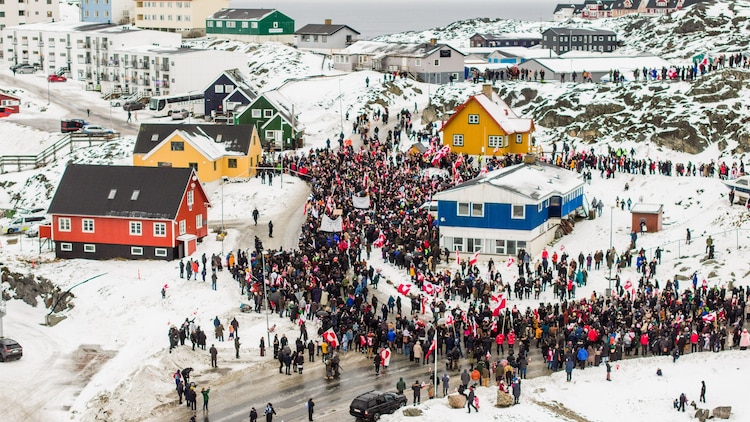
This aerial view shows people as they take part in a demonstration that gathered almost a third of the city population to protest against the US President’s plans to take Greenland, Jan. 17, 2026, in Nuuk, Greenland.
Mads Schmidt Rasmussen/Arctic Creative/AFP via Getty
European Commission President Ursula von der Leyen on Saturday said the bloc’s members will meet Trump’s pressure as a united front.
“We have consistently underlined our shared transatlantic interest in peace and security in the Arctic, including through NATO,” she wrote in a post to X. “The pre-coordinated Danish exercise, conducted with allies, responds to the need to strengthen Arctic security and poses no threat to anyone.”
“Tariffs would undermine transatlantic relations and risk a dangerous downward spiral. Europe will remain united, coordinated and committed to upholding its sovereignty,” von der Leyen said.
Kaja Kallas, the EU’s foreign affairs chief, suggested in a post to X that the escalating tensions between the U.S. and its European allies is a boon for Moscow and Beijing.
“China and Russia must be having a field day,” she wrote. “They are the ones who benefit from divisions among allies. If Greenland’s security is at risk, we can address this inside NATO.”
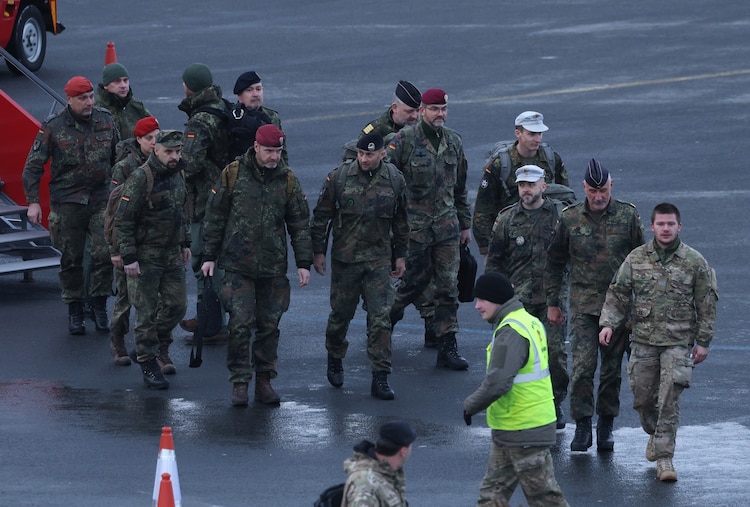
Soldiers of the Bundeswehr, the German armed forces, arrive at Nuuk Airport, January 16, 2026 in Nuuk, Greenland.
Sean Gallup/Getty Images
“Tariffs risk making Europe and the United States poorer and undermine our shared prosperity,” Kallas wrote, suggesting the furor was distracting from allied efforts to support Ukraine against Russia’s ongoing full-scale invasion.
EU pushback against Trump came alongside criticism from national leaders.
“France is committed to the sovereignty and independence of nations,” French President Emmanuel Macron said in a statement Saturday, adding that “no intimidation nor threat will influence us, neither in Ukraine, nor in Greenland, nor anywhere else in the world when we are confronted with such situations.”
“Tariff threats are unacceptable and have no place in this context. Europeans will respond to them in a united and coordinated manner if they were to be confirmed. We will know how to uphold European sovereignty,” Macron said.
British Prime Minister Keir Starmer said, “Applying tariffs on allies for pursuing the collective security of NATO allies is completely wrong.”

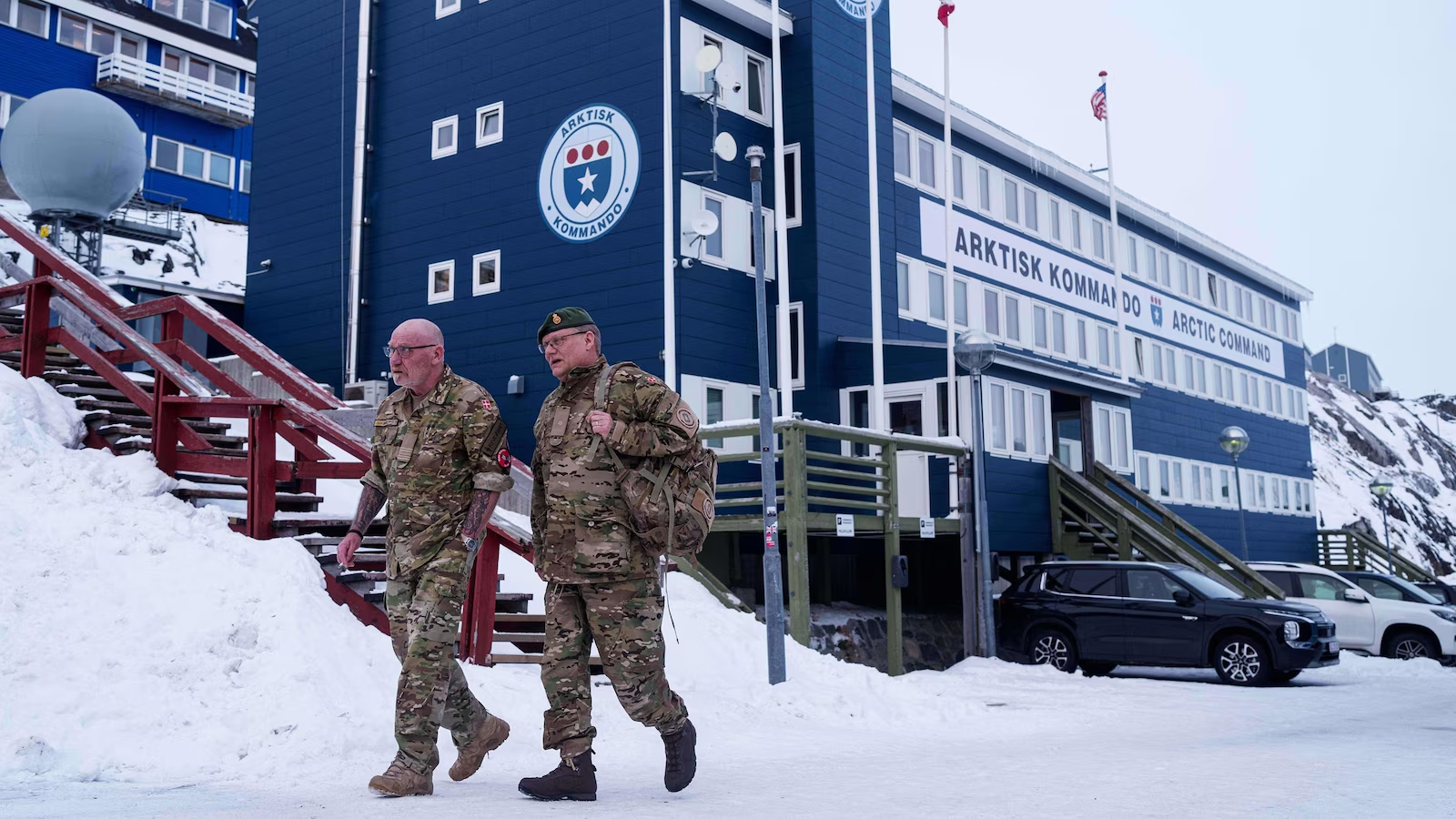
Danish servicemen walk in front of Joint Arctic Command center in Nuuk, Greenland, Jan. 16, 2026.
Evgeniy Maloletka/AP
“Our position on Greenland is very clear — it is part of the Kingdom of Denmark and its future is a matter for the Greenlanders and the Danes,” he said.
Swedish Prime Minister Ulf Kristersson said discussions are ongoing between the affected nations to build a coordinated response.
“We will not let ourselves be blackmailed. Only Denmark and Greenland decide on issues concerning Denmark and Greenland,” he said.
Trump has repeatedly suggested that U.S. sovereignty over the world’s largest island is necessary to ensure American security and blunt Chinese and Russian influence in the Arctic region.
“This is a very dangerous situation for the Safety, Security, and Survival of our Planet. These Countries, who are playing this very dangerous game, have put a level of risk in play that is not tenable or sustainable,” Trump posted on social media on Saturday, referring to deployment of small contingents of troops by European allies.
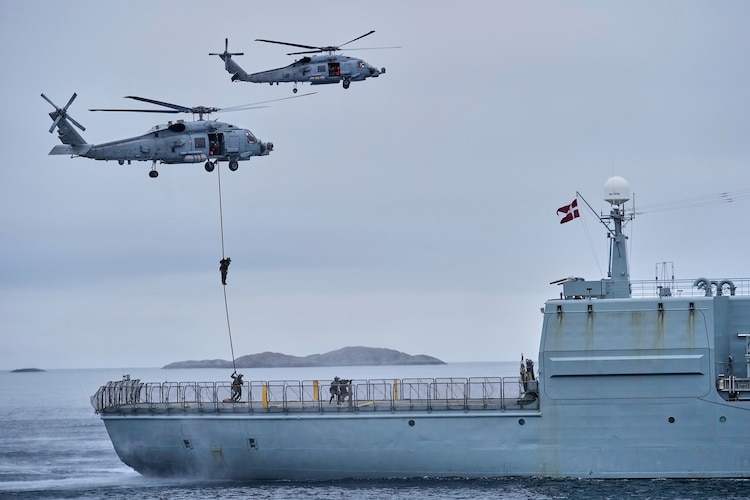
Danish military forces participate in an exercise with hundreds of troops from several European NATO members in the Arctic Ocean in Nuuk, Greenland, Sept. 15, 2025.
Ebrahim Noroozi/AP, Files
“Only the United States of America, under PRESIDENT DONALD J. TRUMP, can play in this game, and very successfully, at that!” he said in the post.
As a part of the Kingdom of Denmark, Greenland is covered by NATO’s collective defense clause. Greenland hosts the U.S. Pituffik Space Base and around 150 American troops, the U.S. having significantly downgraded its footprint from its high point during the Cold War.
A 1951 defense agreement grants the U.S. military access to Greenland. Danish politicians have repeatedly expressed willingness to work with Washington to expand the American and NATO presence there.
Danish officials have also sought to head off concerns about the supposed vulnerability of the Arctic. Last year, Copenhagen announced a $6.5 billion Arctic defense package in response to U.S. criticism that it had failed to adequately protect Greenland.
But such steps do not appear to have deterred Trump, who has said he would consider taking Greenland by force if other means to acquire the land fail.

A woman pulls her children on a sled during a protest against Trump’s policy towards Greenland in front of the US consulate in Nuuk, Greenland, Jan. 17, 2026.
Evgeniy Maloletka/AP
A meeting in Washington, D.C., last week between U.S., Danish and Greenlandic representatives seemingly failed to de-escalate the standoff.
“It’s clear that the president has this wish of conquering over Greenland,” Danish Foreign Minister Lars Løkke Rasmussen told reporters after meeting with Vice President JD Vance and Secretary of State Marco Rubio. Rasmussen said that outcome was “totally unacceptable.”
Rasmussen said Saturday that the president’s threat came as a surprise, citing his “constructive meeting” with Vance and Rubio last week.
Rasmussen said in a statement that the purpose of last week’s military deployments to Greenland “is to enhance security in the Arctic.”
The continued U.S. focus on Greenland prompted protests there this weekend, with crowds of people turning out for a “Stop Trump” march through the capital Nuuk. Greenlandic politicians have collectively and repeatedly said they do not wish to join the U.S.

Protesters hold a banner reading “Yankee Go Home” during a march to the US consulate during a demonstration, under the slogan ‘Greenland belongs to the Greenlandic people’, in Nuuk, Greenland, March 15, 2025.
Christian Klindt Soelbeck/Ritzau Scanpix/AFP via Getty Images
Trump’s efforts have also prompted congressional resistance. On Friday, a bipartisan group of House members and senators traveled to Greenland and said they had “constructive” conversations with members of Denmark’s parliament.
U.S. Sens. Jeanne Shaheen, D-N.H., and Thom Tillis, R-N.C., who were part of the delegation, released a statement Saturday warning that the tariff threat will hurt the U.S.’s relationships with its European counterparts.
“There is no need, or desire, for a costly acquisition or hostile military takeover of Greenland when our Danish and Greenlandic allies are eager to work with us on Arctic security, critical minerals and other priorities under the framework of long-standing treaties,” the lawmakers said in the statement.
Senate Minority Leader Chuck Schumer said on Saturday that Democrats will introduce legislation to block tariffs against countries who oppose a takeover of Greenland.
ABC News’ Victoria Beaule, Chris Boccia, Rashid Haddou, Isabella Murray and Ivan Pereira contributed to this report.