
Editor’s note: This story contains explicit language.
The Department of Justice appears to have withheld dozens of pages of witness notes and reports about an alleged victim of the late sex offender Jeffrey Epstein who, according to Rep. Robert Garcia (D-Calif.), accused President Donald Trump of assaulting her when she was a minor.
An index of witness materials prepared in advance of the trial of Epstein convicted co-conspirator Ghislaine Maxwell suggests that FBI agents interviewed the woman identified by Garcia four times in 2019, but an ABC News search of the DOJ’s vast public archive of Epstein files found a report about just one of the meetings.
An analysis of the index and materials in the public database suggest that three FBI reports — known as 302s — and notes from three interviews were withheld, appearing to total more than fifty pages of material.
Rep. Garcia, the ranking Democrat on the House Oversight Committee, said he reviewed unredacted evidence at the Department of Justice on Monday and determined that notes about the witness who accused President Trump of sexual abuse when she was a minor were withheld.
“Oversight Democrats can confirm that the DOJ appears to have illegally withheld FBI interviews with this survivor who accused President Trump of heinous crimes. Oversight Democrats will open a parallel investigation into this,” Rep. Garcia said in a statement on Tuesday.
The Department of Justice, in a social media post on Tuesday, accused Democrats of “misleading the public while manufacturing outrage from their radical anti-Trump base,” and claimed that all “responsive documents have been produced unless a document falls within one of the following categories: duplicates, privileged, or part of an ongoing federal investigation.”
Oversight Democrats countered that “FBI interviews with a survivor who alleged Trump sexually assaulted her as a child aren’t duplicates or shouldn’t be privileged,” according to a social media post. “Are you saying there’s an active, ongoing federal investigation into President Trump?”
The concerns about the documents were first reported by independent journalist Roger Sollenberger and NPR.
ABC News reached out to an attorney who is believed to have represented the woman, but did not immediately receive a response.
Based on the unique identifying numbers stamped on each document page, the current files released by the DOJ suggest a gap of more than 50 pages of notes and FBI reports about the interviews.
According to an index of witness materials prepared by the Department of Justice, fifteen documents were handed over to Maxwell’s lawyers regarding the witness who Garcia said accused Trump of abuse. Those documents included four FBI reports about interviews with the witness identified by Garcia, three interview notes, three photos, license records, and other FBI reports.
The DOJ’s release of Epstein files earlier this month appeared to contain only six out of the 15 documents — omitting all but one of the interview reports and notes.
What was the allegation?
In July 2025 — after the DOJ had announced that they would release no further Epstein files — members of the FBI prepared a presentation to summarize the investigations into Epstein and Maxwell, including the “salacious statements” made against prominent individuals such as Donald Trump.
Rep. Garcia — who said he reviewed the unredacted versions of the both the presentation and produced 302 on Monday — said the allegations were made by the same individual.
“[The witness] stated Epstein introduced her to Trump who subsequently forced her head down to his exposed penis which she subsequently bit,” the FBI presentation said. “In response, Trump punched her in the head and kicked her out.”
According to the presentation, the allegation is the alleged assault took place between 1983 and 1985 when the victim was between the ages of 13 and 15.
An internal email from July 2025 from a member of the FBI’s New York field office noted that one victim “claimed abuse by Trump but ultimately refused to cooperate.”
Ahead of Maxwell’s 2021 trial on sex trafficking charges, prosecutors turned over any documentation of statements made by witnesses as well as a 63-page index of all materials in their possession. A redacted version of that index was included among the files released by the Department of Justice earlier this month.
While the names of the witnesses were redacted, the index provided a unique identifying number for each document, and every page released by the Department of Justice was individually numbered with what are known as “Bates numbers.”
Searches of the database as of Tuesday morning did not yield any results for the majority of the documents associated with the witness Garcia said claimed Trump assaulted her.
The page number for the only interview report disclosed by the Department of Justice — labeled as 3501.045-001 — ended on the Bates number EFTA000577I5, and the next document released by the DOJ — a photograph labeled 3501.045-008 — resumed with EFTA 00057769, suggesting that at least 50 pages of material may have been omitted from the public release.
What were the reports?
Only one of the four total interview reports created by the FBI was released by the Department of Justice.
The witness told the FBI in that July 24, 2019, interview that she was about 13 years old when she was offered drugs and alcohol and then sexually abused by Epstein after being hired for what she thought was a babysitting job. She said there were no children present, and claims that similar abuse occurred on several more occasions.
Her statement also included allegations that during her fourth or fifth interaction with the man she knew as “JEFF,” there were two other men in the house as well. The agent notes that the witness “may know the name of one man, but she did not feel comfortable providing it at this time,” according to the FBI report. She claimed that the other two men watched and masturbated while JEFF sexually assaulted her. She described the other men as older than JEFF, “fat and disgusting” and with southern accents.
The agent’s notes conclude with an administrative note indicating that the witness became “very emotional” when asked if the other two men participated in the sexual assault, and that she advised agents that she could not continue that day. “The interview ended with the plan to continue with a follow up interview in the near future,” the notes said.
The report from the FBI’s first interview with the woman did not contain allegations against Trump. The president was mentioned during the interview when she identified Epstein by referencing a widely publicized photo of Trump and Epstein sent to her by a friend in 2019, a few months before her interview. The victim told agents that she wanted to crop the photo to only identify Epstein.
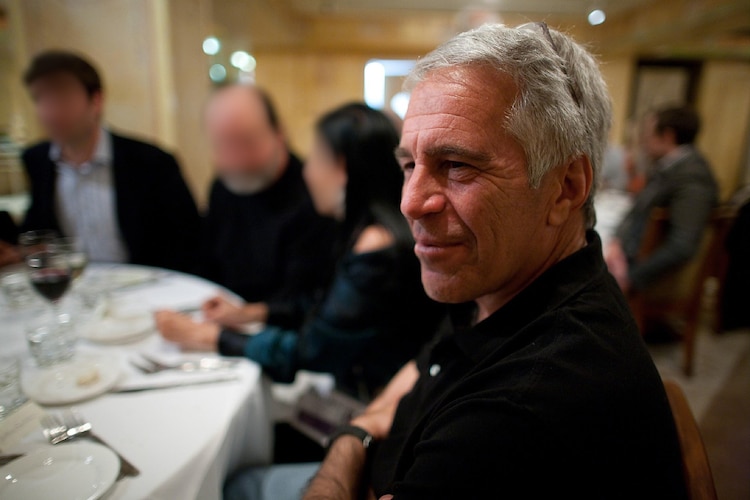
An undated photo from the estate of Jeffrey Epstein is part of a collection of images released Dec. 18, 2025, by Democrats on the House Oversight Committee.
House Oversight Committee Democrats
“The Agents asked whether [she] would be comfortable explaining why she wanted to crop the photograph. When [she] hesitated, [her] attorney advised [she] was concerned about implicating additional individuals, and specifically any that were well known, due to fear of retaliation,” the notes said. “The Agents advised [her that] she could crop the image to show only what she felt comfortable with if she felt it was necessary.”
According to the report, the woman said she “had met” the other person who was cropped out of the photograph but provided no further information.
According to an additional report included in the DOJ release, an attorney for the woman originally reached out to prosecutors in New York to share her allegations and inquire whether her photo was among the files seized from Epstein’s phone.
“[His/her] clients would like to provide information to the FBI, but they would like to do so anonymously,” the report said.
When reached for comment, the White House referred ABC News to a statement issued by the Department of Justice last month.
“This production may include fake or falsely submitted images, documents or videos, as everything that was sent to the FBI by the public was included in the production that is responsive to the Act,” the statement said. “Some of the documents contain untrue and sensationalist claims against President Trump that were submitted to the FBI right before the 2020 election. To be clear, the claims are unfounded and false, and if they have a shred of credibility, they certainly would have been weaponized against President Trump already.”