
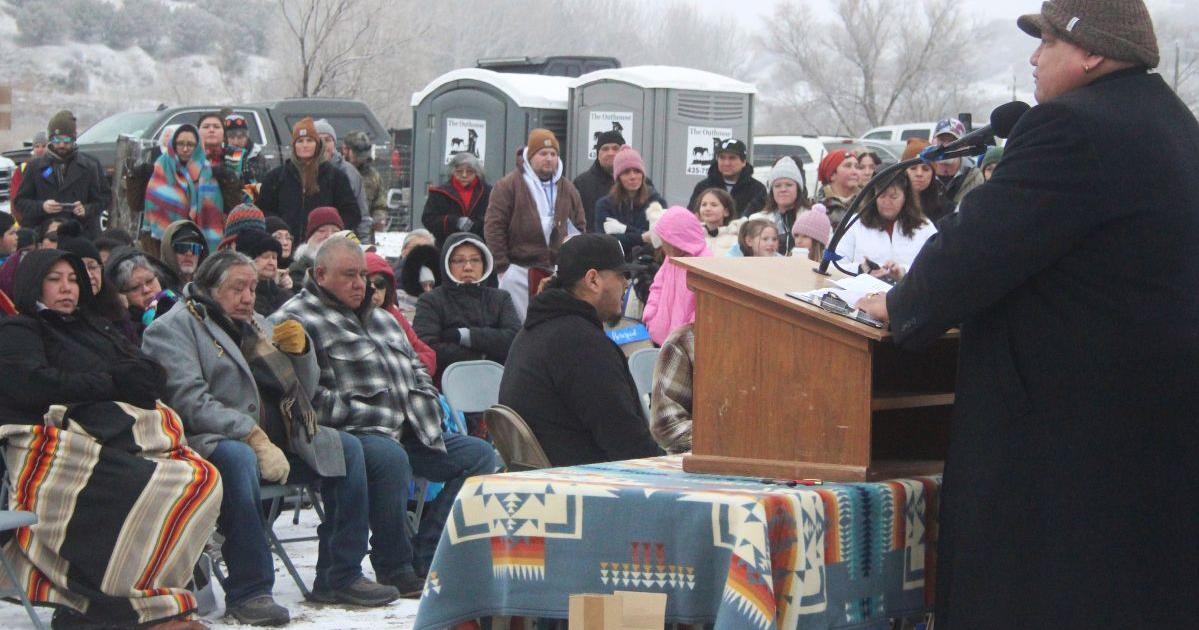
PRESTON – Jason S. Walker, Chairman of the Northwest Band of Shoshone Nation (NWBSN), welcomed some 500 people gathered in the Bear River bottoms north of Preston. They met for the 163rd anniversary of the Bear River Massacre on Thursday.
The memorial was held at the pullover on Highway 91 at the Daughters of the Utah Pioneers’ stone marker just north of the Bear River Bridge.
A drum group played and chanted an honor song while a Color Guard posted the American, Idaho and Utah state flags at the site.
The Color Guard were tribal veterans and active-duty soldiers.
Walker stood at the pulpit and welcomed everyone and thanked them for braving the cold weather to attend the ceremony. This is the second time Walker has served as the chairman of the NWBSN.
“In the year 1863 the nation was in the midst of great change and conflict,” he said. “Many Americans know that in 1863 was the year of the Emancipation Proclamation.”
Walker said students are taught in schools from textbooks about the Battle of Gettysburg in 1863. It was one of the bloodiest battles of the Civil War.
“But far too few people know that in January of 1863, here at Bear River, more than 400 men, women and children were killed in what is now recognized as the largest massacre of Native people in the United States history,” Walker said. “This was not a battle. It was an attack on a winter village, on families, elders and children, people who were trying to survive the cold like anyone else would.”
He said the story of the massacre has been ignored, minimized or erased from the national narrative. They were at the site on that day to honor the those who died, educate and protect the future for their children and grandchildren.
“We are not here to rewrite history,” the chairman said. “We are here to complete it.”
He told the Shoshone people in attendance their survival was a testament to their resilience.
“Despite everything that was taken from us,” Walker said, “we are still here. We still speak. We still remember.”
Names were shared to honor those who were killed and to acknowledge the ongoing work to remember them. Gracie Reyes, a student at Weber State University, and Lilly Martinez, a student at Utah State University, read the names.
The keynote speaker, Bradley Parry, vice chair of the NWBSN, recounted the events that brought the people there to remember the happenings years ago.
Despite the attempts of Col. Conner to annihilate the NWBSN they survived. They survived the events that took place on a bitter cold morning of January 29, 1863, when Col. Patrick Edward Conner and about 200 California volunteers attacked the winter camp of the Northwest Shoshone wintering near some hot springs along the Bear River.
The massacre records kept by the Shoshone people show when the general and his soldiers from Camp Douglas began shooting, raping, bludgeoning, and bayoneting between 270 and 400 Shoshone to death.
The Shoshone fought back with the limited weapons they had, although the band was nearly annihilated and entire families were lost. They lost most of their records and their very existence.
Some escaped and survived the bloodbath and were able to recount the story of what happened there that day long ago.
Long stretches of cars lined both sides of Highway 91 near the Daughters of Utah Pioneers Monument where the ceremony was held. The temperature was in the 20’s, warmer than the temperatures of the day when one of the largest massacres of Native American history took place.