
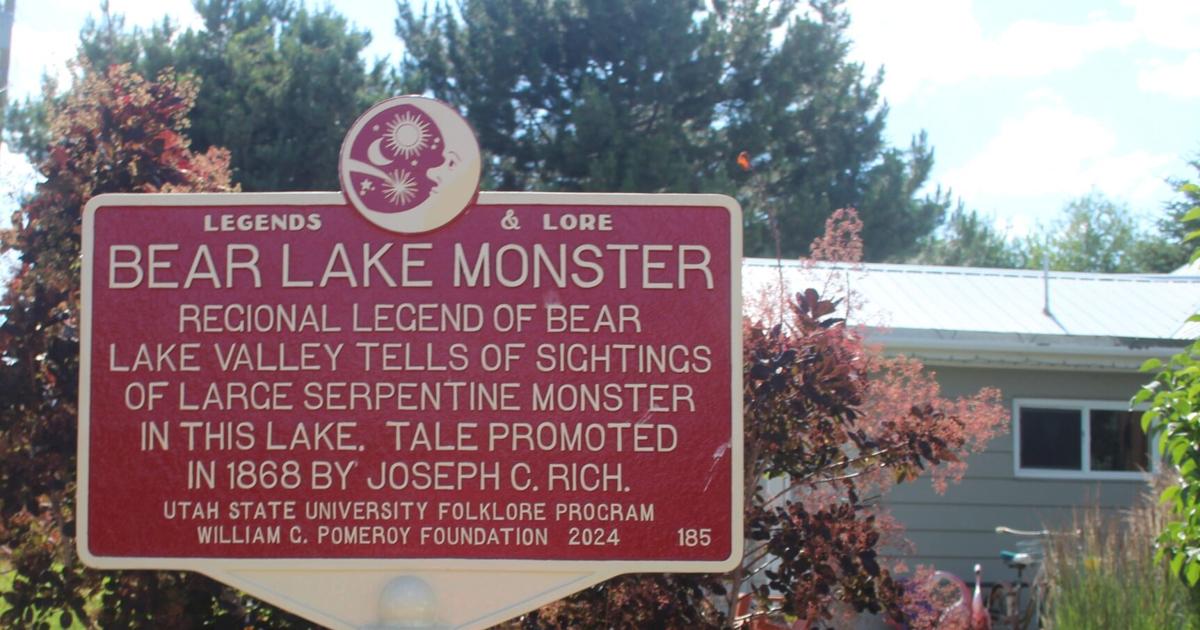
GARDEN CITY – A Utah State University student memorialized the urban legend of the Bear Lake Monster in April with a marker located at 1499 S. Bear Lake Blvd, Garden City. Melissa Anderson Asay, with help from English Professor Jeannie Thomas, wrote a grant to the William G. Pomeroy Foundation that was accepted and they funded the marker.
The Bear Lake Monster legend has fueled imaginations since the time it was first introduced to the world. It began with a letter written by Joseph C. Rich to the Deseret News in 1868. Rich tells the story through the eyes of other people who claimed to have seen the Monster.
“Mr. Davis don’t think he (Davis) saw any part of the body but is positive it must have been not less than 40 feet in length, judging by the wave it rolled up on both sides of it as it swam, and the wake it left in the rear,” Rich wrote. “It was going South, and all agreed that it swam with a speed almost incredible to their senses. Mr. Davis says he never saw a locomotive travel faster, and thinks it made a mile a minute easy.”
Today, the locals have embraced the legend prompting locals to make the Bear Lake Monster Fest a way to bring people together in the coldest part of January.
Asay, a USU Folklore master’s student, found the legend to be fascinating and started working on the project as part of some undergraduate research.
She asked Professor Thomas if she had any ideas on what she could research, and Thomas suggested the Bear Lake Monster.
Asay had to gather materials to show the significance of the Bear Lake Monster and write up an inscription and a longer passage for the website.
Obtaining the marker included writing a grant and gathering pertinent materials to show the Bear Lake Monster was real and significant. The red-colored marker is located on the west side of the road along the walking path.
“I also had to write up an inscription and a longer passage for the website. The most difficult part of the grant was finding a place to put it,” Asay said. “There were a lot of restrictions/things to consider, and the landowners needed to sign a permission slip. I am so grateful to Brad Davis and Jayne Hodges for letting me put up the marker in their yard.“
She plans to do more research on the Bear Lake Monster for her master’s program.
“What intrigues me the most about the Bear Lake Monster is that the lore is multifaceted. There are the Shoshone stories, the settler stories, and now the more contemporary ones,” Asay said. “The Bear Lake Monster played a part in the settling of this area, and it’s fascinating to see what role it plays in society today.
“I love that it shows that it doesn’t matter if a story is ‘true’ or not. The Bear Lake Monster proves that it’s more about how a story connects people, how it weaves itself into the cultural and economic fabric of a place, and how it shapes identity and shared memory.”
Asay’s marker will be added to some 2,533 historical markers the Historical Marker Data Base has on file in Utah.
“The project took about two years. It can be done a lot quicker than that, but because this is the first Legend and Lore marker in the state, it took some time to figure things out,” Asay said. “I am so grateful to Dr. Jeannie Thomas for navigating most of that for me. There is no cost since the William G. Pomeroy Foundation is grant-based.”
She said she was pleased with how it turned out and she has learned a lot from the project.
“This project taught me so much, and I love that there is something I can share with others,” Asay said. “I strongly believe in making folklore accessible to the public, and this is my first step in doing that.”