
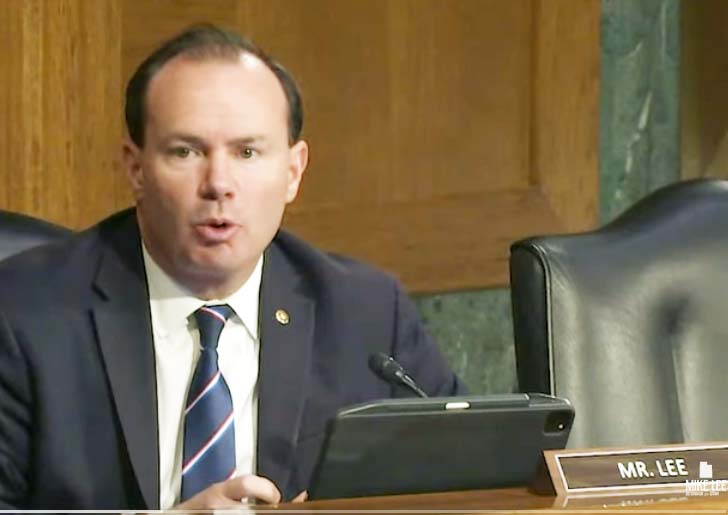
SE. Mike Lee (R-UT) sounds off during his first day as a new member of the Senate Finance Committee.
WASHINGTON, D.C. – Sen. Mike Lee (R-UT) made a splash in this first appearance as a new member of the Senate Budget Committee on Feb. 14.
True to form, Lee immediately crossed swords with committee chair Sen. Sheldon Whitehouse (D-RI).
The first meeting of the Senate budget panel in the 118th Congress had been called by Whitehouse to discuss climate related economic risks and their costs to the federal budget and global economy.
“Let’s not fool ourselves and the American public,” Lee countered in his opening remarks.
“Our ballooning deficits and debt have been driven by … runaway, profligate spending by the federal government, not by any of the effects of climate change.”
Lee cited the national debt – which has reached $31.38 trillion – and the fact that, for the first time since World War II, the federal public debt has reached 100 percent of America’s gross domestic product.
That means that the federal government will soon owe more in debt than it collects in yearly tax revenue, Lee said.
That number is projected to double by 2050, when our net interest will be the single largest item in the federal budget, exceeding the size of both Social Security and Medicare.
By comparison, in 2007, the size of the U.S. public debt was only 35 percent of tax revenues.
Lee’s remarks echoed those of Republicans in the House of Representatives, who this year will under White House pressure to raise the government’s debt ceiling. That decision would let the Biden administration continue business as usual by using deficit spending pay its bills.
Faced with a similar looming financial crisis in 2011, Republicans got the Obama White House to agree to a “cut, cap and balance” proposal that trimmed federal spending.
The GOP went along with debt ceiling increases in October 2013, February 2014 and November 2015 without threatening to force the government to default on its debts payments.
This year is different, however. Following President Joe Biden’s insistence that he will not negotiate spending cuts in exchange for a debt ceiling increase, House Republicans are threatening to tie a vote on that issue to a balanced budget amendment.
Lee and Sen. Chuck Grassley (R-IA) have already introduced a constitutional amendment in the Senate that would require the federal government to balance its budget each year.
In addition to forcing Congress to balance its budget, that amendment would limit federal spending to no more than 18 percent of gross domestic product and require a supermajority vote in both the House and Senate before raising taxes or increasing the federal debt ceiling.
“We cannot rely on self-imposed, statutory spending limits that Congress can waive with a simple majority,” Lee insists.
“To restore fiscal responsibility,” he adds, “we must enact a permanent, structural spending restraint.”
That idea doesn’t sit well with the Center for Budget and Policy Priorities, a progressive think tank in Washington, D.C.
In a recent analysis, they called a balance budget amendment “… an unusual and economically dangerous way to address the nation’s long-term fiscal problems.”
Such an amendment would raise a whole host of problems for the operation of federal “sacred cows,” include entitlement programs like Social Security and Medicare.
Remarkably, however, the Congressional Budget Office (CBO) tends to agree with Lee.
“The high and rising federal debt that CBO projects over the next three decades would have serious consequences for the economy and federal budget,” according to a recent CBO report. “Those include crowding out private investment, high interest costs and the increased risk of a financial crisis.”
But Lee says that the financial crisis is already here and it has nothing to do with climate change.
“Fear has become an all-too prevalent quality in America’s political discourse,” he says.
“That’s especially true among those on the left who seek to use climate alarmism to justify a government take-over of our economy and a radical, unrealistic and damaging transition of our energy sector.”