
Senate Republicans are sounding the alarm on data centers — and warning that backlash to the divisive topic could hurt GOP chances of defending Sen. John Husted’s seat in November.
In a new memo to artificial intelligence companies operating in the state obtained by ABC News, the National Republican Senatorial Committee, the Senate GOP’s campaign committee, wrote that Husted and his Democratic opponent, former Sen. Sherrod Brown, are in a “dead heat,” according to their private polling. Controversial data centers play a role in that race, according to the memo.

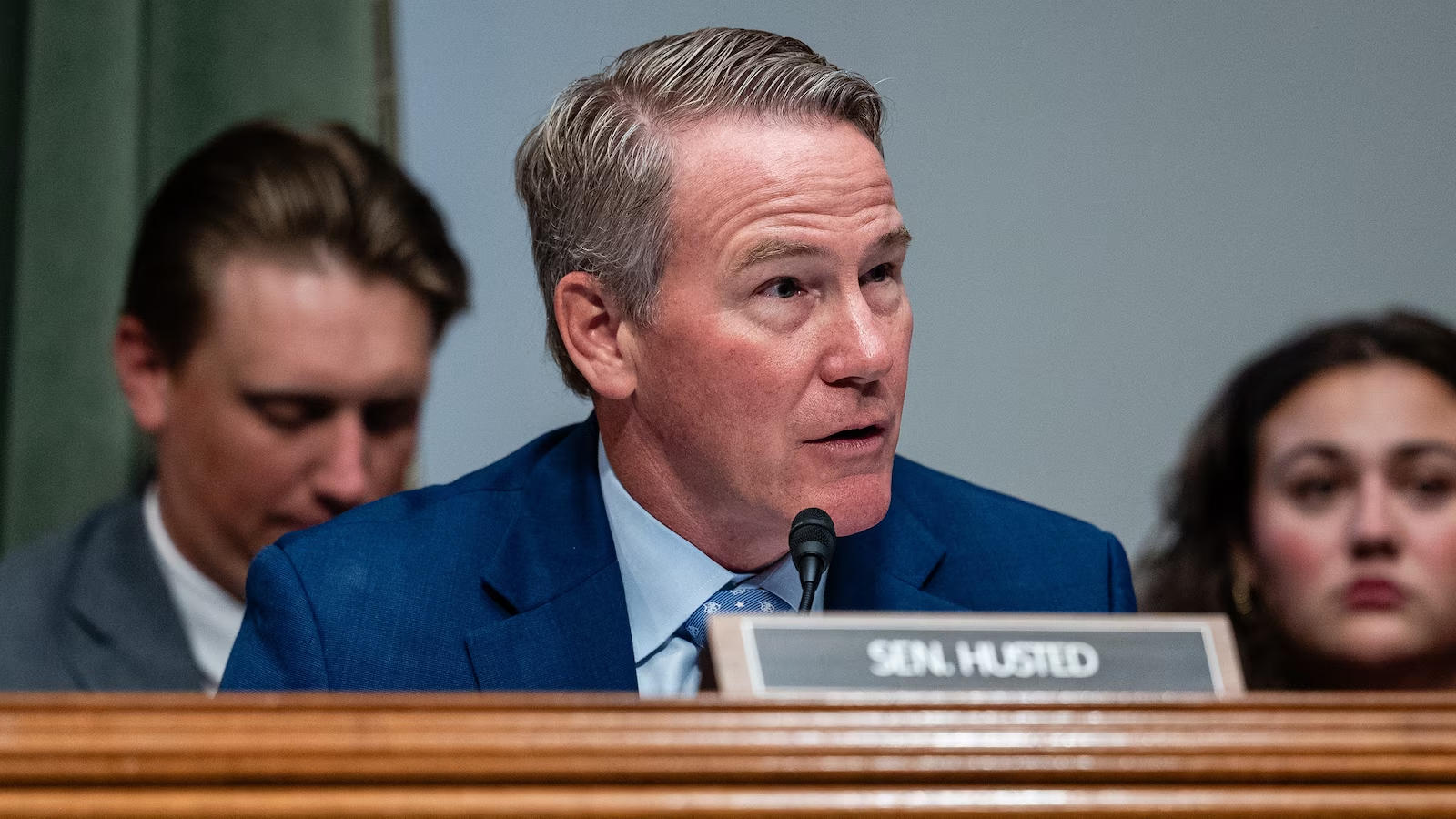
Sen. Jon Husted speaks during a Senate Health, Education, Labor and Pensions Committee confirmation hearing for Keith Sonderling, acting U.S. Secretary of Labor, on Capitol Hill, July 16, 2026.
Eric Lee/Getty Images
“Ohio is one of the leaders in building these AI factories. Brown has made his opposition to them the centerpiece of his campaign against Husted. Brown is using it because it works. More than any other thing in this race, data centers are the anchor hanging around Husted’s neck. If he loses and data centers get the blame, politicians across the country will take notice — and they will not go near the next one,” the memo reads.
In response to the memo, Ohio Democratic Party spokesman Tony Wen said Ohioans “will hold [Husted] accountable” for increased utility bills.
Brown has claimed Husted, who previously served as Ohio’s lieutenant governor before his appointment to the Senate, was responsible for bringing data centers to Ohio and has sought to tie him to the tax breaks from Republican Gov. Mike DeWine’s administration.

Former Senator Sherrod Brown, a Democrat from Ohio, at an election night event during a primary election in Cleveland, Ohio, May 5, 2026.
Daniel Lozada/Bloomberg via Getty Images
In May, DeWine paused new tax exemptions for data centers. Husted also introduced in the Senate a new proposal that would require states to set up new standards for states to make sure data centers pay for their own power generation and that the cost of new transmission or infrastructure is not passed down to consumers.
To this point, AI companies have spent millions on congressional races and primaries for and against candidates on the issue of artificial intelligence regulation.
Data centers, like the ones in Ohio, provide the computing power necessary to process large amounts of data, such as the kind needed to run AI systems. They typically house thousands of computer servers and require tremendous amounts of land, water for cooling, and energy, potentially straining local power grids, while employing few workers long-term, relative to their size.
The state has more than 200 data centers, the fifth most in the country, according to the Ohio Consumers’ Counsel.
At a cryptocurrency event at the White House on Wednesday, President Donald Trump said local leaders should embrace data centers, although he admitted they could use “a little public relations help.”

A building sustained fire damage, left, in November at the Bitdeer Technologies Group cryptocurrency mining data center while under construction in Massillon, Ohio, Dec. 18, 2025.
Justin Merriman/Bloomberg via Getty Images
“And I can say, if I were the mayor of a town or the governor of a state, and I had a chance to get a big plant in an AI plant or a data center, I would absolutely want it because the jobs are enormous and the money paid, the taxes paid are just enormous,” Trump said. “And if you don’t take it, you’re going to be left behind because there are plenty of places that want it.”
A recent poll shows that the public remains skeptical about AI data centers. A Gallup poll conducted this spring found that 71% of Americans oppose the construction of AI data centers in their area, citing concerns about quality of life, the economy, local resources, pollution, water usage, electricity bills and AI in general.
The new GOP memo focuses more on construction, and points to the Trump administration’s recent policies that encourage developers to pledge to create their own power and prevent spiking utility costs for consumers.
Political groups and campaign committees will often write “memos” to signal positions and communicate indirectly with specific campaigns and interest groups on strategy and messaging. The memo was first reported by Axios.
Candidates and election officials across the country are leaning in to Americans’ concerns about the proliferation of data centers and their impacts on communities in this election cycle.
Democratic governors on the ballot, including Govs. Kathy Hochul of New York and Josh Shapiro of Pennsylvania, have recently signed new orders limiting or pausing the developing of some types of data centers. Hochul, for her part, had previously signaled support for AI infrastructure in her state, but faced pressure from progressives to approve new legislation to regulate them.
In Wisconsin, Republican Rep. Tom Tiffany, who is running for governor, has attacked Democratic candidate David Crowley over his past comments on data center development in Milwaukee County.
Texas state Rep. Gina Hinojosa has seized on the issue in her campaign to deny Republican Gov. Greg Abbott a fourth term. Abbott recently ordered an audit of data centers and their impact on utility prices, and paused new grid approvals for projects.